
EDA in Focus
Nobody’s business but my own – BUT is that how EDA’s do business?

There are more questions than answers in the EDA’s May 19, 383-page explanation of its workforce housing project. Photos/Roger Bianchini
On June 2, 2017, Royal Examiner e-mailed questions to the Front Royal-Warren County Economic Development Authority Board of Directors regarding its workforce housing project. Three of the four questions originally submitted to the EDA Board members on May 12, were resubmitted, with some additional clarification requested, as they were not addressed in the 383-page information packet the EDA released on May 19.
Additional questions were added, since as we pointed out in our initial “First impressions of EDA reply…” story, we believe more questions were raised than answered in those 383 pages of documentation.
The revelation that the EDA was not a signing party to the “confidential agreement” that killed the “gift” of the workforce housing property is dealt with in a related story.
Here we explore other issues raised by the EDA’s response to Councilwoman Bébhinn Egger’s request for additional information related to that agreement and conditions now said to require a purchase of the property at a price of $445,000. It is a price Egger noted on November 14, 2016 is $140,000 above the assessed value of the property. The owners of the parcel, gifted then un-gifted to the EDA, are Mr. and Mrs. Walter L. Campbell.
As has been disclosed at various points in the process, the Campbells are relatives of both McDonald and Front Royal Mayor Hollis Tharpe, neither of whom have a financial interest in the property. As previously reported, county and EDA attorney Dan Whitten believes the confidential agreement related to a tax credit the Campbells were to receive in exchange for the gift.
Egger’s November exchange with EDA Executive Director Jennifer McDonald over the price attached to the property came prior to the final vote approving special zoning permit exceptions to enable the project. The Town Council approved those exceptions by a 5-1 vote, with Egger dissenting.
The common thread between our two June 5 workforce housing stories is EDA Board Chair Patricia Wines’ quote in the press release attached to the May 19 informational packet:

EDA Chair Patricia Wines, right, stated that the EDA had no responsibility to inform the Town of Front Royal about crucial information contained in confidential side-agreements related to cost and the financial ability of the EDA to follow through on what it proposed in seeking municipal permitting.
“In response to concern from certain Town officials that we did not disclose the March 1st construction start deadline, the EDA was witness to a confidential real estate transaction and no monies from the Town were involved in the transaction, therefore, the EDA upheld its responsibility to confidentiality and was under no obligation to inform Council.”
Our linked story addresses questions, not about the content of the confidential agreement, but rather about the EDA board’s knowledge of it. Other questions we sought answers to are:
- Who is the EDA’s primary legal and economic responsibility to – the municipalities that create them to conduct business related to economic development, or the individual clients that business is conducted with?
- Does the EDA have legal authority to withhold pertinent information impacting cost and project viability from the municipalities it works on behalf of?

Six of seven EDA board members listen to the county administrator’s report of April 28; from left, Ron Llewellyn, Vice-Chair Greg Drescher, (Executive Director Jennifer McDonald), Chair Patricia Wines, William Biggs, Bruce Drummond and Brendan Arbuckle; Jim Eastham was absent.
Actual expenditures
Other questions revolved around exactly how much the EDA has actually spent on work that has been done versus money earmarked for the project for work that has NOT yet been done, and is recoverable. A primary rationale put forward by Board Chair Wines and Executive Director McDonald on April 28 for proceeding with a $445,000 purchase, was that the EDA had already spent an estimated $500,000 in design and site preparation work.
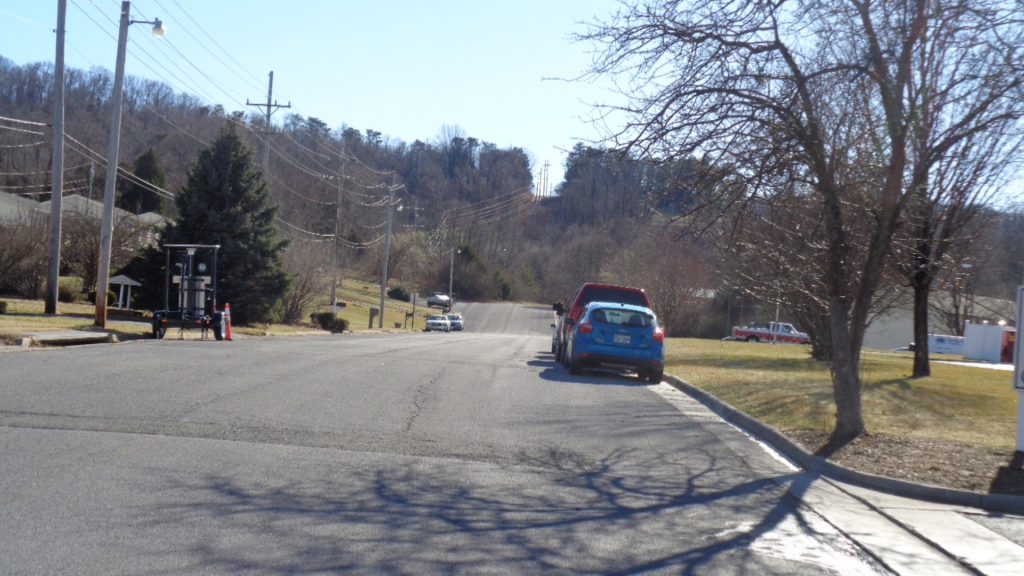
From all angles it appears no site work has yet been done on the workforce housing parcel
In the May 19 information packet, a “Project Invoices & Contracts” section lists a total of $420,765. However, it is NOT clear exactly how much money has actually been spent on development of the Campbell parcel versus how much has simply been proposed for commitment to the project. That is because while some of the included documents were invoices, others were proposals; or related to the establishment of escrow accounts and contingency funds, the latter two alone totaling $207,380 of the $420,765 “expenditure” total listed in the document. So, we asked:
- Could the board verify how much money has actually BEEN SPENT on work that HAS BEEN DONE that is NOT recoverable versus how much money is simply proposed or contracted for work not yet done?
The bottom line is how much of the listed $420,765 cost of site development is recoverable at this point in time? As we have reported, no dirt appears to have yet been turned on the property.

What’s a half million, give or take? As his executive director watches, EDA Board Vice-Chair Greg Drescher reads April 28 motion to proceed with a $445,000 purchase of the formerly ‘gifted’ (with conditions) 3-1/2 acre workforce housing parcel. Motion passed 6-0, Eastham absent.
Lag time
Our final questions related to the fact that the town council was told prior to its November final vote of approval on permitting exceptions for the project, that the $445,000 value placed on the “gifted” deed of transfer was based on an appraisal.
According to the EDA press release attached to the May 19 informational packet, the executive director misspoke as she was attempting to “clarify the difference between ‘assessed’ value … versus ‘appraised’ value” and the fact that appraised values are “usually higher”.
So, we asked when the EDA board members became aware their executive director had left the Town Council, media and public with the impression an appraisal had been done to establish that value? – “That was the appraisal price,” McDonald told Councilwoman Egger on November 14 of the $445,000 value on the deed.

Where the questions began – Nov. 14, 2016, Councilwoman Egger questions EDA Executive Director McDonald on the $445,000 pricing attached to the ‘gifted’ deed of transfer.
A final question was why there was no effort by the EDA board or staff over five to six months, from November 14, 2016 to late April or May 2017, to correct that mistaken impression?
Some EDA officials are scheduled to attend a work session with the Warren County Board of Supervisors after the supervisor’s 9 a.m. meeting of Tuesday, June 6. Perhaps some of these questions will be raised publicly by board members then. Ironically, June 6 marks the one-year anniversary of execution of the deed of transfer “gifting” the property from the Campbells to the EDA.

Courtesy Photo/Malcolm Barr Sr., AP retirees newsletter

Electric Vehicle Market Adjusts as Industry Rethinks the Road Ahead

Cultures Around the World Mark the Spring Equinox With Unique Traditions

Laurel Ridge to Host 46th Annual Spring Follies: “Back to the ’90s”

Love Revival to Host Free Community Easter Celebration in Front Royal

Salvation Army of Front Royal Plans Annual Dinner and Raffle Fundraiser

Stephen Paul Sill (1955 – 2026)

Virginia Seeks Public Input for 2026 Statewide Rail Plan

Front Royal Craftsmen Revive Centuries-Old Timber Framing Tradition

VDOT: Warren County Traffic Alert for March 16 – 20, 2026

Virginia Lawmakers End Session Without Final Budget

Your Personal Mission Statement: A Guide to Getting What You Want Out of Life

Disappointed In Our Olympic Spirit

How St. Patrick’s Day Became America’s Biggest Irish Party

Virginia State Police Urge Sober Plans for Saint Patrick’s Day Celebrations

In a One-Party County, Internal Party Decisions Affect Us All

Virginia State Police Seize Nearly 100 Pounds of Narcotics, Recover Firearms in Weekly Crime Suppression Effort

Barton Charles “Bart” Haller (1940 – 2026)

Dawn Lee Dodson (1970 – 2026)

Mary Helen “Nanny” Spires Johnt (1954 – 2026)

Another Round of ‘Momnibus’ Bills Are Headed Towards the Governor This Year

Virginia Joins States Challenging Trump Admin Regulations That Limit Free Birth Control Access

Update: Charlotte Swanson Smith (1951 – 2025)
Why We are Challenging the Republican Mass Meeting

Bruce Norman Showman (1954 – 2026)
