
Local Government
Paid Time Off and Other Concerns at Town Council Work Session
At their work session on Monday, August 4, the Town Council reviewed potential acquisitions and evaluated possible changes in the employee handbook to the policy on paid time off and other absences. They went on to discuss the pros and cons of a proposed text amendment that would restrict development and conversions in the residential section of the Historic District, and then affirmed the consensus on revising the charter to allow the town manager to reside within Warren County but outside Town limits. Their final objective before going into a closed meeting was to take action that directed a proposed text amendment pertaining to special circumstance housing back to the Planning Commission for further consideration and review.

The Town Council convenes a work session on the evening of Monday, August 4. Royal Examiner Photo Credits: Brenden McHugh.
“It rewards longevity,” Councilman Glenn Wood said at the end of the council’s interaction with Director of Human Resources Laura McIntosh about proposed innovations to the policy, articulated in the Front Royal Employee Handbook, on paid leave and other absences. The new policy would combine the yearly allotments of paid time taken for sick leave or vacation, allowing employees to conserve and use the total as they wish, whether for sick leave, vacation, or personal commitments. To Wood’s point, employees with greater tenure would be allotted more hours, thus creating an environment that is competitive with other localities and hopefully establishing a greater degree of retention. Also, between Wood and Councilman Wayne Sealock, a point was made about the inadequacy of the current twenty-four hours allotted for an absence due to a funeral, whereupon McIntosh confirmed that she would make the necessary adjustment to allow for a leave of three days in such a case as she prepares the new policy for a vote at the council’s regular meeting later in August.

Purchasing Manager Michelle Campbell presents for the council’s approval the purchase of a tilt trailer and a dump trailer, respectively.
A text amendment that would restrict new developments in the residential section of the Historic District to single-family homes and prevent the conversion of existing single-family homes in that section to any other use generated an animated discussion. “This sounds great in theory,” Vice Mayor Amber Veitenthal said, “but there are so many facets.” If, God forbid, another house burned down in that area, this amendment would seriously constrain redevelopment at that point. If, at the onset of old age and with all the limitations that entails, someone wanted to rent out a room on their second floor, this amendment would prevent him or her from doing so. This potential restriction may be based on a desire to maintain a certain Victorian appearance. “When yesteryear is gone,” Councilman Bruce Rappaport said, “it’s gone forever.” While it is possible to achieve a rough approximation, in his mind, perfect retention of that look and feel is not.
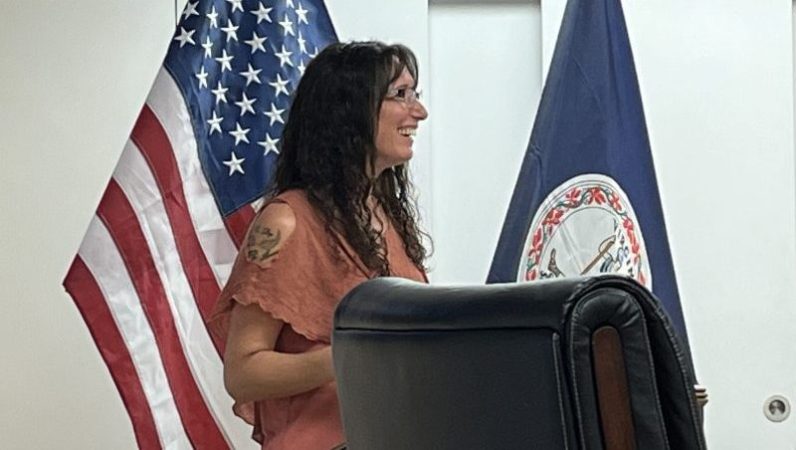
Director of Human Resources Laura McIntosh presents to the council proposed updates to the employee handbook.
Overall, the discussion weighed the values of utility against aesthetics. What may be good for a romantic commitment to the past may not be good for tourism and the investment of citizens in their homes, with all the demands that the modern age and the current market entail. If the guidelines of the Historic District are honored, who on the council can tell the citizens what to do with their homes and how to do it? As these thoughts reached a critical point of distillation, Mayor Lori Cockrell affirmed the wisdom of allowing time for reflection, and since two council members were absent, delaying the further discussion of the item until at least September.

Planning Director Lauren Kopishke presents to the council proposed restrictions for the Historic District as well as the status of a proposed text amendment pertaining to special circumstance housing.
Next, the council affirmed the consensus for modifying the charter and subsequently the Town code to give the town manager flexibility in his residency, possibly living within Warren County but outside town limits. As Cockrell expressed, the requirement that the town manager reside within the town was likely designed for a time, say, 1937, when transportation was not what it is today. To change the charter, the Town will have to appeal to the General Assembly, which, with the constraints of legislative deadlines, needs to happen sooner rather than later. The council then acted on a proposed text amendment pertaining to special circumstance housing, directing it back to the Planning Commission.
With no further business to transact in the open meeting, the council proceeded into a closed meeting to address personnel matters, specifically the Clerk of Council.
Click here to watch the Front Royal Town Council Work Session of August 4, 2025.

‘The Revenant: A Novel of Revenge’

Virginia Lawmakers Close 2026 Session With Focus on Lowering Costs

The 10 Most Important Things That Happened in Virginia’s 2026 Legislative Session

Electric Vehicle Market Adjusts as Industry Rethinks the Road Ahead

Cultures Around the World Mark the Spring Equinox With Unique Traditions

Laurel Ridge to Host 46th Annual Spring Follies: “Back to the ’90s”

Love Revival to Host Free Community Easter Celebration in Front Royal

Salvation Army of Front Royal Plans Annual Dinner and Raffle Fundraiser

Stephen Paul Sill (1955 – 2026)

Virginia Seeks Public Input for 2026 Statewide Rail Plan

Front Royal Craftsmen Revive Centuries-Old Timber Framing Tradition

VDOT: Warren County Traffic Alert for March 16 – 20, 2026

Virginia Lawmakers End Session Without Final Budget

Your Personal Mission Statement: A Guide to Getting What You Want Out of Life
Disappointed In Our Olympic Spirit

How St. Patrick’s Day Became America’s Biggest Irish Party

Virginia State Police Urge Sober Plans for Saint Patrick’s Day Celebrations

In a One-Party County, Internal Party Decisions Affect Us All

Virginia State Police Seize Nearly 100 Pounds of Narcotics, Recover Firearms in Weekly Crime Suppression Effort

Barton Charles “Bart” Haller (1940 – 2026)

Dawn Lee Dodson (1970 – 2026)

Mary Helen “Nanny” Spires Johnt (1954 – 2026)

Another Round of ‘Momnibus’ Bills Are Headed Towards the Governor This Year

Virginia Joins States Challenging Trump Admin Regulations That Limit Free Birth Control Access
