
Local News
A path forward to fix Chesapeake Bay watershed pollution issues

Environmental Integrity Project Executive Director Eric Schaeffer, a former Director of Civil Enforcement at the Environmental Protection Agency – Photo/EIP
Environmental Integrity Project Executive Director Eric Schaeffer, a former Director of Civil Enforcement at the Environmental Protection Agency – Photo/EIPThe authors of a detailed report on wastewater pollution issues in states whose waterways are part of the Chesapeake Bay watershed made suggestions on paths forward in dealing with those issues.
The report “Sewage and Wastewater Pollution in the Chesapeake Bay Watershed” released at 12:01 a.m. Wednesday morning, November 29, by the Environmental Integrity Project (EIP) summarized issues ranging from
- outright permit dumping violations made with minimal consequence;
- a pollution credit trading system available in some states, including Virginia, it says has been carelessly overseen and often abused;
- too slow progress on mandated upgrades to wastewater treatment plants in the bay watershed.
The EIP recommendations on how the bay states could better manage this wastewater pollution include:
- Pollution trading systems, like those of Virginia and Pennsylvania, should be avoided in Maryland and other states not already employing them because they can lead to reduced accountability and increased local pollution “hot spots.” (as EIP reported, Maryland Governor Larry Hogan’s administration is expected to release new draft regulations to allow pollution trading on December 8.)
- The bay region states should more consistently fine wastewater treatment plants and other polluters that violate their permit limits.
- States that do allow facilities to engage in pollution trading should require the plants to accurately and promptly report to public databases their credits purchases and their impact on various rivers and streams.
- EPA should press bay region states, especially Pennsylvania, New York and Delaware, to upgrade more of their large municipal wastewater treatment plants with state-of-the art technology, following the lead of Maryland, the District of Columbia and Virginia.
The EIP report observes that bay region states have not invested equally in modernizing their municipal sewage plants.

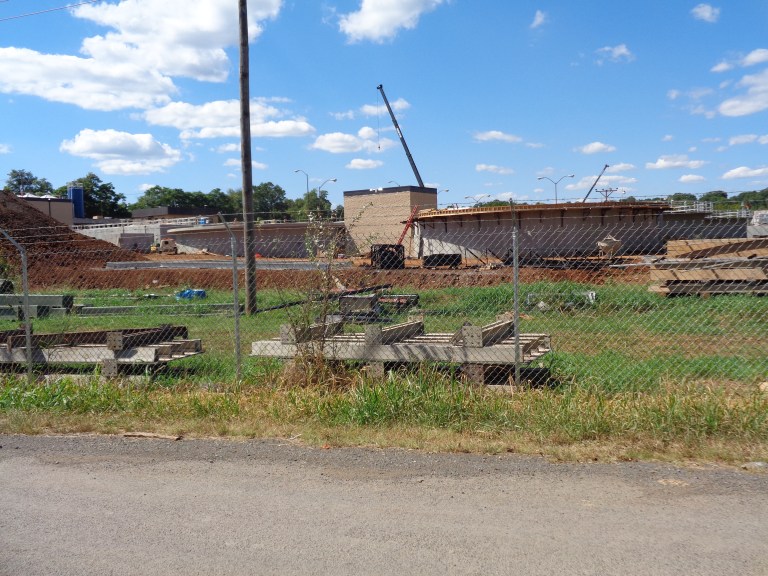
Above, at top center from the air in April; below, from the ground in September – mandated upgrades underway at Front Royal’s Wastewater Treatment Plant (also visible in upper right of aerial is FR’s solar power field) – Aerial Photo/Courtesy Town of FR
Photo/Roger Bianchini
The report states that Maryland has paid about $1.25 billion to upgrade 79 percent of its large municipal sewage plants to enhanced levels since lawmakers passed a “flush tax” law in 2004. Virginia has invested about $800 million to improve 44 percent (40 of 90) of its large municipal sewage plants to similar standards. An estimated $40-million in federal and state-mandated upgrades to the Front Royal Treatment Plant are approaching completion within the coming year.
The District of Columbia region’s one sewage plant – Blue Plains, the bay’s largest – has been upgraded to an enhanced level. In West Virginia about half (6 out of 13) of the wastewater plants have been modernized to this standard.
Other states are lagging further behind.
In Pennsylvania the report notes that “most plants have been upgraded to a lower level, with only 4 percent (7 of 189) of the large-to medium-sized municipal sewage treatment plants in the bay watershed of Pennsylvania having enhanced pollution control systems.”
New York and Delaware are pitching “O-fers” according to EIP – none of New York’s 26 plants have been upgraded and in Delaware it is zero of three.
As stated in our initial November 29 story on the EIP report, see related story through use of the pollution credit trading system the Front Royal WWTP was allowed to dump over twice its permitted amount of phosphorous (9,146 pounds) into the Shenandoah River in 2016. Strasburg’s WWTP was also noted as utilizing the system to dump over three times its permitted level of phosphorous (2,942 pounds) into the North Fork of the Shenandoah last year. The report observes that the North Fork of the Shenandoah already was dealing with what were described as “excessive levels of phosphorous” – a symptom of the trading system’s failures, according to EIP.
Information on the status and impact of upgrades underway at Front Royal’s WWTP on the Town’s past and future use of the pollution credit trading system will be added in an upcoming story.
The Environmental Integrity Project is a 15-year-old nonprofit, nonpartisan organization, based in Washington D.C. It is dedicated to enforcing environmental laws and holding polluters and governments accountable to protect public health.

Registrar Urges Residents to Stay Informed and Participate in Upcoming Elections

South River Forum Brings Residents and Leaders Together at Skyline

CHEO Garden Expands Mission of Food, Learning and Community

Sharing a Room: How to Avoid Sibling Conflicts

Laurel Ridge to Host Week of the Young Child Art Exhibit

Free $1,000 ‘Trump Accounts’ Draw 1 Million Families

‘The Revenant: A Novel of Revenge’

Virginia Lawmakers Close 2026 Session With Focus on Lowering Costs

The 10 Most Important Things That Happened in Virginia’s 2026 Legislative Session

Electric Vehicle Market Adjusts as Industry Rethinks the Road Ahead

Cultures Around the World Mark the Spring Equinox With Unique Traditions

Laurel Ridge to Host 46th Annual Spring Follies: “Back to the ’90s”

Love Revival to Host Free Community Easter Celebration in Front Royal

Salvation Army of Front Royal Plans Annual Dinner and Raffle Fundraiser

Stephen Paul Sill (1955 – 2026)

Virginia Seeks Public Input for 2026 Statewide Rail Plan

Front Royal Craftsmen Revive Centuries-Old Timber Framing Tradition

VDOT: Warren County Traffic Alert for March 16 – 20, 2026

Virginia Lawmakers End Session Without Final Budget

Your Personal Mission Statement: A Guide to Getting What You Want Out of Life
Disappointed In Our Olympic Spirit

How St. Patrick’s Day Became America’s Biggest Irish Party

Virginia State Police Urge Sober Plans for Saint Patrick’s Day Celebrations

In a One-Party County, Internal Party Decisions Affect Us All
