
EDA in Focus
Preservation group adds Afton Inn to endangered historical structure list
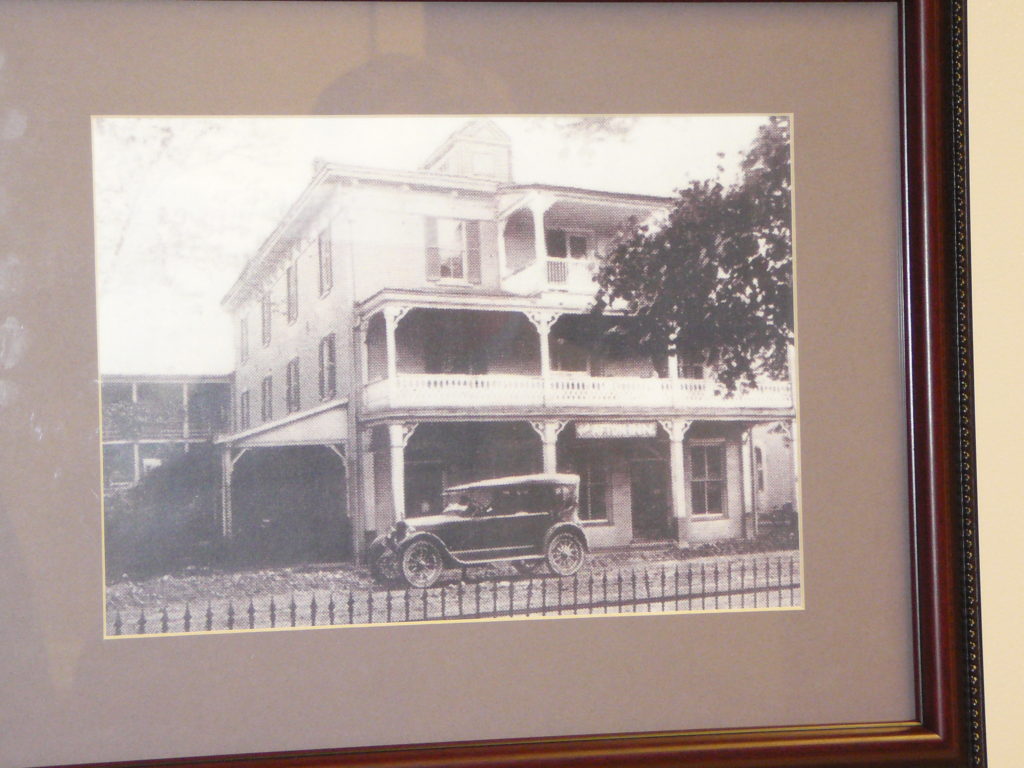
The Afton Inn during its heyday prior to having its porch structure torn down by a local minister driving one of those new-fangled “horseless carriages” (source: local historian & Board of Architectural Review member Duane Vaughan). Photo/Warren Heritage Society
On Tuesday, May 8, a Richmond-based group “Preservation Virginia” released its annual list of “Virginia’s Most Endangered Historic Places”. And this year’s list includes Front Royal’s long-deteriorating Afton Inn, circa 1868.
Contacted about the addition, “Preservation Virginia” Public Relations and Marketing Manager Brittney Jubert said the group was aware of the April 27 announcement at the monthly meeting of the Front Royal-Warren County Economic Development Authority of changes to the redevelopment plan for the Afton Inn, and that those changes were acknowledged in the new listing. Of the Afton Inn, “Preservation Virginia” states:
“At the time that the Afton Inn was nominated to the 2018 Most Endangered list, it was facing demolition despite strong support to save the structure from local citizens and Front Royal’s Board of Architectural Review. On April 27, 2018, the Front Royal-Warren County Economic Development Authority (EDA) Board of Directors approved a plan that will preserve the historic building.”
As Royal Examiner first reported on April 27, Afton Inn redevelopment group “2 East Main Street LLC” (from the Afton Inn street address), formerly known as MODE LLC, announced that after several months of exploration of restoration options and costs it would alter its original and town council-approved demolition-rebuild plan to restore and rebuild. See story here.
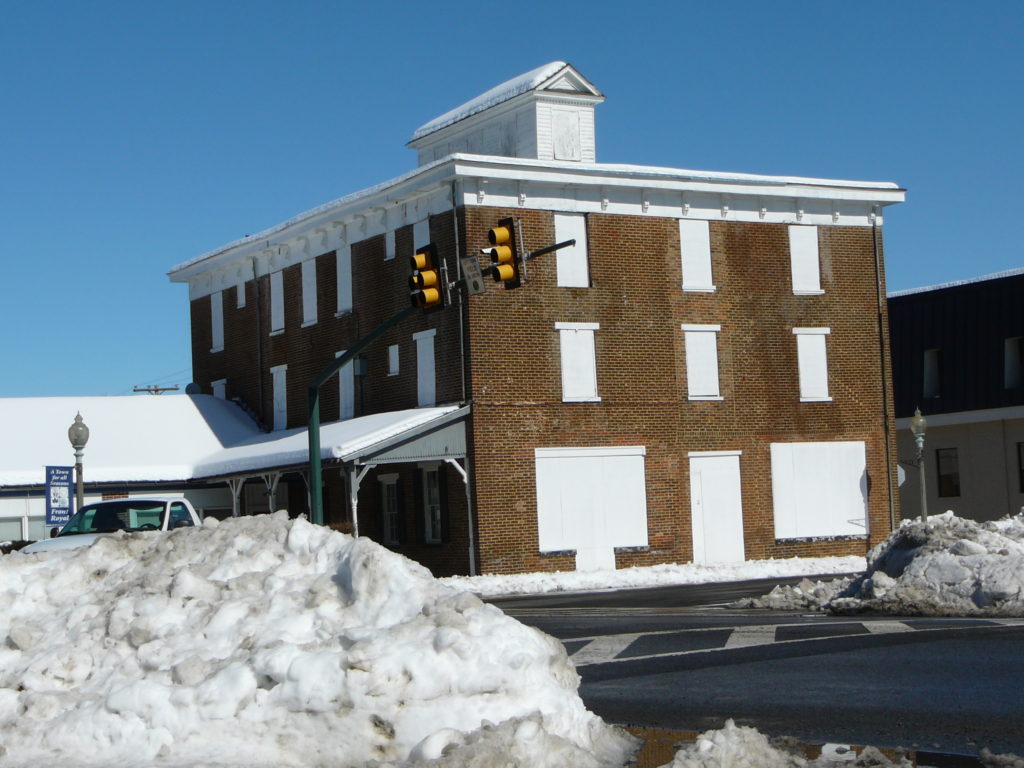
The Afton Inn’s winter of discontent – encompassing most of this century – Photos/Roger Bianchini
The EDA and the LLC formerly known as MODE have been working on a redevelopment plan for the Afton Inn since January 2017. The EDA began marketing the property at the head of the town’s Historic Downtown Business District after the Front Royal Town Council agreed to a then controversial property swap with Afton Inn owner, Northern Virginia developer Frank Barros, in 2014. That swap was for the old Town Hall, circa 1930’s, after the town government outgrew it and moved into its current East Main Street location adjacent to the Afton Inn.s
Initial information from the EDA is that no historical renovation grants were located during 2 East Main LLC’s exploration of restoration-rebuild options; but that the company decided to absorb an estimated $400,000 in renovation costs, raising the total project cost from $2.1 million to $2.5 million.
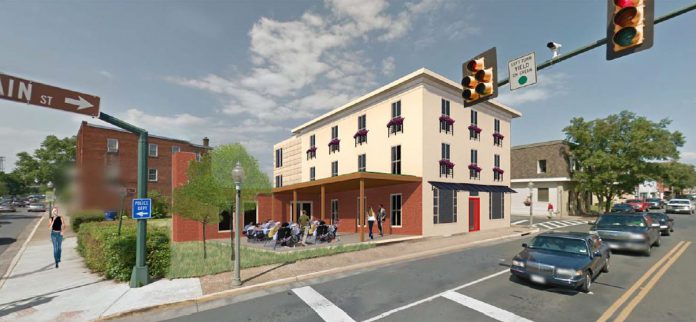
An earlier MODE development group artist’s rendering of a rebuilt Afton Inn – Courtesy Graphic/EDA
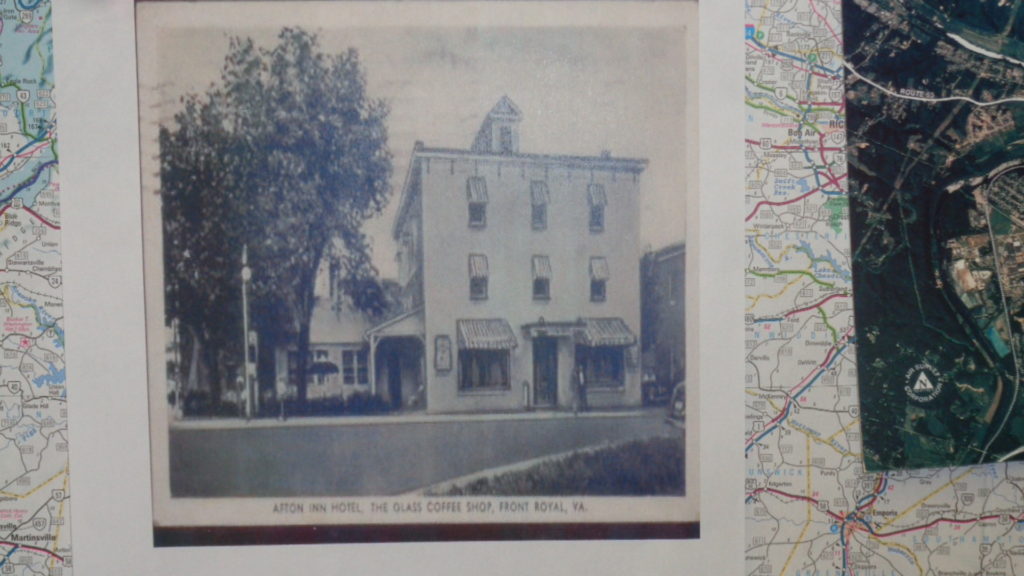
The Afton Inn, circa 1940’s – Photo/Warren Heritage Society
We asked “Preservation Virginia’s” press contact Jubert if the group’s addition of the Afton Inn to its endangered historical structure list might open up some potential state historical preservation funding for the project. She referenced us to “Preservation Virginia” Director of Preservation, Initiative and Engagement Justin Sarafin.
Contacted, Sarafin indicated that while guaranteeing nothing, the “Preservation Virginia” listing does accentuate the structure’s eligibility for the Virginia Rehabilitation Tax Credit Program administered through the State’s Department of Historic Resources (DHR).
“One reason for the listing is to spur such questions,” Sarafin told this reporter. If the Afton Inn was added to the tax credit recipient list, our understanding is that the developer would be eligible for a tax credit equal to 40% of the restoration cost – or $160,000 if that credit is based on the now estimated additional $400,000 to preserve the outer shell of the 150-year-old building.
“Preservation Virginia” is a statewide non-profit. Of its decade-plus annual listing of Virginia’s Most Endangered Historic Places, a preface to this year’s release states, “This list raises awareness of Virginia’s historic sites at risk from neglect, deterioration, insufficient funds, inappropriate development and/or insensitive public policy.
“The list also encourages citizens, localities and organizations to continue to advocate for the protection and preservation of these places.
“The list often includes buildings, archaeological sites and cultural landscapes across the state that face imminent or sustained threats to their integrity or survival.”
State tax credits or not, 2 East Main’s evolving plan is to restore the Afton Inn to a mixed commercial-residential use. Plans unveiled so far indicate upscale studio-style apartments on the two upper floors; commercial and office space on the first floor of the existing building footprint; and loft apartment or other as yet to be determined uses in an extended, new multi-floor rear section.
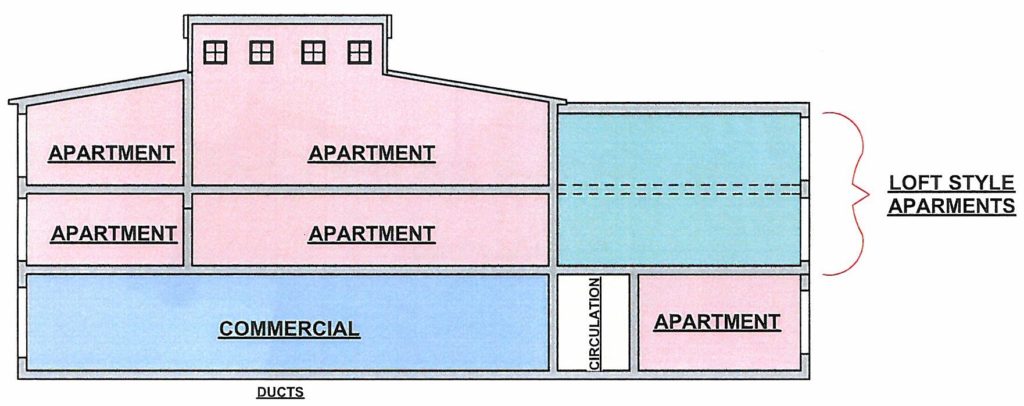
A cross section of the planned use of the now-to-be partially restored Afton Inn – Courtesy Graphic/EDA
What was …
The 150-year-old Afton Inn first opened its doors for business as the Montview Hotel in 1868 during the post-Civil War “reconstruction” era. At various periods in both the late 1800’s and first half of the 20th century lying as it did within walking distance of Front Royal’s downtown train station – now the Front Royal Visitor’s Center – it was a downtown cultural centerpiece.
However, the Afton Inn’s history suffered over the past 30, losing its more fashionable visitors’ destination and downtown centerpiece ambience; transitioning into apartments; and eventually into vacant upper-floors while housing a first-floor restaurant and drinking destination with quite the “Helltown” reputation in the 1980’s and early ‘90’s. The building’s final commercial incarnation was as a schoolbook depository on the first floor in the later 1990’s; before finally being boarded up and sitting completely derelict for the past decade.
And what will be …
The new plan announced on April 27 includes preservation of the four-walled, crumbling brick exterior of what is thought to be Historic Downtown Front Royal’s oldest remaining commercial structure. The new plan will be realized through a lease agreement between the private-sector development LLC and the local EDA that will see the EDA maintain ownership through the restoration-redevelopment process.
EDA Board Chairman Greg Drescher said in a release accompanying the April 27 announcement that the EDA had full confidence in the 2 East Main LLC to follow through on its plans for the structure. However, he added that the decade-plus experience with the previous owner suggested building in assurances that changing economic tides did not lead to a repeat of that unhappy experience.
An 18-month construction timeframe has been estimated once all necessary permitting at the local and state level is achieved and initial site work and partial demolition is completed.
Upon completion of the project “2 East Main” will assume ownership.
About that swap
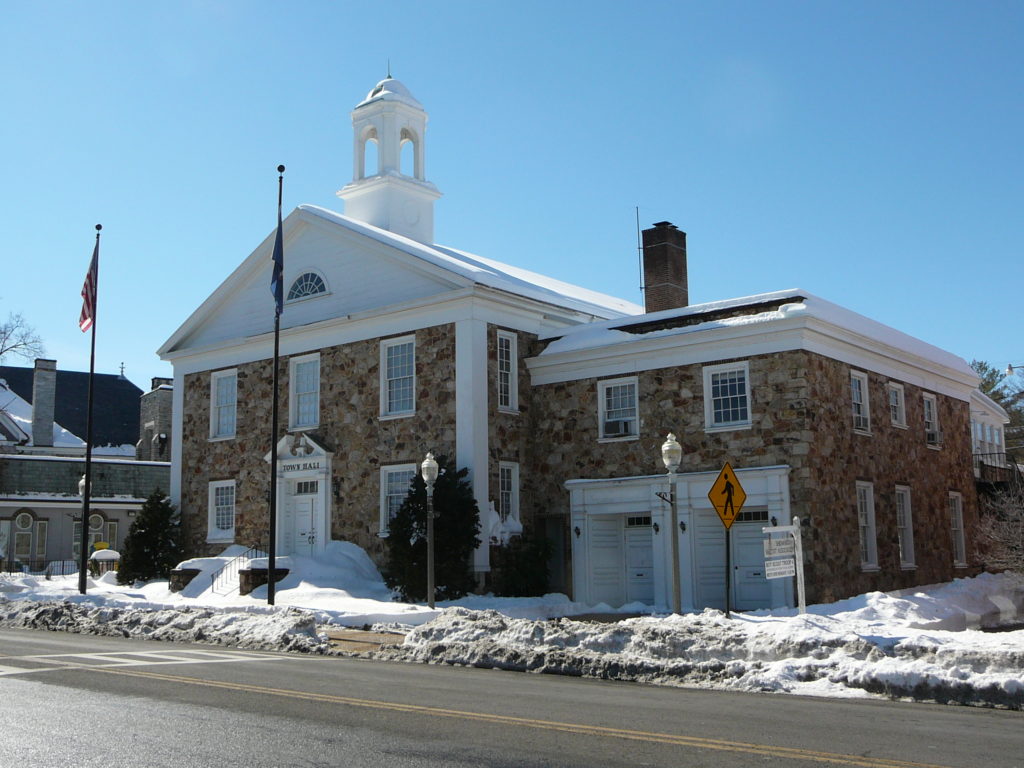
Old Town Hall – the swap that enabled marketing of the derelict Afton Inn
The 2014 property swap that allowed the town government and the EDA to gain control of the languishing Afton Inn was in exchange for the old Town Hall several doors north and across North Royal Avenue from the Afton Inn. The town government had determined that it had outgrown that historical structure dating to the 1930’s and made its move to the current new town hall directly across Crescent Street from the east wall of the Afton Inn.
Northern Virginia developer Frank Barros purchased the Afton in 2005 and developed an elaborate redevelopment plan. However, after the Town’s Board of Zoning Appeals authorized a 2006 zoning exception that would allow renovations that would have made the building taller than the historic Warren County Courthouse directly across East Main Street, the Front Royal Town Council – fearful the BZA decision would set a downtown construction precedent – sued its appointed board to overturn the exception. The controversial vote to pursue litigation was 3-2, one absent.
Expressing a previously shared Town-County desire to maintain a historical, tourist-friendly downtown ambience, Town Codes do not allow buildings to be constructed in the town’s Historic Downtown Business District that are taller than the courthouse.
In the wake of that legal hostility culminating with a 2008 court decision striking down the zoning exception, not to mention the housing market crash of the same year, Barros boarded up the Afton Inn up and resisted subsequent efforts by the Town and EDA to prompt a sale of the building. And so the once-upon-a-time centerpiece of downtown culture continued to sit, empty and deteriorating over the past decade.
Since the 2014 swap the EDA has been marketing the Afton Inn property, with a few hopeful, but false starts – until the LLC formerly known as MODE entered the picture some 17 months ago with the apparent resources to proceed independently of state funding assistance – though we would suggest double checking on that state tax credit program.
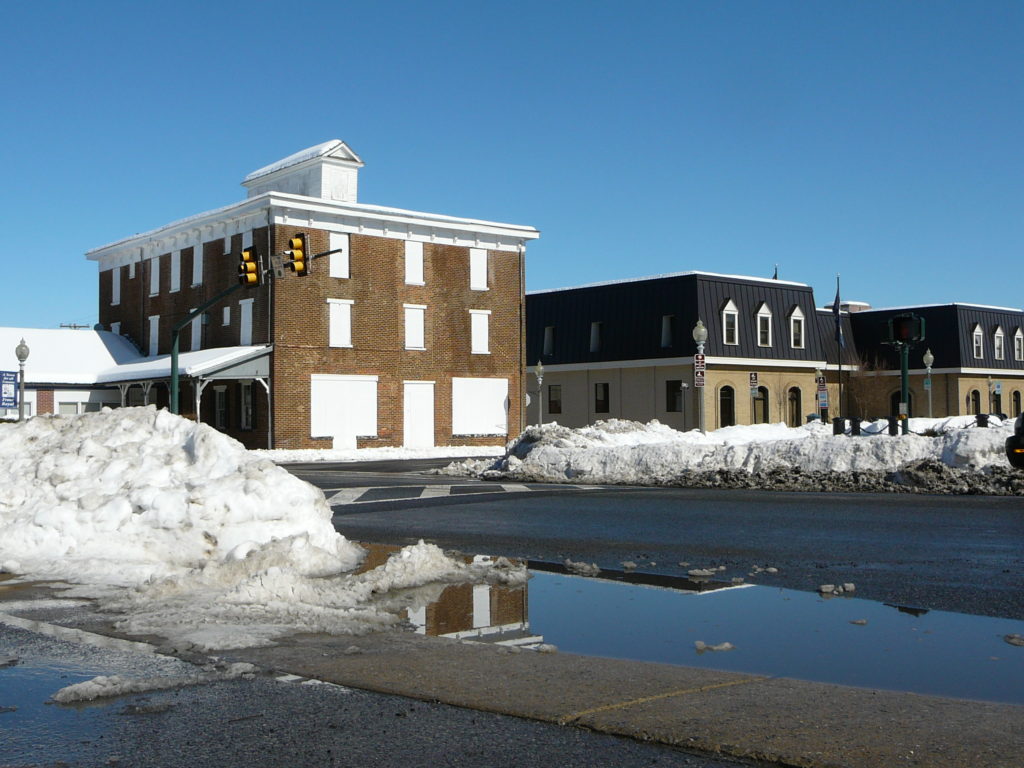
The derelict Afton Inn and new Front Royal Town Hall at right

Get Your Equipment Ready Before the Start of Fishing Season

Landscaping Careers Offer Outdoor Work and Creative Opportunities

Blue Ridge Wildlife Center Patient of the Week: Virginia Opossum

From Crime Scenes to K9 Units: Citizens Academy Opens in May

Weekly Yard Waste Pickup Begins April 8 in Front Royal

Town Council Reviews Goals at Retreat in Advance of Work Session

New Virginia Laws Target School Construction and Classroom Cellphone Use

Clear Horizons Brings Fresh Approach to Mental Health

Funding Cuts, State Error Strain Virginia’s HIV Care System

Virginia Hospitals Filed More Than 1 Million Medical Debt Lawsuits Since 2010, a New Report Finds

POLICE: 7 Day FRPD Arrest Report 4/6/2026

Spanberger Signs Bipartisan Bills Tied to Billions in Business Investment Across Virginia

Birthright Case Forces US Supreme Court to Confront Prospect of Americans Losing Citizenship

Caleb Benton McKinstry (2010 – 2026)

Ideas for Nurturing — or Rediscovering — Your Inner Child

Protein Takes Center Stage in Updated U.S. Dietary Guidelines

Blue Ridge Wildlife Center Acknowledges a Quarter of a Century of Work in Wildlife Preservation & Human Education

What Does A ‘Fair Share’ Really Mean?

South Warren Ruritan Club Hosts 20th Annual Spaghetti Dinner Fuels Scholarships for Local Teens

Trees Take Root as Virginia’s Frontline Defense Against Urban Heat

Virginia Set to Rejoin RGGI as Utilities Prepare to Pass the Cost Back to Ratepayers

Virginia Joins Multi-State Lawsuit Challenging Trump’s Election Order

Trump Budget Seeks 43% Boost in Defense Spending, Cuts in Many Domestic Programs

Virginia Sees 33,000 ACA Enrollment Drop Since Subsidies Expired, More Likely on the Way
