
Community Events
Shawquon Ruritan new and old-fashioned way of making apple butter

Photo collages are courtesy of Harry Newman.
The Shawquon Ruritan has served Stephens City and the south county area since 1956. Our members are dedicated to assessing the needs of the local community and providing volunteer services to make our neighborhoods a better place to live, work and prosper.
The club continues a history of providing college scholarships to local high school seniors. The club also supports fire and rescue and sheriff departments, cub scouts and boy’s scouts, youth organizations, Area 13 Special Olympics, Newtown Heritage Festival, victims of severe illness, homeless shelters and food pantries.
Traditional apple butter making
Fall always means apple butter, at least for many churches and civic organizations in the Shenandoah Valley. As for the Shawquon Ruritans in Stephen City, they are no exception. Here at the Shiley residence, beneath a bright blue sky and end of summer sunshine, the Ruritan Club gathers each year to prepare the season’s jars of homemade apple butter.
Marshall and Pam Shiley have been members of the Shawquon Ruritan Club in Stephens City since 2006. Marshall is a diesel mechanic who founded his own company, MS Heating and Air Conditioning, in 1986. He first learned traditional apple butter making at the family farm on Cedar Creek Grade in Frederick County. He and Pam had previously coordinated apple butter making at Refuge United Methodist Church in Stephens City and White Post United Methodist Church in Clarke County.
The selling of apple butter has become a major fundraiser for the club and Marshall has been making Shawquon Apple Butter for the last 12 years. Marshall uses golden delicious apples from the Loretta McDonald farm. Loretta is an active member of the Ruritan and donates the apples in support of the club’s annual fundraising effort. The apples are usually picked in late August just in time to be used for the annual Shawquon apple butter production during the first week of September.
Marshall informed me that Loretta delivers 42 bushels of golden delicious apples which are used to cook three 50 gallon kettles of apple butter. This year Loretta will have the apples picked and placed in three 14-bushel wooden bins about a day before apple butter production begins. The bins are loaded onto a trailer and driven to the Shiley residence.
Each 50-gallon kettle should produce 45 gallons of apple butter. Each kettle requires 14 bushels of apples which, after peeling and core removal, are trimmed down to nine bushels of snits. The cooking of 27 bushels of snits will take approximately 12 hours per kettle and eventually produce approximately 1,000 pint jars of Shawquon Apple Butter.
The antique apple peeler used in current production is a 1930 F. B. Pease, manufactured in Rochester, New York. Apples are manually placed in cups on the machine and the core is mechanically removed along with all seeds, skin and stems, leaving only the apple pulp which will become apple butter. Over the course of two days, 4,200 apples will be peeled, cored and segmented by the apple peeling machine.
Before making apple butter, Marshall adds lemon juice to the bucket of water that the apples fall into after peeling to keep the apples from turning dark. The lighter the apples the easier for the Ruritan chefs to quarter and slice. Ruritan members work to remove any residual core, seeds or skin from the apple pulp over a two day period. The working of the apples is referred to as a “schnitzen party” (slicing and dicing up the 27 snits of apples). The apple pulp is stored in a cool place until ready to cook.
Marshall always sets the kettle up the night before and makes sure it is on level ground. He butters the sides and bottom of the kettle and stirrers and throws the remaining butter (two sticks) in the kettle. Marshall does this the night before because it saves precious time and it is dark and visibility is poor in early morning. He covers the kettle with a tarp to prevent insects and any dust or debris from getting inside.
The apple butter production begins between 4 am and 5 am. The kettle is made of copper with a rounded bottom and no seams. It sits on legs about one foot above the ground, leaving enough room to fit a gas burner. Marshall prefers using gas versus firewood because if it rains, the kettle can be moved indoors. Marshall modified a 50-gallon copper kettle top to include a 1950’s era McCulloch two-man chainsaw motor-driven post hole digger transmission, which now has an electric motor installed instead of the old chainsaw. The electric motor drives, via belts, the transmission that turns kettle-conforming wooden paddles, thereby stirring the apple butter. The electric stirrer eliminates the need for volunteers to stir and stir and stir for hours, providing increased consistency.
Marshall created two home-made, specially-designed wooden stirrers with an oblong hole on the bottom to help keep the sugar and apple pulp circulating within the kettle. This blade-like utensil must be rounded to fit the bottom of the kettle and prevent burning. The foot of the stirrer must be as long as the kettle is deep to continuously scrape off pulp from the kettle’s sides.
He adds one gallon of fresh apple cider while Ruritan members drop apples from wooden crates until the 50-gallon kettle is full. From the beginning the gas fire keeps the heat even and constant. Ruritan members fill the kettle with raw apples and finish no later than 3 hours after startup. Apples cannot be added to the kettle afterwards, allowing all apples to be cooked equally.
The pulp is at boiling temperature until it reaches the right level of thickness. Marshall cooks for approximately three or more hours before adding sugar. This process will “cook down” the apples to remove much of the water contained in the apples.
After six and one half hours, when a little volcano bubble emerges, Marshall puts a tablespoon of cooked apples on a cold saucer, tilts it and visually determines if the water runs fast from the apples. If it does, the apple butter is not thick enough. It has to stop “weeping,” meaning that water should not separate from the pulp. This is called a water test. Marshall usually runs five to six tests per kettle.
When the water is determined to have been cooked out, Ruritan members under Marshall’s supervision gradually add sugar to each 50 gallon kettle. A medium size sauce pan and handle is used to gently shake the sugar into the kettle, so no clumping occurs. After around three hours of continuously adding sugar, the various tasters agree the apple pulp is sweetened to the right taste.
After the last of the sugar is added, Marshall cooks for at least two or more hours, then checks for consistency. As the kettle content gurgles and spurts, the pulp slowly turns a russet brown color. The sugar caramelizes, darkening the apple butter’s color.
Marshall says apple butter making is a taste-as-you-go process. When he and the tasters are satisfied with color and sweetness, he begins to add spice (only cinnamon) but just after he cuts off the gas heat. Marshall uses artificial oil of cinnamon because the real stuff is very expensive ($65 an ounce). Marshall procures the oil of cinnamon in 4 oz. bottles. The cinnamon is added to taste. “If it does not burn your tongue today, it won’t be right tomorrow,” Marshall said. Ruritan members now begin to continuously stir, using a special home-made six foot long paddle-like stirrer to ensure the cinnamon is absorbed throughout the apple butter. Marshall made the handle from hickory, however he crafted the paddle from walnut because it is a close-grained hardwood that does not bleed wood flavor into the apple butter. To keep the apple pulp constantly rotating, Marshall recommends this cadence for the stirrer on duty: “Twice around left and back through the middle, twice around right and back through the middle.” Marshall and his discriminating tasters sample again and again, adding more cinnamon as necessary, stirring continuously. The cinnamon adding stage takes less than one half hour.
Marshall knows when it is done by judging the apple pulp thickness and russet color. It takes years of experience to know “doneness” and there is no computer algorithm or kitchen gadget employed to determine doneness. It is all about sweetness, color and consistency.
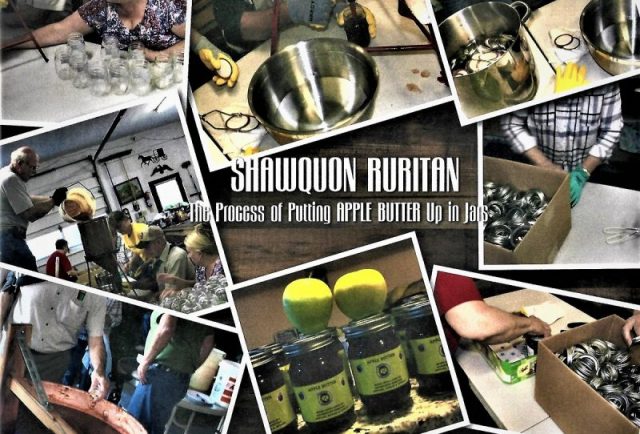
Now the jarring process begins
The jars, lids and rings have been previously sterilized in commercial dish washers and repacked in their original boxes at the McDonald farm and at the Shiley residence. The commercial machines can wash 72 jars at one time and it takes 15 washes to deliver 1,080 jars that will be required if each kettle produces 45 gallons of apple butter. While the kettles of apple butter are cooking, the custom labels are positioned on the jars.
Once pronounced done, the apple butter is poured into Marshal’s home-made four-gallon jar filler. The finished apple butter at this point is extremely hot – almost at the boiling point, so experience and extreme caution is a requirement for Ruritans handling the jar filling process. A production line of Ruritan members support Marshall. When Marshall manually fills the pint jar he slides it over to a member who puts the sterilized lid on and then another member applies the ring. One can hear the popping of the lids as the apple butter cools and a vacuum occurs, sealing the jars. The assembly line continues as the jars are then packed 12 to a box and carried to the storage area.
October is National Apple Month and there is no better way to savor the sweet goodness of tasty apple butter throughout the winter months than by keeping several pint jars in the kitchen cupboard. Consider buying a few pints as Thanksgiving or Christmas gifts for friends and family.
How to buy Shawquon Apple Butter
Shawquon Apple Butter can be purchased for $5 a pint bottle or $60 a 12-bottle case. The apple butter can be bought from the following local stores: The Seven-Eleven in Middletown, Stephens City Barbershop, Gore’s Fresh Meats, Split Ends Hair Salon and White Oak Trading Post.
About Shawquon Ruritan
Shawquon Ruritan meet at the Stephens City United Methodist Church at 7:00 PM every third Thursday of each month. Come join us and become a member. We are dedicated to improving communities and building a better America through Fellowship, Goodwill and Community Service.

5 Tips to Prevent Sports Injuries

Standardbred Owners Ainspan, McDonald Each Score Thoroughbred Wins at Colonial Downs’ Virginia Derby Meet

Most Dangerous Cycling Scenarios Involving Cars

VDOT: Warren County Traffic Alert for March 23 – 27, 2026

Virginia State Police Seize $22.4 Million in Drugs, Recover Firearms in Weeklong Operation

Virginia Home Sales Rise in February as Inventory Grows, Spring Outlook Uncertain

Bing Crosby Stadium Hosts Warren County–Skyline Baseball Battle Tonight

Warren Supervisors Address Audit Contract, Permits, and Property Sale at March 17 Meeting

Here’s How Virginia Lawmakers Suggest the Next State Budget Handle Federal Health Care Funding Fallout

Spring Essentials Checklist: Prepare Your Home for Summer

Virginia Joins National Push for Refunds After US Supreme Court Voids Trump Tariffs

Four Reasons to Consider Hiring a Professional Cleaning Company

Ask the Expert : We Are Applying for a Mortgage Soon. What Kind of Documents Will We Need?

Charles Michael “Rusty” “Chuck” Fischbein (1944 – 2026)

Jerrold E. “Jerry” Groves (1931 – 2026)

Town Planning Commission Moves Forward with Industrial Zoning, Holds Preliminary Discussion of Urban Agriculture

Schools Push for Budget Flexibility, Consistent Funding as Needs Grow

Skyline High Teams, Athletes Successful Seasons and Performances Acknowledged – Oh, and Those Roosters

School Board Seeks to Restore Meals Tax Funding for School Facilities

Wasting Drinking Water: 3 Habits to Eliminate From Your Daily Routine

Medicare Launches TEAM Program to Improve Recovery After Surgery

Izaak Walton League Promotes Conservation and Outdoor Programs at Community Forum

POLICE: 7 Day FRPD Arrest Report 3/16/2026

Blue Ridge Wildlife Center Patient of the Week: Great Horned Owl
