
Local News
Skyline High School continues to fight chronic absences
FRONT ROYAL— With schoolwide chronic absences reaching almost 30 percent last year, the administrators at Skyline High School (SHS) have had to come up with some creative solutions.
One of the most effective practices currently being used at SHS has been an administrator’s knock on the door at the home of a regularly absent student.
“We have gone to several homes of students who don’t want to come to school after we’ve called the parents, who say they just can’t get them there. So I said, ‘Do you mind if I come to your house?’” SHS Principal Michael Smith explained to members of the Warren County School Board during the work session portion of their January 15 regular meeting.
“It’s been pretty effective because the principal is standing there at the front door, almost at their bedroom door, opening it up and asking, ‘Why aren’t you at school?’ The parents get a good kick out of it and it works for the kids; they don’t want us coming back to their house,” said Dr. Smith.
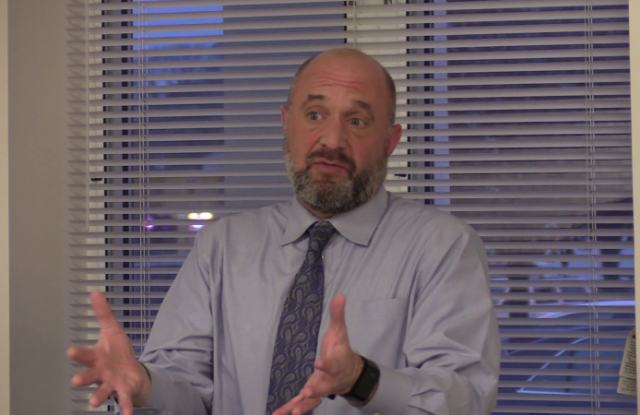
SHS Principal Michael Smith
“Whatever works,” he added. “All of my administrative staff has had to do that, so we’re doing everything we can to get them to school.”
During his presentation to the School Board, Smith said that SHS had an academic review on November 6, 2019. The overall findings and problem identified during the review was that chronic absenteeism at SHS received a Level III performance standing, meaning accredited with conditions, he said.
Melody Sheppard, interim superintendent for Warren County Public Schools (WCPS), told School Board members on Wednesday night that SHS is one of the school district’s two schools dubbed accredited with conditions, and the board next month will hear from Principal Shane Goodwin about similar efforts under way at E. Wilson Morrison Elementary School to curb chronic absenteeism.
Following the academic review, Smith said the subsequent SHS corrective action plan was submitted to the Virginia Department of Education on November 18, 2019, while essential actions to improve the chronic absenteeism rate have been added to the SHS school plan for the 2019-2020 school year.
Additionally, attendance expectations for accurate reporting of attendance were added to the staff handbook; an annual staff training was conducted on the attendance protocol; and attendance data will be reviewed monthly to identify students on track to be chronically absent and to prioritize students requiring Tier 2 and Tier 3 levels of support, he said.
Tier 2 level students are those who have missed nine days at the mid-school year point, while Tier 3 level students are chronically absent from school, said Sheppard, who noted that students are allowed a total of 18 excused absences in a school year.
And according to WCPS attendance policy, absences are excused for a funeral, illness, injury, legal obligations, medical procedures, suspensions, expulsions, religious observances, and military obligations that parents are aware of and support.
In addition to the impromptu at-home visits, Smith said another current practice is to assign teacher mentors to Tier 2 and Tier 3 level students for daily and weekly contact. “It’s usually their first block teacher or another teacher they’re comfortable with,” he said, adding that the goal is for the teacher mentor to get information from the student about why he or she isn’t attending school.
The subsequent data that the teacher mentors put into an online Google form describes when they met with students, what they talked about, and what they determined were some possible solutions. Smith said this data also provides useful evidence for future decision-making around making individualized attendance plans, for example.
Smith outlined several other current practices that are ongoing at SHS to stem the chronic absenteeism problem.
Every Sunday, for instance, Smith sends out a weekly phone blast to relay pre-recorded information about the upcoming week, as well as the importance of regular attendance.
Other practices include what Smith called “simple things,” such as teachers greeting students as they enter the classrooms and administrators greeting students in the morning as they enter the school building. These are county-wide policies aimed at fostering positive relationships across an entire school, he said.
“I actually have two assistant principals at the entrances to the school,” Smith told School Board members. “They open doors and greet every single kid who comes into the school.”
There also has been an attendance committee with parents developed at SHS that already has met twice. “Parents were surprised at the number of students who miss substantial amounts of classroom time,” said Smith.
During the attendance committee meetings that Smith holds with students and their parents, they develop an Attendance Success Plan for each student. He’s so far held 66 meetings.
Second attendance meetings also are held between Smith, the parents, students, and the SHS truancy officer, with 15 having been held thus far. “It’s nothing punitive, it’s just about getting students to realize the importance of what they’re missing when they’re not in the classroom,” said Smith.
Smith also sent out 890 letters to every SHS household asking parents to come in and discuss the chronic absenteeism situation. The parents who did respond to the letter, he said, were the ones whose kids regularly attend school, but who said they wanted to learn how to share the value of coming to school with other families and students.
Additional current practices include a Principal’s Cabinet that consists of class officers who discuss the atmosphere of the school and what incentives might help improve attendance.
During the last meeting, Smith said cabinet members commented that for those students who regularly miss school, they likely wouldn’t attend “no matter what incentive we have.”
The SHS attendance secretary also notifies parents every day to determine why students are absent.
Going forward, Smith told School Board members that SHS will continue to: run the teacher mentor program; meet with students and parents; and send the Sunday phone blasts.
Warren County School Board Vice Chairwoman Catherine Bower asked what the most common reasons are for the chronic absences. Smith said there’s a wide array of excuses.
For instance, many students say they just don’t want to get out of bed or that they’re bored at school, which essentially relates to instruction, said Smith.
Sheppard pointed out that all the current practices at SHS to fight chronic absenteeism are evidence-based practices. “It’s all about building positive relationships with kids,” she said. “Whenever a student comes to school, they have somebody there that they can have a conversation with and not feel uncomfortable.”
“It is about the relationships, the rapport and the trust,” agreed School Board Chairman Arnold Williams Jr., who told Smith to “keep doing what you’re doing. Keep moving forward. I know you can get there.”
“We will,” Smith told him, noting that last year, SHS was at 29 percent chronic absenteeism and this year’s goal is to reduce that mark to 24 percent. “If we can get there, that would be a huge decrease.”
Watch the latest Warren County School Board work session where SHS Principal Michael Smith discusses this problem with the board:

Chronic absenteeism impacts accreditation at Skyline High School

Clear Horizons Brings Fresh Approach to Mental Health

Funding Cuts, State Error Strain Virginia’s HIV Care System

Virginia Hospitals Filed More Than 1 Million Medical Debt Lawsuits Since 2010, a New Report Finds

Spanberger Signs Bipartisan Bills Tied to Billions in Business Investment Across Virginia

Birthright Case Forces US Supreme Court to Confront Prospect of Americans Losing Citizenship

Caleb Benton McKinstry (2010 – 2026)

Ideas for Nurturing — or Rediscovering — Your Inner Child

Protein Takes Center Stage in Updated U.S. Dietary Guidelines

Blue Ridge Wildlife Center Acknowledges a Quarter of a Century of Work in Wildlife Preservation & Human Education

What Does A ‘Fair Share’ Really Mean?

South Warren Ruritan Club Hosts 20th Annual Spaghetti Dinner Fuels Scholarships for Local Teens

Trees Take Root as Virginia’s Frontline Defense Against Urban Heat

Virginia Set to Rejoin RGGI as Utilities Prepare to Pass the Cost Back to Ratepayers

Virginia Joins Multi-State Lawsuit Challenging Trump’s Election Order

Trump Budget Seeks 43% Boost in Defense Spending, Cuts in Many Domestic Programs

Virginia Sees 33,000 ACA Enrollment Drop Since Subsidies Expired, More Likely on the Way

Annual Dental Checkups and Cleanings: Essential Appointments

4 Stimulating Activities for a Healthy Brain After 50
The First Amendment: America’s Unique Foundation of Freedom

How to Tackle Credit Card Debt

Summer Enrichment Camp Gives Teens Hands-On Learning Opportunities

VDOT: Warren County Traffic Alert for April 6 – 10, 2026

David Silek to Remain in Chairman’s Seat of WC Republican Committee Pending 6th District Appeal Decision

Sales Set to Bloom Like Daffodils This Spring
