
Community Events
Sons of the American Revolution conduct presentation on the Battle of Cowpens
On March 16, 2022, the Warren Heritage Society and the Colonel James Wood II Chapter of the Virginia Society Sons of the American Revolution conducted a presentation on the Battle of Cowpens. There were several battles in the struggle for independence that had a major influence on the direction of the war. It was the Battle of Cowpens that, many feel, was the turning point that led to the colonial victory.

Dale Corey giving a presentation on the Battle of Cowpens. (Pictures courtesy of Dale Corey)
This battle was the beginning of the end. By 1778, the northern campaign had come to a stalemate between the American forces and the British. General Sir Henry Clinton was the commander of British forces in the colonies. He decided to turn his attention to a southern campaign. It was felt there was a strong loyalist support for the crown and they would take up arms. Initially, they were quite successful, capturing Savannah, Charleston and Camden, giving them the confidence that victory in the south was theirs. The British felt with the addition of the southern loyalists and the easy victories to date, they would crush the southern American armies. They would head north and destroy George Washington’s northern army.
In December 1780, Washington replaced southern commander Major General Horatio Gates with Major General Nathanael Greene. Greene split his army, sending Brigadier General Daniel Morgan, with a small army of continental soldiers and militiamen, west to destroy supply lines and create havoc in the backcountry. General Lord Cornwallis was the commander of British forces in the south. He countered this move by sending Lieutenant Colonel Banastre Tarleton to block Morgan’s actions and destroy his Army. Tarleton was a fearless and aggressive leader with 1,150 men and two 3 pound cannons. Tarleton pursued Morgan through heavy rains and across flooded rivers.
Morgan made his stand at a field known as the Cowpens. This was a roughly 500 yard square pasture. The field was in a bend of the flooded Broad River, which helped prevent any of his soldiers who would be tempted from retreating from the field. They made camp at a swale between two small hills. While encamped, a number of militiamen from the backcountry joined the colonists, increasing the size of his army to about 1,900 fighters. Tarleton pushed his men hard and was confident of victory. He had Morgan hemmed in by the Broad and the park like terrain was ideal for his dragoons.
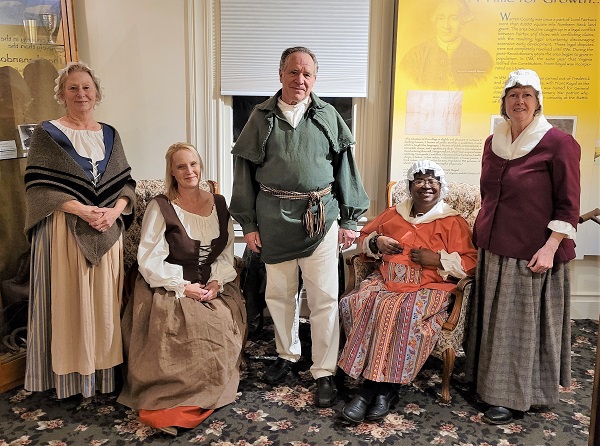
Dale Corey with ladies of the Warren Heritage Society
On the morning of January 17th, the British forces were awakened at 2:00 a.m. and prepared for battle. They marched forward and at 7:00 a.m., came to the wide open cowpens pastureland. Throughout the night, Morgan had moved among his troops offering encouragement and developing a plan for the ensuing battle. He positioned three defensive lines. The first were riflemen who were told to fire two shots and then retreat to the second line. This was the militiamen who were told to fire and then retire to the third line consisting of Continental Soldiers. Tarleton aligned dragoons and artillery to make a frontal assault. As the British charged, the riflemen took a toll on the dragoons, killing 15 and then retreated to the second line. The British reformed and charged again. Morgan had instructed his militiamen to take two shots and then retire to the third line. Seeing this, Tarleton’s men felt the colonists were fleeing the battlefield and charged again. The militiamen retreating had misunderstood the commands, causing Morgan to rally the troops with shouts of “form, form my brave fellows! Old Morgan was never beaten!”
The British reserves were the 71st Highlanders, one of the elite units in the southern command. They entered the battle with bagpipes, beating drums and shouts as they charged into the fight. The American cavalry led by Lieutenant Colonel William Washington charged in from the right flank with the reformed militia they created a double envelopment. This overwhelmed the British the they began to lay down their arms. Tarleton with some of his officers and men began a retreat. He was pursued by Washington’s cavalry which resulted in a brief dual between the two leaders. Tarleton escaped to rejoin Cornwallis. The battle was a resounding victory for the Americans.
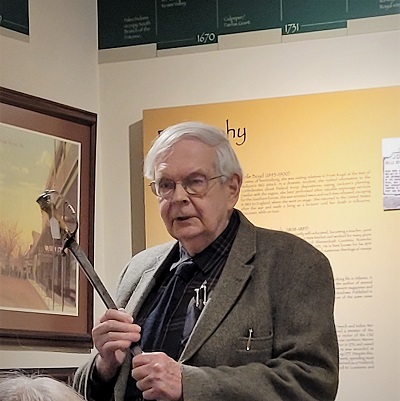
Richard Hoover with Revolutionary War era sword
Of the British 1,150 men, 110 were killed, 229 wounded and 529 captured or missing with colonial casualties at 149. The battle has lasted about an hour. At it’s completion, Morgan had the dead buried and began a march to join Greene’s Army. Tarleton’s command was one of the elite forces and it had been totally decimated, resulting in an embarrassing loss to the crown. British loyalist support waned and a less than stellar victory at Guilford’s Courthouse left Cornwallis’ Army in extremely poor condition. He moved his army to Yorktown in September to eventually surrender to George Washington on October 19, 1781.
The presentation included briefings by Richard Hoover about bladed weapons and Dale Corey on muskets and rifles used during the Revolutionary War. Hoover presented four swords, a pike and the use of the bayonet as a major infantry weapon at the time. Corey brought three muskets and a rifle.

Electric Vehicle Market Adjusts as Industry Rethinks the Road Ahead

Cultures Around the World Mark the Spring Equinox With Unique Traditions

Laurel Ridge to Host 46th Annual Spring Follies: “Back to the ’90s”

Love Revival to Host Free Community Easter Celebration in Front Royal

Salvation Army of Front Royal Plans Annual Dinner and Raffle Fundraiser

Stephen Paul Sill (1955 – 2026)

Virginia Seeks Public Input for 2026 Statewide Rail Plan

Front Royal Craftsmen Revive Centuries-Old Timber Framing Tradition

VDOT: Warren County Traffic Alert for March 16 – 20, 2026

Virginia Lawmakers End Session Without Final Budget

Your Personal Mission Statement: A Guide to Getting What You Want Out of Life

Disappointed In Our Olympic Spirit

How St. Patrick’s Day Became America’s Biggest Irish Party

Virginia State Police Urge Sober Plans for Saint Patrick’s Day Celebrations

In a One-Party County, Internal Party Decisions Affect Us All

Virginia State Police Seize Nearly 100 Pounds of Narcotics, Recover Firearms in Weekly Crime Suppression Effort

Barton Charles “Bart” Haller (1940 – 2026)

Dawn Lee Dodson (1970 – 2026)

Mary Helen “Nanny” Spires Johnt (1954 – 2026)

Another Round of ‘Momnibus’ Bills Are Headed Towards the Governor This Year

Virginia Joins States Challenging Trump Admin Regulations That Limit Free Birth Control Access

Update: Charlotte Swanson Smith (1951 – 2025)
Why We are Challenging the Republican Mass Meeting

Bruce Norman Showman (1954 – 2026)
