
Local News
Students Honor Veterans Through EarlyAct Program at E. Wilson Elementary
Students at E. Wilson Elementary School are learning an important lesson that goes beyond the classroom: What it means to serve others and show gratitude.
Through the school’s EarlyAct Club, led by advisor Michael Williams, students recently participated in a project to create thank-you cards for veterans participating in an upcoming Honor Flight to Washington, D.C.

George Donovan (left), Lt. Col. Edie McGoff-Donovan (center), and Michael Williams (right) speak with students at E. Wilson Elementary as part of an Honor Flight outreach program. Photos by Brenden McHugh, Royal Examiner.
The visit from Lt. Col. Edie McGoff-Donovan (USAF, Ret.) and her husband, Vietnam veteran George Donovan, helped bring that lesson to life.
Teaching Service at a Young Age
Williams said the EarlyAct program, supported by Rotary, is built on a simple idea: “service above self.”
The club has grown rapidly, from about 20 students to more than 150, and now includes children from kindergarten through fifth grade.
“It was worth it because I saw the enjoyment the kids got out of it,” Williams said. “I saw how it helped them… they were taking more pride in being here.”
Students have taken on a wide range of service projects, from cleaning up school grounds to assembling 400 hygiene kits for the homeless and raising money to support local families and veterans.
One recent effort raised more than $1,700 through a schoolwide “change war.”

“It snowballed,” Williams said.
But for Williams, the goal is bigger than any one project.
“I want them to understand… you don’t get to come to school for free just because somebody decided it,” he said. “Men and women died so you can have the freedom to do the things that you’re doing.”
Connecting Students to Veterans
That message was reinforced during the visit from Honor Flight volunteers.
Edie Donovan, a nurse who has worked with Honor Flight for a decade, explained how the program provides veterans with a free trip to Washington, D.C., to visit memorials honoring their service.
“Imagine you did something very brave a long time ago and now people want to celebrate you,” she told the students.
The trips include visits to major memorials, including the Vietnam Veterans Memorial, where many participants search for names of fallen comrades.
“They take paper and pencil… and mark over it so that their name is actually on the paper,” Donovan said, describing how veterans create personal keepsakes from the experience.
Each veteran is paired with a guardian to assist throughout the trip, and medical staff like Donovan are there to support those who may struggle emotionally during visits.
“There are some veterans who really have had a bad time, and they just can’t go there,” she said. “And I… sit with them until we move on.”
A Powerful Moment: Mail Call
One of the most meaningful parts of the Honor Flight experience happens on the ride home.
“On our way back… we have mail call,” Donovan said.
That’s where the students’ work comes in.
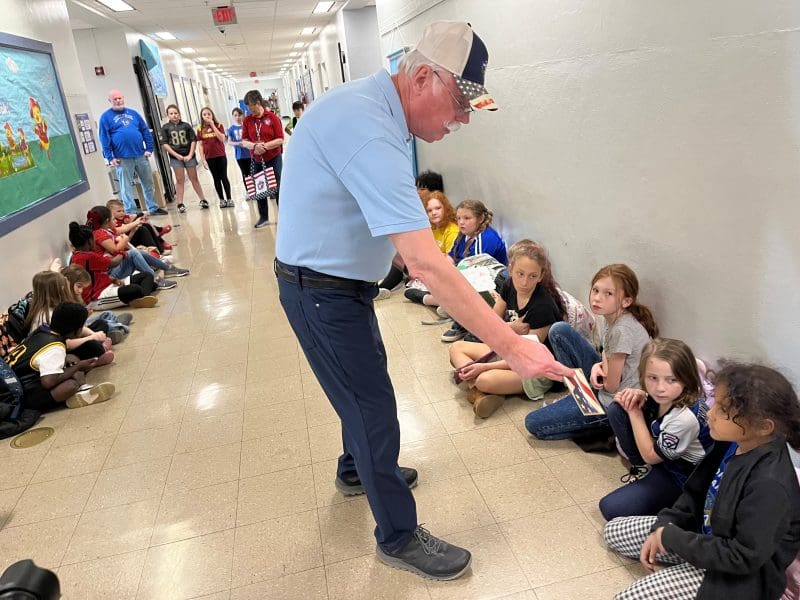
George Donovan speaks with students and looks over their handwritten cards, created to thank veterans ahead of an upcoming Honor Flight to Washington, D.C.
George Donovan, who served two tours in Vietnam, described how much those letters mean.
“It’s very important to a veteran to have somebody tell them thank you for your service,” he said.
Each veteran receives a bag filled with letters, many written by students like those at E. Wilson.
For some, it’s the first time their service has been recognized in such a personal way.

Lessons That Last
As students prepared their cards, they were encouraged to keep their messages simple but meaningful: “Thank you for your service,” “Thank you for protecting our freedom.”
For Williams, the experience connects history, service, and gratitude in a way students can truly understand.
The project also reflects the broader mission of EarlyAct, to help young people see their role in making a difference.
“We try to have the kids put together the projects that matter to them,” Williams said.
By writing letters to veterans, students are not only giving thanks but also learning about sacrifice, service, and the freedoms they enjoy every day.
And for the veterans receiving those cards, the message is clear: their service is remembered.




American Songs Concert Coming to First Baptist Church in Front Royal on October 25

When Grief Doesn’t Ease With Time

Sudden Cardiac Arrest May Not Be As Sudden As Its Name Suggests

100 Years of Hundred Acre Wood

A Moment of Honor: Veterans Receive a Powerful Tribute at the Tomb of the Unknown Soldier

Samuels Public Library Invites Young Writers and Artists to Enter 48th Annual Holiday Contest

New Exhibitions Bring World-Class Contemporary Art to Downtown Front Royal

VDOT: Warren County Traffic Alert for October 19 – 23, 2026

Discover The Many Benefits Of Organized Sports

The Family Bond That Doesn’t Necessarily End When Contact Does

Virginia State Police Urge Drivers to Stop for School Buses and Students

Economic Development Director Patrick Barker Details Maturing Plan at Town-County Liaison Meeting

Virginia Breeders’ Championships Begin This Weekend at Shenandoah Downs

Local Author Invited to Share Children’s Book at Irish Castle That Inspired It

Virginia State Police Seize More Than $334,000 in Drugs, Recover Five Firearms in Weeklong Operations

Business Growth Series: Big Projects Don’t Get Done — Small Tasks Do

Data Center Moratorium Bills Stack Up Ahead of Virginia Legislative Session in January

Transgender Care for Young Patients Remains On Hold at Virginia Hospitals

Commentary: Spanberger’s Energy Plan Dazzles – and Disappoints

The Workplace Accommodation That Costs Nothing

Nothing In Dolly Parton’s Library Is Ever Returned

Trump: Execution of Fort Hood Shooter Will Not Be Livestreamed

Harmony Hollow Holler Music Festival Brings Appalachian Music to Front Royal October 17

Winsome Earle-Sears Warns of Consequences of Virginia’s Proposed Constitutional Amendments
