
Local Government
Supervisors Defend Public Schools and Crucial Services Budget Cuts as Sign of Tight Economic Times
At its Fiscal Year 2026 Public Hearing on Tuesday, June 10th, the Warren County Board of Supervisors heard from 13 citizens urging them to, if not fully fund, at least adequately fund crucial community services. Those services cited by citizen speakers included Warren County Public Schools and Fire & Rescue services extending to the dual-county funded Chester Gap Volunteer Fire Department located in Rappahannock County.
Four of the five supervisors were present to hear the citizen input on budget variables, with Fork District Supervisor Vicky Cook absent, apparently due to out-of-state car repair issues in Tennessee, Chairman “Jay” Butler later indicated to this reporter.

The WC Board of Supervisors, minus 1, prepares to hear from the public on its recommended FY-2026 budget. The assessment was not positive. Royal Examiner Still Photos Roger Bianchini, video Mark Williams.
As the staff meeting agenda packet noted, the State requires budget public hearings to be held a minimum of seven days prior to a vote on approval of the budget. Adoption of the 2026 Fiscal Year budget beginning July 1 is scheduled for a vote at the supervisor’s Special Meeting on Tuesday, June 24th, starting at 6 p.m.

After County Administrator Ed Daley and Finance Director Alisa Scott presented a graphics-assisted FY-2026 budget summary (see summary at story’s end), the public weighed in. That public included a number of Public School teachers wearing identifying WC Public School Teacher T-shirts.
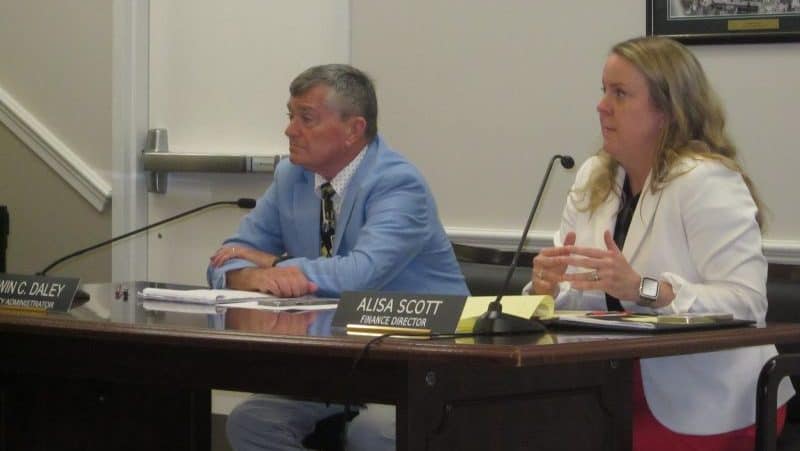
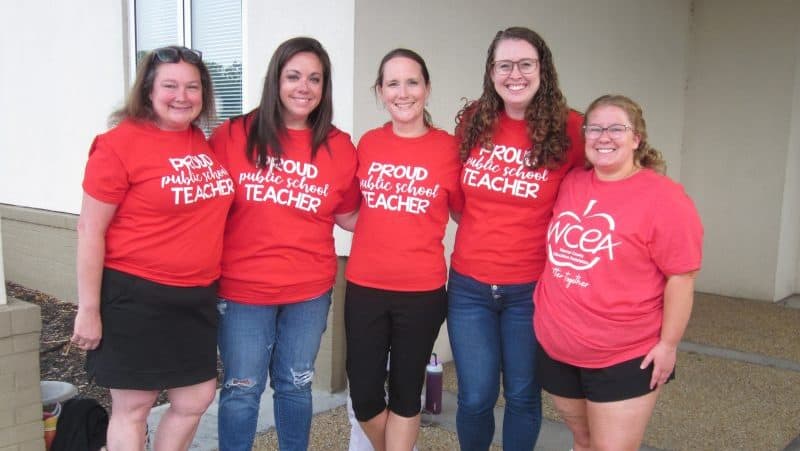
County Administrator Ed Daley and Finance Director Alisa Scott handled the staff summary of the proposed budget and revenue projections versus requested expenditures. Below, outside the WCGC public school, teachers display their pride in their work. Several spoke during the Public Hearing, telling the supervisors their proposed budget would negatively impact the community’s publicly educated children most of all.
Samuels Library and “Misplaced Priorities”
While not the dominant issue of the evening, the recent controversy surrounding Samuels Public Library surfaced in public comments—often used to argue against cuts to education and emergency services.
Fork District resident George Cline, husband of WC Sheriff Crystal Cline, delivered one of the evening’s most pointed and impassioned statements, accusing the board majority of fostering a toxic political climate while mismanaging taxpayer funds. His remarks drew attention to a range of issues—personal attacks, misplaced priorities, and underfunded public services—that he argued were symptoms of both dysfunction and disregard for core community needs.

“I want to start with two simple definitions,” Cline began. “Toxicity is when bad behavior spreads and stops good things from moving forward. Fiscal irresponsibility is wasting taxpayers’ money, spending without purpose, ignoring real needs, and pushing personal political agendas over the people you were elected to serve.”
He told the board that both were on full display in Warren County.
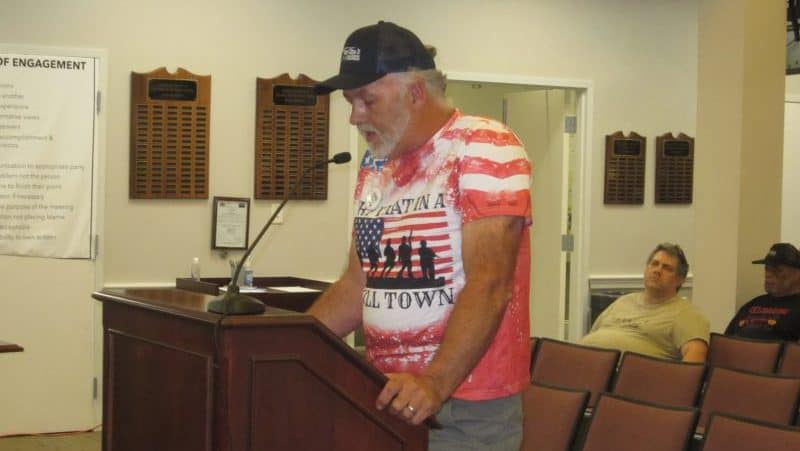
Fork District resident and school board candidate George Cline pulled no punches in negatively assessing this board majority’s track record as Warren County’s elected officials.
Cline cited specific examples of what he called political toxicity: a public incident where a library board member, Melanie Salins, allegedly texted a sitting supervisor during a meeting to call her a liar; Supervisor Vicky Cook’s continued criticism of the sheriff’s office, which Cline argued was less about performance and more about political grievance; and the board’s decision to stack powerful committees like the Library Board and Audit/Finance Committee with politically aligned appointees, sidelining diverse voices and community representation.

But it was the spending decisions that drew his most forceful criticism.
“You’ve spent $51,000 fighting a well-run library,” Cline said, referring to the county’s ongoing legal and political battle with Samuels Public Library over content and governance. “That money and time could have gone to roads, public safety, schools, and basic infrastructure.”
He offered a striking anecdote to illustrate his point: a building inspection vehicle with more than 200,000 miles reportedly broke down near Gooney Loop last week—an area with no cell service. The stranded staff member had to walk to the nearest home to call for help. “$51,000 could have replaced that vehicle,” Cline said.
He then pointed to underfunded emergency services, noting that fire and rescue services were unable to respond to 429 calls this year—an issue compounded by reduced support for Chester Gap Volunteer Fire Department. “Our firefighters are missing calls. And your answer is, fight a library?”

Cline also credited the Warren County Sheriff’s Office with using internal cost-saving measures to fund an overdue records system upgrade. But that came at a cost, he said: the sheriff had to agree not to fill five vacant deputy positions to adjust the department’s salary scale, simply to remain competitive with town salaries.
Meanwhile, he noted, the county’s school system is facing serious challenges.
“Teachers are buying their own supplies,” Cline said. “Facilities staff are asking for money for roof repairs, tennis court maintenance, and basic energy upgrades. Blue Ridge Tech turned away 100 students this year because they’ve outgrown their space. Our schools need your help, and your priority is to control the library?”
His closing words underscored the gravity of the moment as he saw it.

“You have a choice,” Cline said. “You can stop wasting money fighting a functioning library and use that money to help solve real problems. Being fiscally irresponsible with the community’s money is compounding the problem—and will cost even more when a responsible board is finally elected in November.”
He ended with a warning: “If you don’t act, you’ll be remembered not just for being toxic and irresponsible but for choosing to do nothing when the community needed you the most.”
Multiple speakers framed the Samuels controversy as emblematic of deeper issues—citing it as an example of misplaced focus during a time when basic services are underfunded.
Public Schools plea
Lead-off speaker Sara Jones of the Happy Creek District set the tone of coming pro-public schools comments (at the 18:54 mark of the video): “I am here tonight with a simple but urgent message: You must prioritize funding our public schools now. I understand that the requested increase of $4.2 million is significant. However, it is important to remember they were flat-funded last year, and the needs of our students have not diminished—an increase of only $750,000 falls far short of what is adequately required to support every student.
“At the very least, I urge you to consider approving a $1.2-million increase to help our schools begin addressing these essential needs. This isn’t just another line item in the budget. It is an investment in the future of Warren County, in the future of over 5,000 children who walk into those classrooms every day full of potential, hope, and promise.
“If you could see their faces on the first day of school, their excitement when they find their classroom, when they are welcomed by a teacher who believes in them when they find a talent or a strength they never knew they had, you’d know this is something we can’t afford to delay or short change.
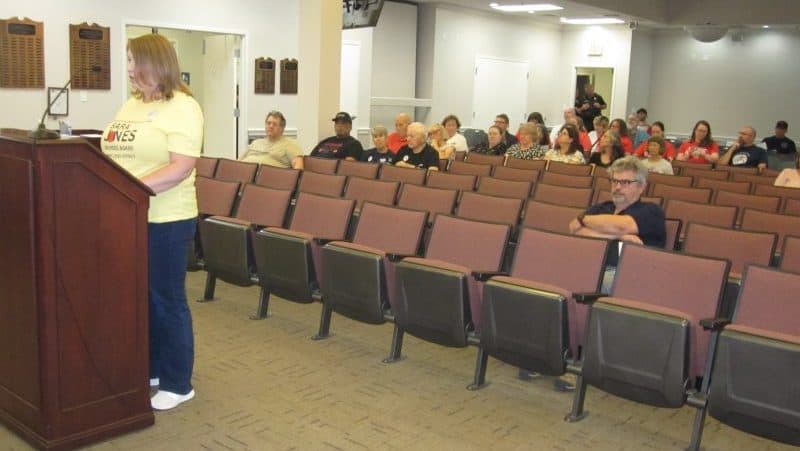
Lead-off Budget Public Hearing speaker Sara Jones made the point in explaining the need and importance to the community’s children of a funding increase, even less than requested, for WC Public Schools this year.
“And behind every one of those moments is the educators and staff of Warren County Public Schools, mentors, supporters, advocates doing everything they can to help students grow, learn, and believe in themselves. They need our full support, not just words, but resources. Our community can’t afford the cost of inaction,” Jones said pointedly, adding in conclusion:
“The time to act is now. Our students can’t wait. Our teachers can’t stretch themselves any thinner. Our community can’t afford the cost of inaction. Let’s make it clear: Warren County’s future depends on strong, well-funded public schools. Invest in that future today.”
But Public Schools weren’t the only crucial funding need addressed during the FY-2026 Budget Public Hearing.
Chester Gap: “This is life or death”
The Chester Gap Fire & Rescue Department, located near the county’s edge, became the emotional heart of the evening. Residents credited the station with saving lives in emergencies where response times were measured in minutes, not miles.
“I should have died,” said former Public Schools administrative staff employee Alan Fox (starting at 41:40 video mark), who was struck by a car in 2021 as he attempted to change a flat tire on the side of the road. He said Chester Gap EMS intubated him on scene and kept him alive long enough to be transferred to Fairfax. “They’ve saved my life, my father’s, my mother’s, and my mother-in-law’s,” Fox recounted of a life-and-death family history that impacted positively across county lines in southern Warren County.
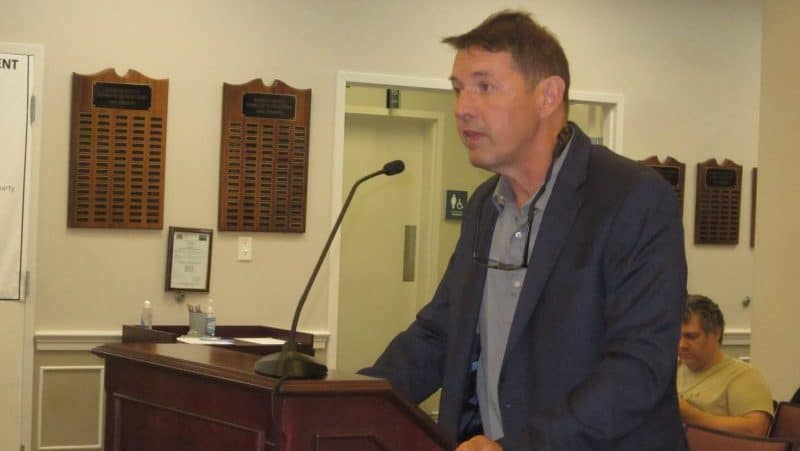
Former WC Public Schools Admin staffer Alan Fox recounts how Chester Gap F&R saved his life several years ago due to a rapid response time after he was struck by a car while changing a tire off the side of the road. Following her brother to the podium, Janet Fox-Monismith lauded the presence and quick emergency access of the Chester Gap F&R Station to not only her brother and family but all the Chester Gap-southern Warren County residents in times of emergencies.
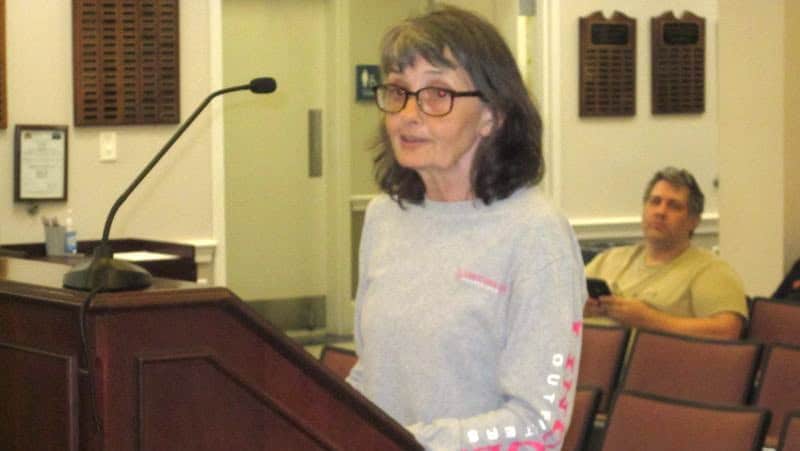
Fox’s sister, Janet Fox-Monismith, followed her brother to the podium. She recounted the accident’s aftermath. “They were there in three minutes. Alan had five brain bleeds and 15 broken ribs … but he survived. Chester Gap made that possible.”
Under the current funding structure, Warren County contributes about $178,000 annually—less than 5% of the public safety budget—to support Chester Gap’s paid EMS staff in coordination with Rappahannock County. The proposed FY26 budget removes that funding, which would eliminate paid coverage and leave only volunteers.
“This is not political,” said Lt. Kris Fulton of Chester Gap, who identified himself as a representative of the Chester Gap Fire & Rescue Company. “Fires double in size every 60 seconds. Brain damage begins in four to six minutes without oxygen. This is a life or death decision.”
Fulton, a U.S. Army veteran and career firefighter, pointed out that replacing Chester Gap with fully staffed county career responders would cost around $1 million annually. “We’re not a liability. We’re your best return on investment,” he told the supervisors.
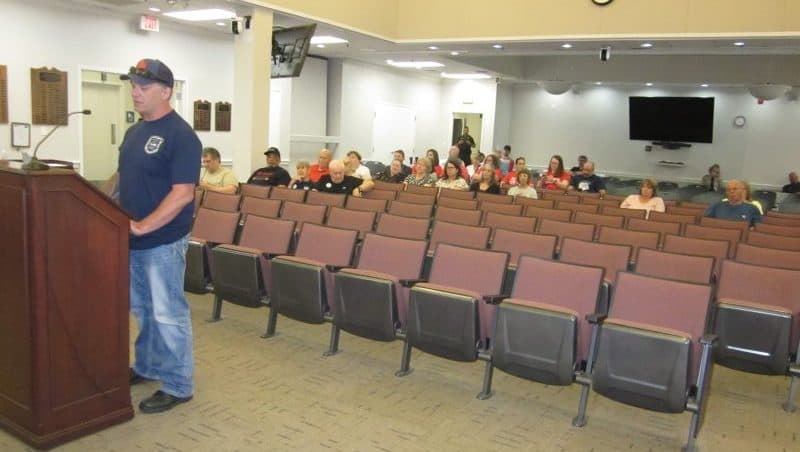
Chester Gap Station Lt. Kris Fulton told the supervisors adequate funding for paid personnel is more than a budget matter; it is a matter of Life & Death moving ahead for southern Warren County. Below, Lt. Fulton and another Chester Gap F&R Station supporter talk with their South River District rep Cheryl Cullers and Chairman ‘Jay’ Butler following the meeting’s 6:20 p.m. adjournment.
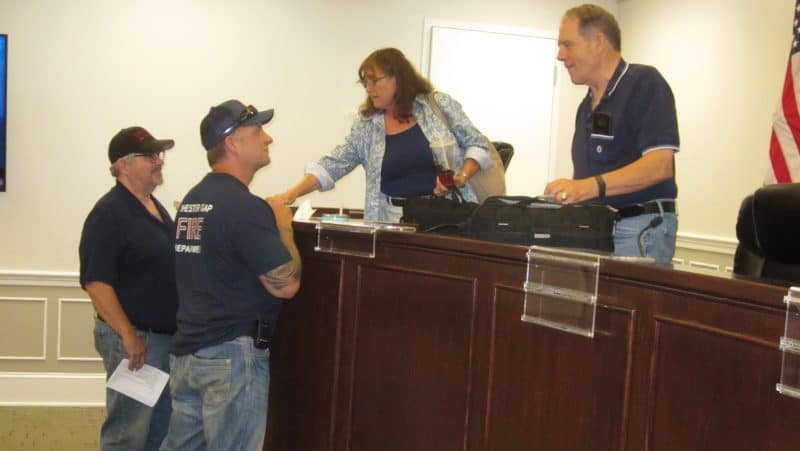
Fulton left the board with a final message: “Good business isn’t cutting things that work. It’s investing in systems that save lives and money. And Chester Gap does both.”
Supervisor Cheryl Cullers, in whose South River District Chester Gap lies, is a longtime supporter of the Chester Gap Fire & Rescue Department. She made her stance clear: “I have always championed Chester Gap, and I continue to do so. I don’t support the elimination of these positions. Lives cannot be replaced,” she told her colleagues.
But despite Fulton and Cullers ‘Life & Death’ public-hearing closing comments and the Fox family history heard earlier among all the citizen comments, these were words explaining a reluctance to provide the requested revenues for Public Schools, the Rappahannock-based Chester Gap Fire & Rescue Department, and likely other departmental and partner budgets as well.
Following the public hearing comments, several supervisors defended their budget cut decisions as being a consequence of tight economic times, diminished County revenue, and their stated opposition to public tax increases to provide needed revenue, even for a level of public services seeming to be desired by a majority of citizens addressing the issues publicly.
Supervisors response
Supervisor Rich Jamieson acknowledged the difficult financial choices before the board: “There’s no comfortable decision other than just to create the money and give everybody everything they need.”
Supervisor John Stanmeyer echoed those concerns, pointing to the shared staffing agreement with Rappahannock County. “Rappahannock has put us in a difficult position,” he said. “We don’t want to make these cuts, but we can’t spend what we don’t have.”
“We are in a tight place,” Stanmeyer said of the Public Schools budget. “The same is true for Chester Gap 2 (Fire & Rescue). We would like to be able to fund everything. But hard decisions need to be made, and sometimes it comes down to data-driven analysis,” Stanmeyer concluded.
Budget overview
Click here for the Fiscal Year 2025-2026 budget packet.
Warren County Finance Director Alisa Scott began the public hearing by outlining the key figures and structure of the proposed Fiscal Year 2025–2026 County Budget. She stated that the total proposed budget is $93,450,661, which represents a decrease of $1.5 million from the previous year’s amended budget.
Scott explained, “There is no tax rate increase included in this budget,” reaffirming that the real estate tax rate has remained flat for the fourth consecutive year.
She noted that while revenues have increased, the overall reduction in the budget is primarily due to the removal of one-time capital expenditures that were present in the FY-2025 budget, not because of any loss in local tax revenue. “Revenue growth continues to be strong, particularly in real estate assessments, meals and lodging taxes, and personal property tax,” Scott said.

At the meeting’s outset Finance Director Alisa Scott took the lead in responding to board questions about the overall perspective on the proposed FY-2026 budget.
Specifically, she highlighted that:
- Real estate tax revenue will increase due to property assessment growth, even though the rate remains unchanged.
- Personal property tax revenue is projected to total $15.4 million, down from $16.2 million the prior year, due to market adjustments in vehicle values.
- Sales tax revenue is estimated at $5.6 million, up from $5.2 million.
- Meal tax is expected to bring in $1.9 million.
- Lodging tax is projected at $1.2 million.
She emphasized the importance of prioritizing essential services within the confines of available revenue, stating: “This budget seeks to strike a balance between maintaining vital county services and recognizing the inflationary pressures residents are facing.”
Scott also confirmed that the proposed $750,000 increase for the school division is included in the budget, though she acknowledged the school board had requested significantly more—$1.147 million at minimum—adding that county staff had worked to meet as many priorities as possible.
No new positions are funded in this budget, and departments were asked to level-fund where possible. However, salaries were adjusted to include a 4% cost-of-living increase for county employees, which was necessary to remain competitive.
Scott concluded her remarks by noting that a balanced budget is required by law, and this budget accomplishes that, even in a year of “competing needs and limited flexibility.”
Royal Examiner video by Mark Williams.



Going Shopping? Don’t Forget to Ask About a Senior Discount

Virginia State Police Seize More Than $2.6 Million in Drugs During Weeklong Operations

Give Downtown Front Royal a Place to Sit

Warren County High School Welcomes E. Wilson Morrison Students After Emergency Closure

Warren Heritage Society Opens New Main Street Pocket Museum and Tour Headquarters

Carla Schwarck Slater (1947 – 2026)

PickleStock Returns to Warren County Fairgrounds September 12

William “Bill” John Mathers (1935 – 2026)

Trump Orders Commission to Explore Creation of U.S. Space Academy

First Warren County GOP Meeting Under Scott Lloyd Stalls in Procedural Disputes, Ends Without Officer Vote

Virginia Officials Announce Disbursement of $122 Million in Rural Health Transformation Fund Awards

If Virginia’s Reproductive Rights Amendment Passes, Challengers Say They’ll Fight to Overturn It in Court

Agritourism Summit Brings Farmers, Tourism Leaders and State Officials Together in Frederick County

Terry Wayne Foster (1962 – 2026)

Cottonwood Ranch Hosts Saturday Social With Live Music, Wine and Local Food

Business Growth Series: Why Simple Businesses Grow Faster

As Student Well-Being Concerns Grow, Virginia Advocates Push for Stricter School Tech Guidelines

With Six West Nile Cases Reported Statewide, Infected Mosquitos Are on the Rise in Virginia Beach

Commentary: A Pesticide-Free Farm Can Have Worse Soil Than One Sprayed With Roundup

Warren County Sheriff’s Office Foundation Expands Community Programs, Plans Fall Events

New Proposal from Grid Operator PJM Would Require Data Centers to Gring Their Own Power

Apple Wallet Adds Driver’s Licenses and IDs for Virginia Residents

Samuels Library Sets September Lineup With SamiCon, Community Programs and Family Activities

Virginia to Receive $353 Million in Landmark Meta Child-Safety Settlement
