
Seasonal
Thanksgiving 2018: revisiting a holiday wish and holidays lost
Acknowledging the season and a lost dream of peace for all…
I find celebrating Thanksgiving on November 22 a somewhat melancholy undertaking. I first reflected on the reason for that melancholy on Thanksgiving Day, November 22, 2007 while still with the paper* I co-founded a year earlier. Now, 11 years later we will again celebrate Thanksgiving on November 22 and I feel compelled to revisit words offered by an American president just over 55 years ago that were a call for thanksgiving around the world.
But first, why do I, the cultural cynic, hold this holiday in such high esteem? – Because it is a celebration of, not only cooperation between peoples striving for mutual respect and survival, but also the importance of family life to our own emotional survival.
So why do I feel compelled to share both my melancholy, as well as words of hope delivered over a half century ago with you this Thanksgiving? – Because we can all use a good dose of hope for a better tomorrow every once in awhile.
As for the melancholy – well, I won’t burden you with my theories as to exactly what led up to the events of November 22, 1963 in Dallas, Texas, when a U.S. President moving his country away from war, away from fear and separation, had his head blown off by a magic bullet for mythical reasons – no, I won’t do that today.


President John F. Kennedy reflects a spirit of playful banter with the White House press corp he did not view as an enemy of the people. Photos Kennedy Library/Public Domain
What I will do is urge you to transcend time, space or preconceived notions about political leadership to read the words of a U.S. President history now tells us helped keep the world’s two Superpowers of the post-World War II era from escalating a mutual security crisis into a nuclear war that would have made all of mankind’s best dreams and hopes moot, perhaps even extinct, points.
On June 10, 1963, just seven months after the world returned from the nuclear precipice of the Cuban missile crisis and just over five months before he was assassinated, President John Fitzgerald Kennedy delivered this Commencement Address on the campus of American University in Washington D.C. The speech is credited with propelling the United States and the Soviet Union past mutual mistrust toward a nuclear test ban treaty. Yes, while it may be hard to fathom for younger readers, the U.S. and Soviets both used to regularly detonate nuclear weapons of increasingly immense size in the atmosphere sending radioactive dust across the planet.
For some sense of brevity I have deleted Kennedy’s introduction acknowledging his hosts, the university’s graduating class, and some colleagues present, as well as some references to specific issues of the time.

John F. Kennedy’s American University Commencement Address, June 10, 1963:
“There are few earthly things more beautiful than a university,” wrote John Masefield, in his tribute to English universities – and his words are equally true today. He did not refer to spires and towers, to campus greens and ivied walls. He admired the splendid beauty of the university, he said, because it was “a place where those who hate ignorance may strive to know, where those who perceive truth may strive to make others see.”
I have, therefore, chosen this time and this place to discuss a topic on which ignorance too often abounds and the truth is too rarely perceived – yet it is the most important topic on earth: world peace.
What kind of peace do I mean? What kind of peace do we seek? Not a Pax Americana enforced on the world by American weapons of war. Not the peace of the grave or the security of the slave. I am talking about genuine peace, the kind of peace that makes life on earth worth living, the kind that enables men and nations to grow and to hope and to build a better life for their children – not merely peace for Americans but peace for all men and women – not merely peace in our time but peace for all time. I speak of peace because of the new face of war. Total war makes no sense in an age when great powers can maintain large and relatively invulnerable nuclear forces and refuse to surrender without resort to those forces. It makes no sense in an age when a single nuclear weapon contains almost ten times the explosive force delivered by 11 of the Allied air forces in the Second World War. It makes no sense in an age when the deadly poisons produced by a nuclear exchange would be carried by wind and water and soil and seed to the far corners of the globe and to generations yet unborn.

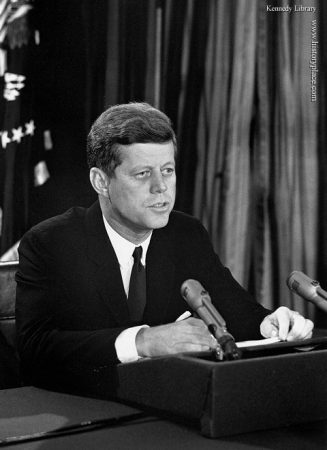
President Kennedy addressing the nation on television during the Cuban Missile Crisis; Russian documents released after the collapse of the Soviet Union indicted Russian submarines with nuclear-tipped torpedoes had been ordered to fire on American warships had they attempted to board Soviet ships transporting missile parts to Cuba during America’s blockade of those transports.
Today the expenditure of billions of dollars every year on weapons acquired for the purpose of making sure we never need to use them is essential to keeping the peace. But surely the acquisition of such idle stockpiles – which can only destroy and never create – is not the only, much less the most efficient, means of assuring peace.
I speak of peace, therefore, as the necessary rational end of rational men. I realize that the pursuit of peace is not as dramatic as the pursuit of war – and frequently the words of the pursuer fall on deaf ears. But we have no more urgent task.
Some say that it is useless to speak of world peace or world law or world disarmament – and that it will be useless until the leaders of [other nations] adopt a more enlightened attitude. I hope they do. I believe we can help them do it. But I also believe that we must reexamine our own attitude – as individuals and as a nation – for our attitude is as essential as theirs. And every graduate of this school, every thoughtful citizen who despairs of war and wishes to bring peace, should begin by looking inward – by examining his own attitude toward the possibilities of peace …

First: Let us examine our attitude toward peace itself. Too many of us think it is impossible. Too many think it unreal. But that is a dangerous, defeatist belief. It leads to the conclusion that war is inevitable – that mankind is doomed – that we are gripped by forces we cannot control.
We need not accept that view. Our problems are manmade – therefore they can be solved by man. And man can be as big as he wants. No problem of human destiny is beyond human beings. Man’s reason and spirit have often solved the seemingly unsolvable – and we believe they can do it again.
I am not referring to the absolute, infinite concept of universal peace and good will of which some fantasies and fanatics dream. I do not deny the value of hopes and dreams, but we merely invite discouragement and incredulity by making that our only and immediate goal.
Let us focus instead on a more practical, more attainable peace – based not on a sudden revolution in human nature but on a gradual evolution in human institutions – on a series of concrete actions and effective agreements, which are in the interest of all concerned. There is no single, simple key to this peace – no grand or magic formula to be adopted by one or two powers. Genuine peace must be the product of many nations, the sum of many acts. It must be dynamic, not static, changing to meet the challenge of each new generation. For peace is a process – a way of solving problems.

With such a peace, there will still be quarrels and conflicting interests, as there are within families and nations. World peace, like community peace, does not require that each man love his neighbor – it requires only that they live together in mutual tolerance, submitting their disputes to a just and peaceful settlement. And history teaches us that enmities between nations, as between individuals, do not last forever. However fixed our likes and dislikes may seem, the tide of time and events will often bring surprising changes in the relations between nations and neighbors …
No government or social system is so evil that its people must be considered as lacking in virtue. As Americans, we find communism profoundly repugnant as a negation of personal freedom and dignity. But we can still hail the Russian people for their many achievements – in science and space, in economic and industrial growth, in culture and in acts of courage …
So, let us not be blind to our differences – but let us also direct attention to our common interests and to the means by which those differences can be resolved. And if we cannot end now our differences, at least we can help make the world safe for diversity. For, in the final analysis, our most basic common link is that we all inhabit this small planet. We all breathe the same air. We all cherish our children’s future. And we are all mortal.
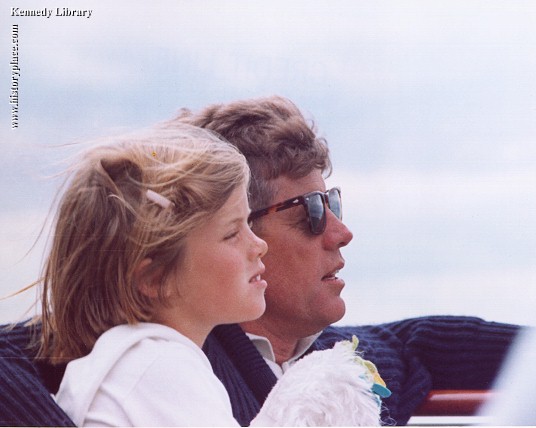
John Kennedy relaxes at sea with daughter Caroline.
Above all, while defending our own vital interests, nuclear powers must avert those confrontations, which bring an adversary to a choice of either a humiliating retreat or a nuclear war. To adopt that kind of course in the nuclear age would be evidence only of the bankruptcy of our policy – or of a collective death wish for the world …
For we can seek a relaxation of tensions without relaxing our guard; and, for our part, we do not need to use threats to prove that we are resolute … We are unwilling to impose our system on any unwilling people – but we are willing and able to engage in peaceful competition with any people on earth.
For there can be no doubt that, if all nations could refrain from interfering in the self-determination of others, the peace would be much more assured … This will require a new effort to achieve world law – a new context for world discussions. It will require increased understanding … And increased understanding will require increased contact and communication …
Finally, my fellow Americans, let us examine our attitude toward peace and freedom here at home. The quality and spirit of our own society must justify and support our efforts abroad. We must show it in the dedication of our own lives … we must all, in our daily lives, live up to the age-old faith that peace and freedom walk together. In too many of our cities today, the peace is not secure because freedom is incomplete.
It is the responsibility of the executive branch at all levels of government – local, state and national – to provide and protect that freedom for all of our citizens by all means within their authority …
All this is not unrelated to world peace. “When a man’s ways please the Lord,” the Scriptures tell us, “he maketh even his enemies to be at peace with him.” And is not peace, in the last analysis, basically a matter of human rights – the right to live out our lives without fear of devastation – the right to breathe air as nature provided it – the right of future generations to a healthy existence?
While we proceed to safeguard our national interests, let us also safeguard human interests. And the elimination of war and arms is clearly in the interest of both. … The United States, as the world knows, will never start a war. We do not want a war. We do not now expect a war. This generation of Americans has already had enough – more than enough – of war and hate and oppression. We shall be prepared if others wish it. We shall be alert to try to stop it. But we shall also do our part to build a world of peace where the weak are safe and the strong are just. We are not helpless before that task or hopeless of its success. Confident and unafraid, we labor on – not toward a strategy of annihilation but toward a strategy of peace.
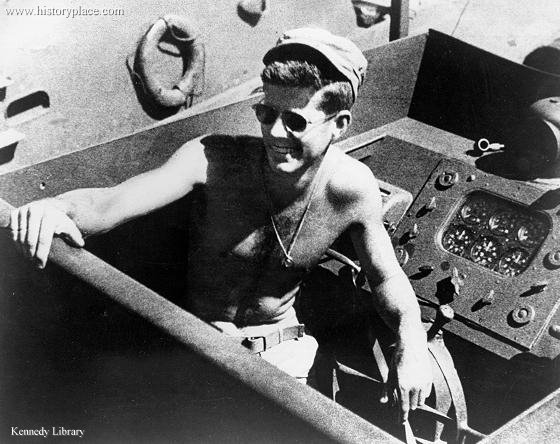
Kennedy had seen the face of war. He was credited with saving one injured crewman’s life after his boat PT 109 was sunk in combat with a Japanese destroyer during World War II.
Postscript: Unfortunately, history tells us Kennedy’s vision expressed that day of a peaceful future of cooperation and communication with, not only this nation’s allies, but its adversaries as well, died with the President five months later on the streets of Dallas, Texas. Kennedy’s verbal message “the hawks are rising,” delivered to Soviet Premier Nikita Khrushchev during the Cuban Missile Crisis, expressing the political and military climate he was operating in, has largely held sway since November 22, 1963 from the jungles of Vietnam, to the deserts of the Middle East, and now at a still-rising cost of about $25 million over the past month, it would seem even at our southern border with Mexico.
But hope springs eternal as a sage philosopher once said – and why not hope for a better tomorrow this Thanksgiving Day, 2018? It will just take the effort to see through the lie at the root of so many conflicts: the lie that we are so fundamentally different from “the others” that there can be no common ground for dialogue or human compassion between our “tribes”. If we continue to buy into that lie, then in the end will we all be nothing more than pawns in the hands of those for whom the acquisition of wealth and power for wealth and power’s sake is the cynical and ultimate meaning of the universe?
Happy Thanksgiving – and hoping for a better tomorrow – this November 22, 2018.

President Kennedy leaves the White House for the final time
*Footnote: Warren County Report




Samuel’s Public Library Packs October With Programs for All Ages

EPA to Give $90M for Clean Water and Restoration Projects in Chesapeake Bay Watershed, 28 in Virginia

Hiring Slows in September with Job Growth of 29K

Avis Arline Earley (1930 – 2026)

Josh Ingram Seeks Another Term on Front Royal Council, Points to Water, Jobs and Data Centers

The Collective Farms in Your Grocery Cart

Mayor Lori Athey Cockrell Looks to Water, Economic Development and Rail Trail in Another Term

WCHS vs. Brentsville HS – Girls Volleyball – October 6, 2026

BMI Is Only One Piece of the Health Picture

The Eye Surgery Factory That Could Not Expand

Ancient Ownership of Israel

VDOT: Warren County Traffic Alert for October 5 – 9, 2026

Reaching Out Now Expands Programs and Opportunities for Warren County Youth

Dance and Arts VA Finds New Home, New Opportunities on Water Street

Ann L. Shuman (1933 – 2026)

Wendy Lee Whitacre-Stout (1966 – 2026)

Spanberger’s Energy Plan Keys in on Clean Energy to Meet Growing Demand and VCEA Goals

Jean Elizabeth Grubbs Fogle (1939 – 2026)

Feds Provide Guidance on New Federal K-12 Scholarship Tax Credit Program

Why Wait Till November? Mid-Term Election Early Voting Processes in Place Now

US Senate Leaves Nation’s Capital in Advance of Midterms With Much Still Undone

Business Growth Series: If You Don’t Control Your Day, It Controls Your Business

The End of a 20-Year Monopoly on the Credit Score
Voltron and Immigration
