
State News
The 10 Most Important Things That Happened in Virginia’s 2026 Legislative Session
Virginia lawmakers wrapped up the 2026 General Assembly session in dramatic fashion Saturday evening, adjourning their regular session without a budget deal after an unexpected dispute over data center tax breaks fractured negotiations among Democrats who otherwise controlled every lever of power in Richmond.
The standoff overshadowed what had otherwise been a consequential session for Democrats, who entered the year with a newly minted trifecta and an ambitious policy agenda.

People gather in the rotunda of the Virginia State Capitol in the final days of the 2026 legislative session. (Photo by Charlotte Rene Woods/ Virginia Mercury)
With Gov. Abigail Spanberger in the executive mansion and Democratic majorities in both the House of Delegates and the Senate, lawmakers moved swiftly to pass a wide range of priorities that had stalled in previous years under divided government.
Affordability became the central theme of the session. Spanberger and legislative leaders framed their agenda around lowering costs for Virginians while expanding worker protections and consumer safeguards.
In a statement, Spanberger spokesman Jack Bledsoe said the governor views the session as an important step toward addressing the cost pressures facing many Virginians.
“Governor Spanberger is grateful to legislators for their work to address the top-of-mind challenges facing Virginia families,” Bledsoe said.
“The governor is encouraged to see lawmakers prioritize making the commonwealth a more affordable place to live — including by passing the entire Affordable Virginia Agenda to lower the cost of housing, healthcare, and energy that she and General Assembly leaders announced in December.”
Bledsoe added that Spanberger “looks forward to reviewing all legislation that reaches her desk as she continues to focus on lowering costs for families, growing Virginia’s economy, and strengthening Virginia’s schools to make sure every student is set up for success.”
Stephen Farnsworth, a political scientist at the University of Mary Washington, said that when all the leaders in the executive and legislative branches belong to the same party, “that’s when the fights get interesting.”
Although Democrats now control the legislature and governor’s office, Farnsworth said, “there are still big decisions to be hammered out regarding the budget and the regulation of data centers, to name two things.”
Over the course of the session, lawmakers approved an expansive set of proposals that reflected long-standing Democratic priorities.
They advanced a controversial mid-decade congressional redistricting referendum, approved sweeping gun-control legislation including an assault-style weapons ban, and sent constitutional amendments on reproductive rights, voting rights restoration, and marriage equality to voters.
Lawmakers also passed a phased minimum wage increase to $15 an hour, created a framework for a legal cannabis retail market, and approved a Prescription Drug Affordability Board, while advancing housing policies aimed at increasing supply near job centers.
They also expanded worker protections, including paid leave proposals, and approved legislation limiting cooperation between state agencies and federal Immigration and Customs Enforcement, fulfilling a campaign promise from Spanberger’s 2025 campaign.
Another measure approved this year would update the process by which the General Assembly reviews and confirms certain gubernatorial appointments, refining the procedures lawmakers use to evaluate nominees to state boards, university governing bodies, commissions, and other positions.
Democrats pursued those initiatives while defending their broader affordability platform against an aggressive political pushback from Republicans, who repeatedly warned that the agenda relied too heavily on tax increases.
Several proposed revenue measures — including taxes on services such as dog walking, firearms, and gym memberships — drew criticism but were either scaled back, defeated, or never taken up by lawmakers.
“Republicans are going to paint Democrats as high-tax, regardless of the level of evidence that can be offered,” Farnsworth said. “It’s a narrative that finds resonance with voters.” But the reality of a large Democratic majority in the House, he added, means that more aggressive proposals introduced by some lawmakers rarely advance.
“When you’re the speaker, you can toss overboard the most extreme eight or so members of your caucus and their initiatives whenever you need to,” Farnsworth said.
Despite the late budget impasse, Farnsworth said Democrats are likely to view the session as a success.
“I think for Democratic activists, this session has been a significant and productive one,” he said, pointing to the in-progress constitutional amendments and the redistricting referendum.
“Those will all be big wins, if the voters authorize these adjustments to the Constitution.”
1. Spanberger’s inauguration and the start of unified Democratic control
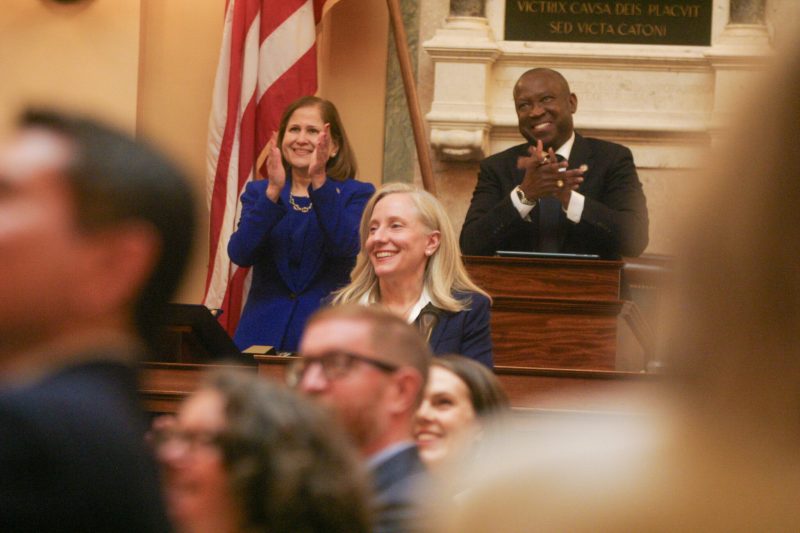
Gov. Abigail Spanberger gives her first address to the joint General Assembly on Jan. 19, 2026 in Richmond. (Photo by Shannon Heckt/Virginia Mercury)
On Jan. 17, three days after the General Assembly convened for its 2026 session, Democrat Abigail Spanberger was sworn in as Virginia’s 75th governor, becoming the first woman to lead the commonwealth and ushering in a new era of unified Democratic control of state government.
Standing on the steps of the Virginia Capitol in Richmond, Spanberger called the peaceful transfer of power “a cornerstone of our American democratic experiment” and reflected on generations of women who fought for the right to vote and hold office.
Her inauguration marked the start of a Democratic trifecta in Richmond, with Ghazala Hashmi sworn in as lieutenant governor — the first Indian American and Muslim woman elected to statewide office in the state — and Jay Jones as attorney general, who became the first Black man to earn the role. The moment underscored a broader political shift after years of divided government.
Within hours of taking office, Spanberger signed a package of executive orders aimed at lowering costs for families, strengthening public schools and reviewing housing and health care policies. She also rescinded a directive from former Gov. Glenn Youngkin requiring state and local law enforcement to assist federal immigration enforcement.
2. The mid-decade congressional redistricting referendum
Democrats’ push for a mid-decade congressional redistricting referendum became one of the most contentious issues of the 2026 General Assembly session, unfolding through legislation, court fights, and often divisive political campaigns.
The effort traces back to late 2025, when Democratic lawmakers approved a constitutional amendment allowing Virginia to redraw congressional districts outside the normal 10-year census cycle if other states engage in aggressive partisan redistricting. The General Assembly gave the measure final passage in January, sending the question to voters in a statewide referendum.
Soon after, Democrats released a proposed congressional map, significantly reshaping Virginia’s delegation in Washington, potentially giving the party an advantage in most of the state’s 11 districts.
Republicans challenged the measure in court, filing lawsuits that briefly blocked election preparations before the Supreme Court of Virginia allowed the referendum to move forward, while litigation continues.
Early voting began March 6 ahead of the April 21 referendum, with former President Barack Obama and Gov. Abigail Spanberger urging Virginians to support the amendment.
3. Assault weapons ban and gun-control package
Democrats used their new governing majority to advance the most sweeping firearms restrictions considered in Virginia in years, culminating in the passage of an assault-weapons ban and several related measures.
Early in the session, the House of Delegates approved a broad gun-control package that included a prohibition on the sale of assault-style firearms and large-capacity magazines, along with new storage rules and expanded liability for the gun industry. Republicans strongly opposed the legislation, arguing it infringed on Second Amendment rights and would likely face legal challenges.
The proposal moved through both chambers over several weeks as Democrats said the restrictions were necessary to address gun violence and mass shootings. Under the legislation, the purchase, sale, import, and manufacture of assault-style firearms would be prohibited, while people who already legally own them could keep them.
By early March, the General Assembly had approved the measure and sent it to Spanberger’s desk, positioning Virginia to join other states with similar bans if it becomes law.
4. Three constitutional amendments on civil rights
Another major focus of the 2026 session was a trio of proposed constitutional amendments dealing with reproductive rights, voting, and marriage equality — the culmination of a multi-year Democratic effort to rewrite key provisions of Virginia’s constitution.
The proposals first passed the General Assembly during the 2025 session, beginning the two-session process required to amend the state Constitution. Lawmakers gave them final legislative approval early in the 2026 session.
One measure would enshrine reproductive rights in the Constitution, another would automatically restore voting rights to people who have completed felony sentences, and a third would remove Virginia’s long-dormant ban on same-sex marriage.
Spanberger signed legislation in February formally sending the amendments to voters for statewide referendums later this year.
The push also sparked legal challenges from opponents who argued lawmakers violated procedural requirements for constitutional amendments. But new legislation approved this year could weaken those claims as courts consider the cases.
If voters approve them, the measures would permanently embed those protections in Virginia’s Constitution.
5. Budget showdown and the data-center tax break fight
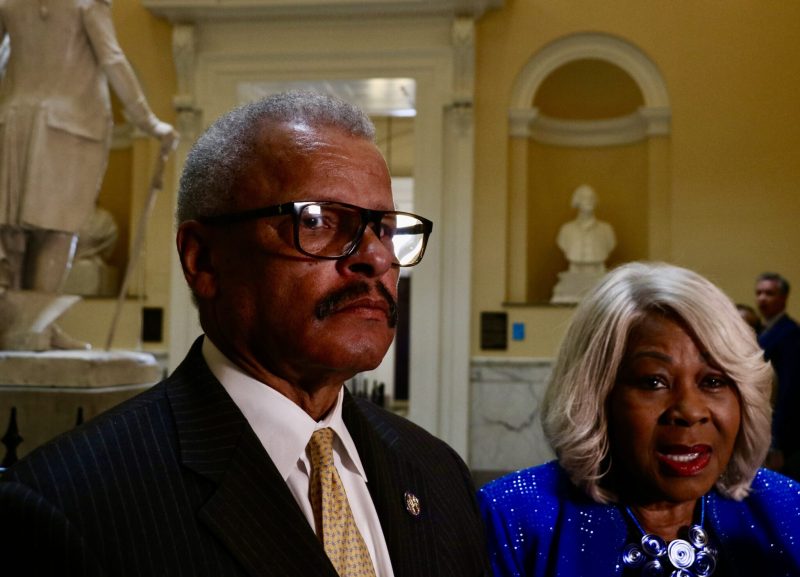
House Appropriations Committee Chair Luke Torian, D-Prince William, and Senate Finance and Appropriations Committee Chair Louise Lucas, D-Portsmouth, speaking to reporters about ongoing budget negotiations that have stalled over data center tax exemptions, Friday, March 13, 2026. (Photo by Charlotte Rene Woods/Virginia Mercury)
An unexpected fight over data center tax incentives derailed Virginia’s budget negotiations and forced lawmakers to adjourn the 2026 General Assembly session without approving a new spending plan — despite Democrats controlling both chambers and the governor’s office.
The dispute centered on a long-standing retail sales and use tax exemption that allows large data centers to avoid paying taxes on expensive computer equipment and related infrastructure. The industry has grown rapidly in Virginia, where the incentives have helped make the state the world’s largest data-center hub.
During budget negotiations, Senate Democrats proposed eliminating the tax break, which they said would generate roughly $1 billion in additional revenue for the state budget. House leaders and Spanberger opposed the change, arguing Virginia should honor commitments made to companies that invested under the incentive program.
The disagreement prevented budget conferees from reaching a compromise before the session’s adjournment deadline. Spanberger is expected to call lawmakers back to Richmond for a special session once negotiators finalize a budget agreement.
6. Minimum wage increase to $15 an hour
Another major economic policy change to emerge from the 2026 General Assembly was legislation raising Virginia’s minimum wage to $15 an hour over the next several years — a proposal Democrats had attempted in earlier sessions but that stalled under Youngkin.
The legislation, carried as House Bill 1 and Senate Bill 1, codifies Virginia’s current minimum wage of $12.77 per hour and establishes a series of scheduled increases. Under the measure, the statewide minimum wage would rise to $13.75 on Jan. 1, 2027, and reach $15 per hour on Jan. 1, 2028.
Both the House of Delegates and the Senate approved the plan largely along party lines during the 2026 session, marking one of the most significant labor policy changes lawmakers considered this year.
Supporters argued the gradual increase would help workers keep up with rising living costs, while many Republicans and business groups warned it could raise costs for employers. Spanberger said she intends to sign the bill, positioning Virginia to join a growing number of states that have adopted a $15 minimum wage.
7. Cannabis retail market legalization effort
Five years after Virginia legalized possession of small amounts of marijuana, lawmakers in 2026 finally approved legislation establishing a regulated retail market for adult-use cannabis. The General Assembly had repeatedly passed similar proposals in previous years, but those efforts were vetoed by Youngkin.
This year, with a Democratic governor in office, both chambers approved legislation creating a statewide licensing system, tax structure, and regulatory framework for cannabis sales overseen by the state’s Cannabis Control Authority.
The House and Senate bills were largely identical but differed on when stores could begin operating. The House version would have allowed sales to start Nov. 1, 2026, while the Senate proposal set a later launch date of Jan. 1, 2027.
The disagreement sent the legislation to a conference committee and delayed final approval until the closing hours of the legislative session. Lawmakers ultimately adopted the Senate timeline, clearing the way for Virginia’s first legal recreational cannabis sales beginning early next year.
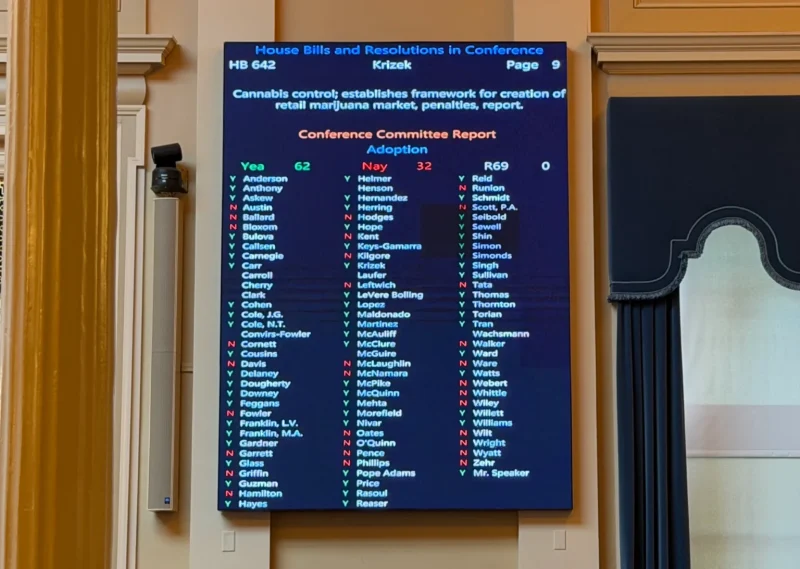
Five years after Virginia legalized adult-use cannabis, the General Assembly approved legislation to finally create a retail market on the final day of the 2026 legislative session, March 14. The Senate passed the bill 21–18 on Friday, and the House approved it by 64-32. If enacted, retail sales would begin Jan. 1, 2027. (Photo by Markus Schmidt/Virginia Mercury)
8. Prescription Drug Affordability Board
After years of failed attempts, Virginia lawmakers in 2026 moved closer than ever to creating a Prescription Drug Affordability Board, a proposal aimed at tackling the high cost of medications.
Democrats had pushed versions of the measure for several sessions, but Youngkin vetoed similar legislation in 2024 and 2025, saying it could discourage pharmaceutical innovation and investment.
This year, lawmakers revived the effort with new legislation establishing an independent panel of medical and policy experts tasked with reviewing high-cost prescription drugs and determining whether price limits should apply in certain state health plans.
Supporters say the board could help rein in rapidly rising medication prices and give Virginia greater leverage when negotiating drug costs. Opponents, including pharmaceutical industry groups, warn it could reduce access to new treatments.
The proposal advanced through both chambers during the 2026 session as part of a broader affordability agenda championed by Spanberger, positioning Virginia to join a small but growing group of states experimenting with drug-price oversight.
9. Housing and “housing near jobs” legislation
Housing affordability emerged as another major theme of the 2026 General Assembly session, with lawmakers advancing a slate of bills aimed at increasing the state’s housing supply and easing zoning restrictions.
One centerpiece proposal — often described as the “housing near jobs” initiative — would require local governments to allow by-right construction of multifamily housing, townhomes and mixed-use developments in certain commercial corridors, reducing barriers to building new homes in areas close to employment centers.
Supporters argued the changes are needed to address Virginia’s growing housing shortage and rising rents, particularly in fast-growing metropolitan areas. Home-building groups and housing advocates said the reforms could make it easier for developers to add new units and help localities expand their housing stock.
Although local-control concerns prompted pushback from some lawmakers and local officials, versions of the housing bills cleared both the House and Senate, positioning them for final action by Spanberger.
10. Worker benefits and labor protections
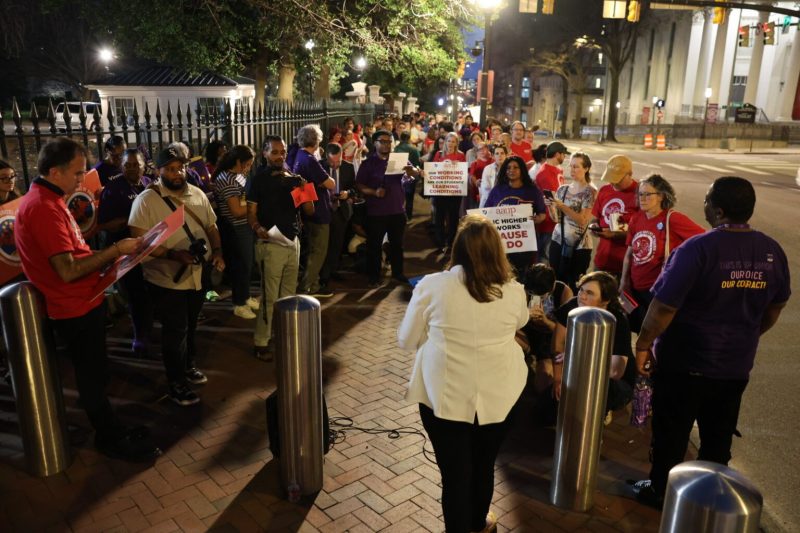
Virginia workers call on lawmakers to expand collective bargaining to all employees outside of the state Capitol building in Richmond on March 11, 2026 (Photo by Nathaniel Cline/Virginia Mercury)
Another major labor issue debated during the 2026 session involved proposals to expand paid leave protections for workers, including both paid sick days and a statewide paid family and medical leave program.
Democrats revived the effort after similar legislation had stalled in previous years and had been vetoed by Youngkin. Advocates argued the proposals would give workers more security when dealing with illness, caring for family members, or welcoming a new child.
One bill approved by the House would require employers to provide paid sick leave that workers could accrue based on hours worked, a policy supporters say would benefit the roughly 1.2 million Virginians who currently lack paid sick days.
Lawmakers also advanced legislation establishing a state-run paid family and medical leave insurance program, allowing workers to take up to 12 weeks of leave while receiving a portion of their wages.
In the final days of the legislative session, university employees rallied at the Capitol in support of a measure to repeal Virginia’s ban on collective bargaining for state employees, and pushed for state college workers and home health employees to be afforded bargaining rights.
The proposal passed the House Saturday on a 62-34 vote.
Together, the measures reflected Democrats’ broader push to strengthen workplace protections during their first session, controlling both the legislature and the governor’s office.
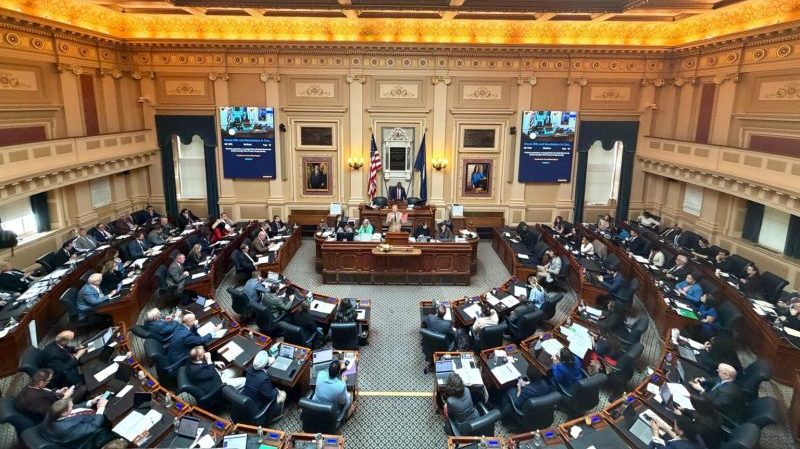
The House of Delegates convened on March 14, the final day of the 2026 legislative session. (Photo by Markus Schmidt/Virginia Mercury)
by Markus Schmidt, Virginia Mercury
Virginia Mercury is part of States Newsroom, a nonprofit news network supported by grants and a coalition of donors as a 501c(3) public charity. Virginia Mercury maintains editorial independence. Contact Editor Samantha Willis for questions: info@virginiamercury.com.

‘The Revenant: A Novel of Revenge’

Virginia Lawmakers Close 2026 Session With Focus on Lowering Costs

The 10 Most Important Things That Happened in Virginia’s 2026 Legislative Session

Electric Vehicle Market Adjusts as Industry Rethinks the Road Ahead

Cultures Around the World Mark the Spring Equinox With Unique Traditions

Laurel Ridge to Host 46th Annual Spring Follies: “Back to the ’90s”

Love Revival to Host Free Community Easter Celebration in Front Royal

Salvation Army of Front Royal Plans Annual Dinner and Raffle Fundraiser

Stephen Paul Sill (1955 – 2026)

Virginia Seeks Public Input for 2026 Statewide Rail Plan

Front Royal Craftsmen Revive Centuries-Old Timber Framing Tradition

VDOT: Warren County Traffic Alert for March 16 – 20, 2026

Virginia Lawmakers End Session Without Final Budget

Your Personal Mission Statement: A Guide to Getting What You Want Out of Life
Disappointed In Our Olympic Spirit

How St. Patrick’s Day Became America’s Biggest Irish Party

Virginia State Police Urge Sober Plans for Saint Patrick’s Day Celebrations

In a One-Party County, Internal Party Decisions Affect Us All

Virginia State Police Seize Nearly 100 Pounds of Narcotics, Recover Firearms in Weekly Crime Suppression Effort

Barton Charles “Bart” Haller (1940 – 2026)

Dawn Lee Dodson (1970 – 2026)

Mary Helen “Nanny” Spires Johnt (1954 – 2026)

Another Round of ‘Momnibus’ Bills Are Headed Towards the Governor This Year

Virginia Joins States Challenging Trump Admin Regulations That Limit Free Birth Control Access
