
Local Government
Town moving to include 2018 Corridor Amendment into Town Codes
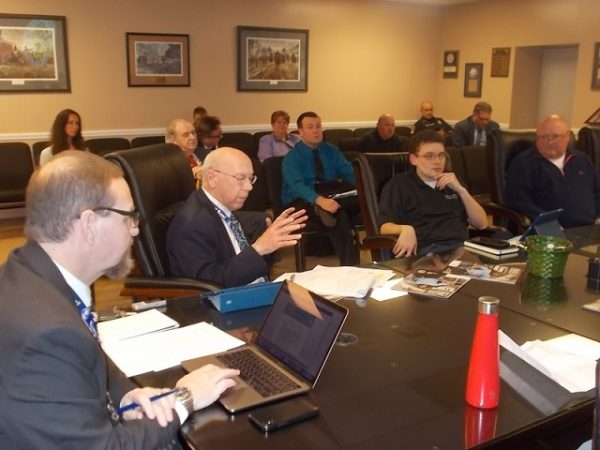
At an April 16 work session, Town Attorney Doug Napier briefed the Front Royal Town Council on the dynamics of further formalization to updates to the Town-County Voluntary Settlement Agreement regarding development and the Town’s provision of central water-sewer utilities enabling that development on County land in the Route 340/522 North Commercial-Industrial Corridor. The agreement dates to 1998 and was a first of its kind municipal arrangement in Virginia approved by a three-judge panel.
The proposal presented by the town attorney would make changes recently approved by both the town and county governments a part of Town Codes. Napier’s agenda packet summary states that “because the provision of water and sanitary sewer services are essential public services, they are required to be provided to all customers on a materially equal basis. For this reason, experience has shown that these utility contracts, including the PILOT (“Payment-In-Lieu-Of-Taxes”) contracts, are best included as a model in the Town Code, so all potential customers in the Corridor know up front what to expect when negotiating with the Town and County to locate in the Corridor.”
As previously reported, concerns expressed by the corridor’s newest proposed restaurant client Chic-fil-A prompted the move to formalization of a 2015 Memorandum of Agreement (MOA). According to staff summaries Chic-fil-A worried at the informal nature of the MOA that allowed either side to pull out of the agreement on short notice; potentially leading the Town to re-impose meals tax-based fees, potentially doubling a corridor restaurant’s meals tax.
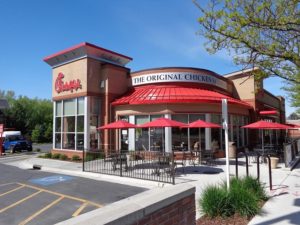
The pending arrival of Chic-fil-A to the North Commercial Corridor has prompted a flurry of legal activity between the Town and County to assure continued cooperation on corridor-generated revenue to both municipalities. Photo/Public Domain
The Warren County Board of Supervisors approved a Resolution approving formalization of the 2015 MOA between the Town and County on April 3. The Front Royal Town Council followed suit on April 9.
As Royal Examiner reported in covering the progress of the 2018 Amendment to the 1998 Voluntary Settlement Agreement, the 2015 MOA ended six years of often contentious negotiations between the Town and County. Those negotiations focused on replacing revenues lost to the town government following a 2009 Circuit Court decision that removed an estimated $600,000 to $800,000 in annual Meals and Lodging Tax-based PILOT (Payment In Lieu Of Taxes) fees from the Town’s corridor revenue stream.
That 2009 court ruling sided with three corridor restaurants (TGIFridays, Applebee’s and Cracker Barrel) that contended in part that the meals tax portion of PILOT fees wasn’t actually a tax on the businesses as allowed in the Voluntary Settlement Agreement, but was a “pass-through” tax on customers.
The 1998 Voluntary Settlement Agreement was formulated so as to place corridor businesses receiving Town central water-sewer utilities on an equal financial footing with in-town businesses that pay both County and Town taxes. Corridor businesses receiving central Town water-sewer utilities continue to pay other PILOT fees corresponding to town taxes that in-town businesses pay.
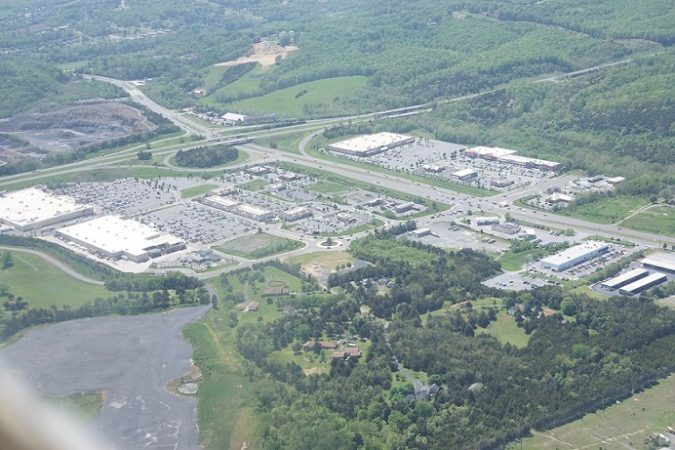
Looking southwest, an aerial view of the Rt. 340/522 North Commercial Corridor – Riverton Commons is to the left and Crooked Run to right. Crooked Run Phase 2 will expand that shopping center to the west, or further right along I-66 in photo. Photo/Roger Bianchini & CassAviation
The 2015 MOA mandated that the County pay the Town 30% of the revenue realized from its corridor Meals Taxes and 5% of its Lodging Tax revenue. While some Town staff and elected officials felt those numbers were light in compensating the Town, they were and continue to be viewed by a council majority as preferable to the potential of high legal fees to continue a hostile negotiation for a larger share of the corridor tax pie.
According to Front Royal Finance Director B.J. Wilson, over the past two fiscal years that 2015 MOA-generated revenue has totaled about $465,000, $227,874 in FY17 and an estimated $237,252 in FY18. The County pays the Town in two installments in December and June of each fiscal year.
As noted by the town finance director, the great bulk of those payments are from the meals tax portion of the arrangement, as illustrated by the FY17 split of $225,266 in meals tax revenue and just $2,608 from the 5% lodging tax aspect of the payment. According to auditors the County collected $782,066 in corridor meals tax in FY17 and $52,619 in corridor-associated lodging tax.
The 2018 Amendment to the three-year-old MOA also adds the land targeted for the Crooked Run West expansion to the 1998 Voluntary Settlement Agreement, and perhaps most importantly to the County places a formal 25-year moratorium (to 2043) on the Town’s ability to launch annexation proceedings on County land in the northside commercial-industrial corridor.
The proposed amendment to the Town Code will further formalize and codify the 2018 Amendment approved earlier this month by both municipalities.

Virginia Joins Multi-State Lawsuit Challenging Trump’s Election Order

Trump Budget Seeks 43% Boost in Defense Spending, Cuts in Many Domestic Programs

Virginia Sees 33,000 ACA Enrollment Drop Since Subsidies Expired, More Likely on the Way

Annual Dental Checkups and Cleanings: Essential Appointments

4 Stimulating Activities for a Healthy Brain After 50

The First Amendment: America’s Unique Foundation of Freedom

How to Tackle Credit Card Debt

Summer Enrichment Camp Gives Teens Hands-On Learning Opportunities

VDOT: Warren County Traffic Alert for April 6 – 10, 2026

David Silek to Remain in Chairman’s Seat of WC Republican Committee Pending 6th District Appeal Decision

Sales Set to Bloom Like Daffodils This Spring

America 250: The Bookseller Who Helped Save the Revolution

Business Growth Series: Why Good Businesses Still Struggle to Grow

Brownies with Mini Chocolate Easter Eggs

Shenandoah Downs Opens 11th Season April 11 with Tribute to Roger Hammer

We Don’t Know Everything About DNA

How PAAS Came to Dominate the Easter Egg Dye Tradition

Spanberger Signs Bipartisan School-Safety, Student Support Bills Into Law

Melanie J. Pomeroy (1958 – 2026)

David Benjamin Heller (1990 – 2026)
1776 Wasn’t Just About Independence

Three-Tiered System for Urban Agriculture Based on Lot Size Takes Shape at Town Planning Commission Work Session

Child Abuse Awareness Month Brings Focus to Reporting, Prevention in Warren County

National Dental Hygienists Week: Is Your Oral Care Routine Optimal?
