
Local Government
Town Planning Commission Holds Preliminary Discussion of Regulation for Data Centers
“We know what not to do,” Planning Director Lauren Kopishke stated at the Wednesday, August 6 work session of the Town Planning Commission, amid a preliminary discussion of data center regulation. Her statement highlighted the history of data centers, which, through extravagant use of resources, have led many to view them as wasteful and even maleficent. Of course, technology is advancing rapidly, and already there are indications that data centers may be able to operate, providing processing services and bringing in a sizable tax revenue for the municipality, without creating hardship.
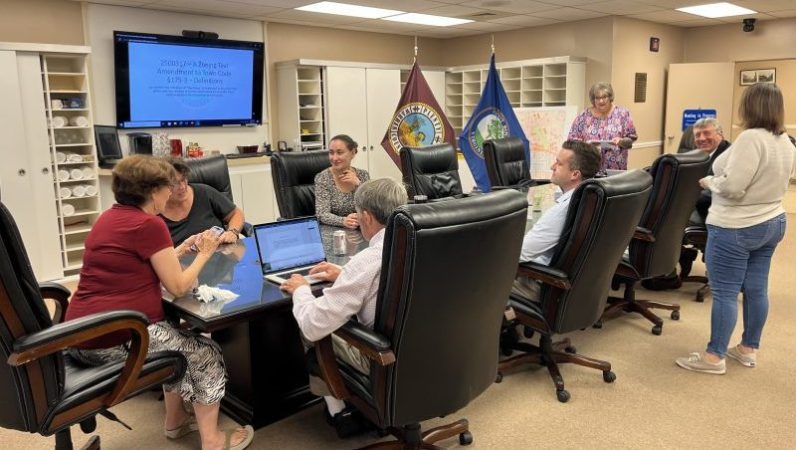
The Town Planning Commission settles into a work session on the evening of Wednesday, August 6. Royal Examiner Photo Credits: Brenden McHugh.
The planning and zoning department walks the edge of a knife. By introducing regulations for data centers into the zoning code, Kopishke risks a dissatisfied demographic that views any concession to data centers as a pact with Satan. However, if no performance standards are articulated, and even if the Town government expressly prohibited data centers, a veritable clown cart of consequences could be unleashed. It could spell a loss of local control as developers go ahead unharnessed, or, in the case of a ban, litigate for the reasonable use of their property and possibly win, whereupon they could proceed with their projects in the absence of the regulations that were not established in the first place.
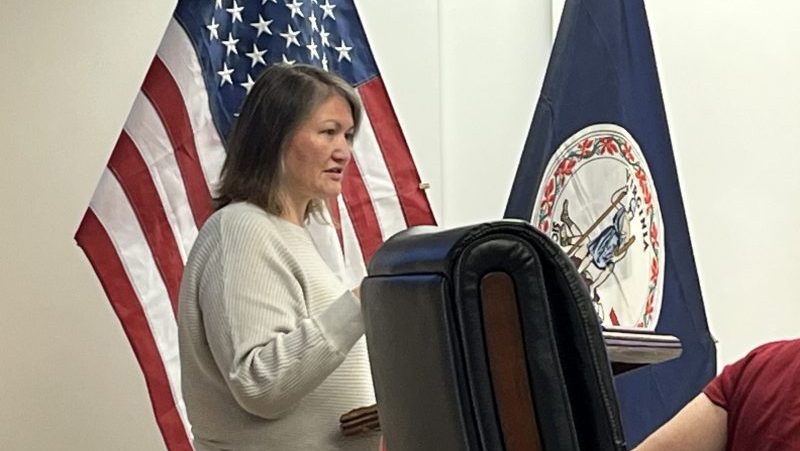
Planning Director Lauren Kopishke presents key information for the items being discussed by the commission.
There is a time to be Switzerland. One can appreciate why data centers have left a bad taste in so many mouths without annihilating the possibility that a revolutionary approach could be feasible. What should be aborted is the notion that this topic is somehow new. While it is true that no data center developer has approached the Town, and one can trust that there are no private conversations among officials with the intention of establishing that use, the issue has been on the radar for some time. A rezoning of November 2020 by the Town Council allowed by-right development of a data center on a property in Front Royal as part of its proffered conditions. Obviously, that potential was never realized, and the legality of doing so now could be questioned. However, the issue has a history in this town, and it should not be treated as an innovation.
For better or worse, the effort to establish performance standards for data centers is going forward. The work session of the commission targeted key points that need to be regulated, such as setbacks, noise, lighting, appearance, and parking. But perhaps the most significant is water cooling standards, as data centers have been notorious for how much water they have consumed. Under the current iteration of the performance standards, “Data Centers are not permitted to permanently utilize potable water for industrial cooling, including but not limited to data center cooling.” This restriction does not apply to domestic water, drinking, and sanitary for employees and occupants, nor does it apply to fire suppression. There is an exception, though. “Temporary potable water for industrial cooling may be provided through a Water Service Agreement approved by the Town Council to bridge initial water requirements while an industrial reuse water cooling system is constructed.”
Because the computing industry is advancing so rapidly and now has the capacity to use less water and recycle the water they do use, these standards arguably are not a hardship. Commissioner Megan Marrazzo raised the question, though: why not require them to be independent of potable water for their cooling system from day one? Commissioner Allen Neel nuanced her question with the perspective that they may need to grow into that capacity. Also, the commission identified other water sources, like a well or the river. Again, Marrazzo expressed skepticism, this time about whether drawing from the river is something that would not affect the town. At that point, Kopishke verified that any river draw would have to go through the Department of Environmental Quality.
The requirement of a utility impact analysis, as well as physical and environmental, would address these concerns and others. Finally, Marrazzo asked legal whether it would be appropriate for the data center to offset the cost of any upgrades the Town will need to make in its infrastructure to accommodate the use, and the answer was: “Yes, that would be appropriate.” But that is more of a concern for the town attorney to address than the commission.
Click here to watch the Front Royal Planning Commission Meeting of August 6, 2025.

Blue Ridge Wildlife Center Acknowledges a Quarter of a Century of Work in Wildlife Preservation & Human Education

What Does A ‘Fair Share’ Really Mean?

South Warren Ruritan Club Hosts 20th Annual Spaghetti Dinner Fuels Scholarships for Local Teens

Trees Take Root as Virginia’s Frontline Defense Against Urban Heat

Virginia Set to Rejoin RGGI as Utilities Prepare to Pass the Cost Back to Ratepayers

Virginia Joins Multi-State Lawsuit Challenging Trump’s Election Order

Trump Budget Seeks 43% Boost in Defense Spending, Cuts in Many Domestic Programs

Virginia Sees 33,000 ACA Enrollment Drop Since Subsidies Expired, More Likely on the Way

Annual Dental Checkups and Cleanings: Essential Appointments

4 Stimulating Activities for a Healthy Brain After 50
The First Amendment: America’s Unique Foundation of Freedom

How to Tackle Credit Card Debt

Summer Enrichment Camp Gives Teens Hands-On Learning Opportunities

VDOT: Warren County Traffic Alert for April 6 – 10, 2026

David Silek to Remain in Chairman’s Seat of WC Republican Committee Pending 6th District Appeal Decision

Sales Set to Bloom Like Daffodils This Spring

America 250: The Bookseller Who Helped Save the Revolution

Business Growth Series: Why Good Businesses Still Struggle to Grow

Brownies with Mini Chocolate Easter Eggs

Shenandoah Downs Opens 11th Season April 11 with Tribute to Roger Hammer

We Don’t Know Everything About DNA

How PAAS Came to Dominate the Easter Egg Dye Tradition

Spanberger Signs Bipartisan School-Safety, Student Support Bills Into Law

Melanie J. Pomeroy (1958 – 2026)
