
Local Government
Town staff fields questions on electric rate and bill increases prior to vote
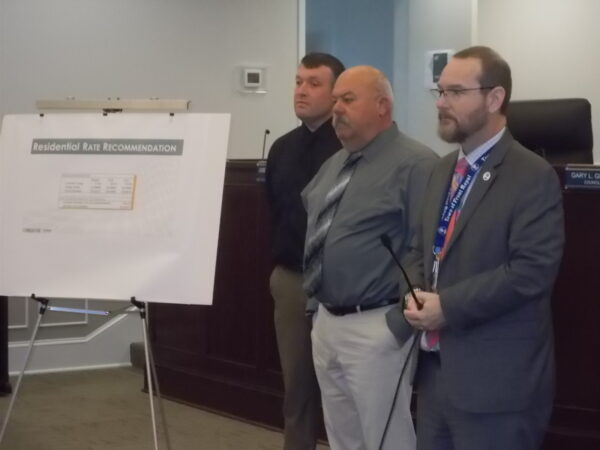
‘Power trio’ – from right, Town Manager Joe Waltz, Energy Services Director David Jenkins and Finance Director B.J. Wilson field questions from citizens about electric bill increases – Photos/ Roger Bianchini
With a public hearing and first reading vote on adjustments to Front Royal’s electric service rates on its meeting agenda of Monday, March 11, town staff addressed citizen concerns at a question and answer session held at 6 p.m., an hour prior to the beginning of the first regular town council meeting of the month. Present to field questions were Town Director of Energy Services David Jenkins, Director of Finance B. J. Wilson and Town Manager Joe Waltz.
Council observers from near the outset included Mayor Hollis Tharpe, Vice-Mayor William Sealock, Councilwoman Letasha Thompson and Councilmen Eugene Tewalt, Gary Gillespie and Chris Holloway. Jacob Meza was absent from Monday’s Q&A and regular meeting.
“Everyone on Facebook is complaining about increases up to $200 dollars or more,” one woman told those present.
“Everyone on Facebook” translated to six citizens at the session’s outset who asked questions about the dynamics involved in creating that higher electric portion of town utility bills in recent months. That number grew to nine and then 12 with the addition of three downtown business people, Rick Novak, Mike McCool and Ann Orndorff, and a few others as the regular meeting time approached.

As Vice-Mayor Sealock, right listens, Councilman Gene Tewalt gives some background on past Town explorations on mitigating utility costs as the initial six citizens present for Q&A session take it all in.
Only one of those, Springtime Garden Center owner Orndorff, spoke at the public hearing preceding the regular meeting first-reading vote on the proposed increase. That vote was 4-1, Holloway dissenting and Meza absent, for approval of the proposed rate changes. A second and binding vote is scheduled for March 25.
At issue for those present on March 11, and the social media multitudes absent, are substantial increases in the electric portion of town utility bills in recent months. Thus far those cost-of-service increases have been reflected in a Power Cost Adjustment (PCA) line that has been included in Town utility bills since November 2008.
“What is that a tax? Will it ever go away,” the first citizen to speak asked of the PCA line item on utility bills.
The PCA aspect is generally utilized to accommodate costs that fluctuate in the short term, sometimes monthly, to allow those service provision costs to be met without necessitating a lengthier – Waltz cited two months – political process of approving base rate adjustments back and forth on a continual basis.
“The PCA is a tool used by most electric utilities so they can recover those costs without having to increase their actual electric rates,” Director of Energy Services Jenkins and his Administrative Assistant Mary Ellen Lynn explained to this reporter in response to earlier questions, adding, “A big part of it is also the fluctuation in fuel costs to generate the power. The PCA provides an avenue to adjust dependent on any differences in the average cost from the base cost of wholesale power.”
“We were hoping the increases were anomalies but they stayed,” Town Manager Waltz told those assembled Monday at the Warren County Government Center meeting room, noting that when that permanence in power provision costs became apparent the Town commissioned a consultant rate study. That study resulted in a series of recommendations to increase rates to cover the Town’s electric utility expenses.
“It is the cost of doing business – we have not raised our base (electric) rate in 10 years,” Waltz told those present on March 11.
In response to previous questions from Royal Examiner, Jenkins and Lynn elaborated, “The Town has seen an increase in wholesale power cost, transmission and congestion charges on the transmission network over the past year. This increase has prompted staff to engage GDS Associates to perform a Cost of Service Study to determine the appropriate rate structure. The Town’s distribution system is continuously changing, and we must adjust accordingly to accommodate any changes and ensure that our rates recover our costs to serve our customers.”
As Waltz noted several times, by law municipal utilities are not operated for profit and can only charge fees necessary to maintain and expand their service as necessary.
And while aided by its municipal energy cooperative membership in American Municipal Power (AMP) Front Royal was enjoying its place as one of the three cheapest municipal power providers in Virginia, including several years in the number one spot on that list, no one took notice of those monthly PCA adjustments. But when the PCA started adding $100 or more to monthly bills in recent months, people definitely took notice.
When a rate change is approved following the required second reading those cost increases now showing on the PCA line of utility bills will be incorporated into the kilowatt hour usage aspect of those bills (ELEC-RE) and will vanish from the PCA line.
“The energy charge increase and PCA decrease almost balance each other out,” Energy Services staff told this reporter. The proposed adjustment in the Town’s residential electric rates would see a hike in the charge per kilowatt hour from the current 8.49-cent rate to 9.85 cents (+1.36 cents); and a corresponding drop in the PCA from 2.3-cents down to 1.0 cent (-1.3 cents).
The bulk of the estimated two-dollar hike per 1,000 kilowatt hours of residential usage come from a $1.50 increase to the “facility or customer charge” aspect of the electric bill from the current $7 level to $8.50.
According to energy department staff the facility or customer charge, “is essentially a fee on each customer’s bill that helps pay for the equipment, infrastructure and upkeep associated with providing electricity – transformers, power lines, etc.”
However, it is the increase already felt and thus far reflected in the existing PCA line on utility bills that is the basis of citizen complaints and confusion. And as Waltz explained early on, those increases “are the (rising) price of doing business” after 10 years of not having to do so on the power provision front.
On the commercial side of the increase the monthly facility/customer charge will go from $7.16 to $20; with the charge on the first 700 kilowatt hours rising from 11.5 cents to 12.6 cents; and from 7.56 cents to 8.8 cents per kilowatt hour over 700.
That commercial facilities or customer charge jump from the seven to twenty dollar range (200%) compared to the $1.50 jump (about 23%) on the residential side definitely attracted the attention of commercial customers Novak and Orndorff, as did a base rate hike five times the residential rate – $2 per 1,000 kilowatt hours per month residential versus $11 per month on the commercial side.
When Novak asked if the rate hikes couldn’t be spread more equally between residential and commercial customers, staff explained the proposed changes reflected the consultant study of how commercial and residential rates are generally balanced.
And if adjusting to the increased costs has taken the Town of Front Royal down a notch in the cheapest municipal energy provider “sweepstakes” according to a chart provided by the town staff, Front Royal does remain favorably positioned among energy providers statewide. With its PCA adjustment in place the Town ranked eighth of 31 various types of municipal providers across the commonwealth; after the rate adjustment on the table the Town will fall to 12th place.
Where does the Town of Front Royal rank among other utilities in VA?
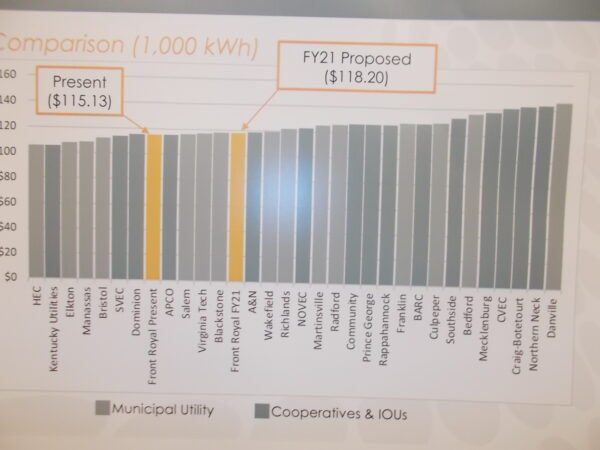
Chart shows Front Royal’s current and future position among 31 municipal and cooperative power providers in Virginia.

What Factors Are Most Likely to Affect the Cost of a Funeral?

Learn to Spot Scams: Free Workshop Set for June 2

Smart Ways to Use Your Tax Refund This Year

Supervisors Revisit Cross-County Chester Gap F&R Service, See Member-Staff Confrontation After Numbers Apology Offered

Get Your Equipment Ready Before the Start of Fishing Season

Landscaping Careers Offer Outdoor Work and Creative Opportunities

Blue Ridge Wildlife Center Patient of the Week: Virginia Opossum

From Crime Scenes to K9 Units: Citizens Academy Opens in May

Weekly Yard Waste Pickup Begins April 8 in Front Royal

Town Council Reviews Goals at Retreat in Advance of Work Session

New Virginia Laws Target School Construction and Classroom Cellphone Use

Clear Horizons Brings Fresh Approach to Mental Health

Funding Cuts, State Error Strain Virginia’s HIV Care System

Virginia Hospitals Filed More Than 1 Million Medical Debt Lawsuits Since 2010, a New Report Finds

POLICE: 7 Day FRPD Arrest Report 4/6/2026

Spanberger Signs Bipartisan Bills Tied to Billions in Business Investment Across Virginia

Birthright Case Forces US Supreme Court to Confront Prospect of Americans Losing Citizenship

Caleb Benton McKinstry (2010 – 2026)

Ideas for Nurturing — or Rediscovering — Your Inner Child

Protein Takes Center Stage in Updated U.S. Dietary Guidelines

Blue Ridge Wildlife Center Acknowledges a Quarter of a Century of Work in Wildlife Preservation & Human Education

What Does A ‘Fair Share’ Really Mean?

South Warren Ruritan Club Hosts 20th Annual Spaghetti Dinner Fuels Scholarships for Local Teens

Trees Take Root as Virginia’s Frontline Defense Against Urban Heat
