
Local Government
Town will waive card-payment fees thru June, undecided on long-term options

Above, welcome to virtual meeting world, March 30, 2020; below, Town IT and Communications Director Todd Jones (TJ) hooked council and staff in for about a half-hour, pre-7 p.m. meeting. – Don’t forget there are people signed in, listening who you can’t see, boys, Jones reminded some chatty councilmen. – Royal Examiner Photos/Roger Bianchini – Royal Examiner Audio/Mike McCool
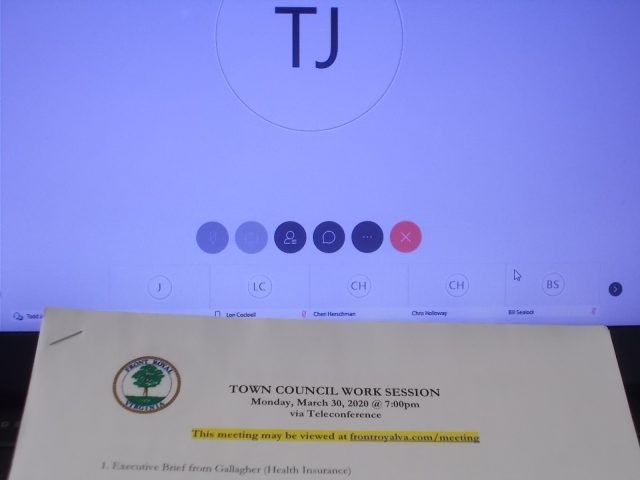
Life in municipal government COVID-19 pandemic virtual world continued Monday evening, March 30, as the Front Royal Town Council “gathered” by remote computer hook up for work session discussion of several matters.
Near the meeting’s end, Interim Town Manager and Town Director of pandemic Emergency Management Matt Tederick noted a third confirmed case of the COVID-19 (Coronavirus Disease-2019) in Warren County. He also was joined by the mayor and council in thanking staff for helping the town government traverse the unfamiliar territory of continuing to provide services under state-recommended restrictions on public interactions. Those restrictions have led to the locking of municipal building doors to the public, funneling most citizen-government interactions to online, phone or drive-thru options.
Consequently, one of the four topics of conversation Monday was a lifting of the 2.35% fee on payment of Town utility or other fees by credit or debit card. After a somewhat laborious discussion of contractor “technical interface” issues not allowing direct withdrawals from customer bank accounts, which would bypass the need for the plastic money fee on utility account payments, the council agreed to waive the fee for the three-month balance of this fiscal year.
Since the issue is tied to an upswing in credit or debit card payments tied to the restrictions on public interactions and municipal building closures due to the COVID-19 emergency response, Town Attorney Doug Napier told the mayor and council that they simply had to authorize Tederick to move forward on waiving the card-payment fees as part of his duties as the Town’s COVID-19 Director of Emergency Management.
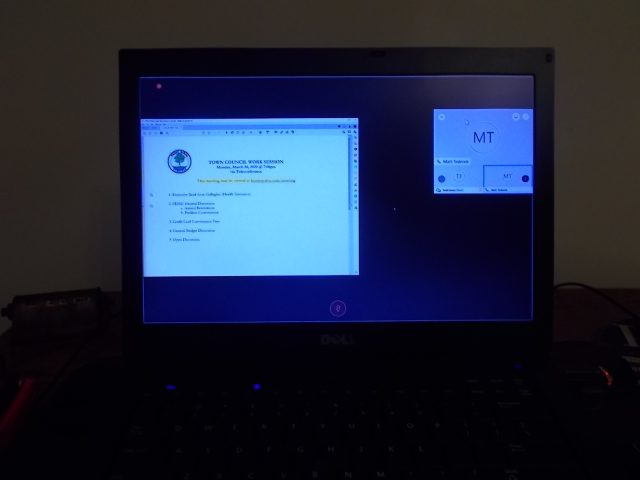
The meeting gets underway with agenda cover sheet displayed at left; box at right displays who is talking by initials, in this case, Interim Town Manager/Director of Emergency Services Matt Tederick (MT).
Staff is estimating a $60,000 revenue shortfall over the three-month period, twice the current average of $10,000 monthly in plastic transaction fees. The staff summary noted that the shortfall could possibly be offset by a “reduction of expenditures identified by staff and/or usage of the reserve fund balance.”
It was noted that one of the Town Finance Department’s drive-thru windows remains open for business at the rear of Town Hall, as an option on cash or check payments. And Councilwoman Lori Cockrell wondered if many citizens were aware of the option to set up automatic payments from their bank accounts.
Prior to the consensus to allow Tederick as director of emergency management to move forward with the fee waiver, Councilwoman Thompson worried over the suggestion that Town utility fees be raised in the coming fiscal year as another means of offsetting the revenue shortfall. That led to a discussion in which Town Finance Director B. J. Wilson expressed the opinion that the lost fees, as an “operating expense” of the Town, could not be covered by the use of fund balance reserves.
“We can’t go into reserves to cover an operating expense. So, we’d have to either reduce our expenses or raise our revenues to cover this. But we cannot dip into the reserves,” Wilson told the council.
“That doesn’t make any sense, credit card fees is an operating expense, isn’t it?” Councilman Jacob Meza offered in response.
“Yes, it’s an operating expense, so we have to cover it with our revenues,” Wilson repeated.
Queried further, Wilson explained that in the short term if the funds were not available from the utility departments’ revenues, reserves might have to be used to temporarily plug the gap.
“Well, let there be a shortfall, and cover it with the reserves,” Meza suggested, drawing some laughter from council.
However, the finance director observed such a path could lead the Town into eventual trouble with state financial authorities.
“Obviously that would have to be an option for our current year if it comes down to it. But moving forward … our (utility) revenues are supposed to cover our (utility) operating expenses. And if we continually have a shortfall it could get us into a little trouble with the APA,” Wilson told the council’s cut, spend and reduce majority.
Queried later, Wilson explained “APA” stands for Auditor of Public Accounts, a State financial department that tracks municipal budgetary submissions for irregularities.

Bill Sealock – we promise he’s there – asks council to move past a discussion of long-term causes and solutions on costs and how the Town’s utility departments interface online with customers, to the business at hand – authorization for the Town Director of Emergency Services to waive credit-debit card fees for the next three months during the pandemic emergency response.
As the discussion progressed, Vice-Mayor Bill Sealock observed that in the short term the Town could cover the cost of the card fee waiver, but that long-term revenue/expenditure issues in the face of the COVID-19 Coronavirus pandemic response would have to be dealt with in the coming FY-2021 budget starting July 1.
“We can absorb $60k in our reserve. Of course, I also want to talk about saving any dollars in the 2019-2020 (budget) then move on to our new budget, because we’re going to see some significant shortfalls. So, I’m wondering why we’re spending so much time on this thing that you can’t resolve tonight. And why we’re not moving on … I hear everybody say they’re for it for the 90 days. So, we’re not going to resolve anything else about whether it comes out of reserves or we’re rescheduling some work,” Sealock told his colleagues.
“We can discuss this all night and we’re still not going to get anywhere,” Mayor Gene Tewalt concurred, moving council toward its instruction to Tederick to enact the card payment fee waiver as part of his role as director of emergency management for the Town.
In lieu of videotaping a black computer screen with informational boxes popping up here and there, Royal Examiner audio-taped the work session for the later perusal of citizens not linked in to listen live.

Above, the cover page of the Gallagher company’s health insurance proposal the Town plans to adopt, discussion indicated not in the coming fiscal year, but July 1, 2021, at outset of FY-2022; below, an informational page summary of coming changes for the Town and its employees – not sure if Gallagher is recommending calling in the police for implementation.
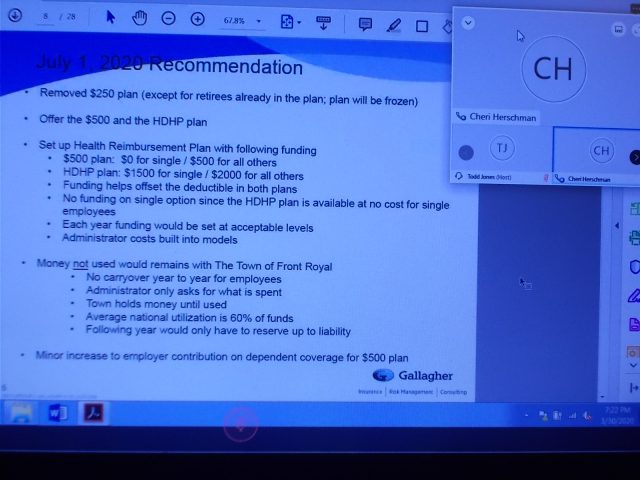
In this linked audio recording, hear the above discussion, as well as council and staff’s visiting of how the pandemic response may impact the Community Development Block Grant (CDBG) funding and plans for downtown façade and other improvements; a planned switch of the Town’s employees’ insurance package that would raise the deductible option from $250 to $500, but will not be enacted until FY-2022 after the changes have been fully explained to staff; and evolving budget variables in the current pandemic “non-essential” business closures environment as council moves forward with its locked-in half-cent real estate tax decrease in place for FY-2021.
Here’s the audio from the March 30 Work Session:

Spanberger Joins Other Governors in Push for PJM to Prioritize Ratepayer Protections

Cannabis Testing Challenges Persist as Virginia Retail Market Nears

Quick Quiz on Tooth Decay

The Fat Facts: Busting Common Food Myths

Importance of Chiles v. Salazar and the Protection of Free Speech

MAGA Suicide?

Warnick Posts Natural Hat Trick as Shenandoah Downs Opens Spring Meet

Youngkin Returns to Campaign Trail, Calls for Court to Strike Redistricting Vote

‘We Have To Do Something’: Former U.S. Attorney General Eric Holder Supports Virginia Redistricting

3 Ways to Extend the Life of Your Electric Vehicle Battery

Serious Charges Highlight Warren County Grand Jury Indictments

Ducks, Flowers, and Fun: Redbud Festival Returns to Browntown

Potato-Crust Quiche Makes a Lovely Brunch

Faye Barr Vance (1930 – 2026)

James Christopher “Chris” Sain (1948 – 2026)
Alice “Maybelle” Henson (1938 – 2026)

How Sleep and Stress Affect Cancer Risk

Spanberger Signs Sweeping Public Safety and Gun Violence Bills

Horses, Fans Return as Shenandoah Downs Season Begins

Skill Games Halted Again as Spanberger Issues Veto

VDOT: Warren County Traffic Alert for April 13 – 17, 2026

The Cat Who Outlasted Six Prime Ministers
Front Royal, Virginia. Vacation Destination?

Virginia State Police Report Major Drug Seizures in Weekly Crime Suppression Effort
