
Local Government
Town’s surplus situation not as rosy as some on council may have thought
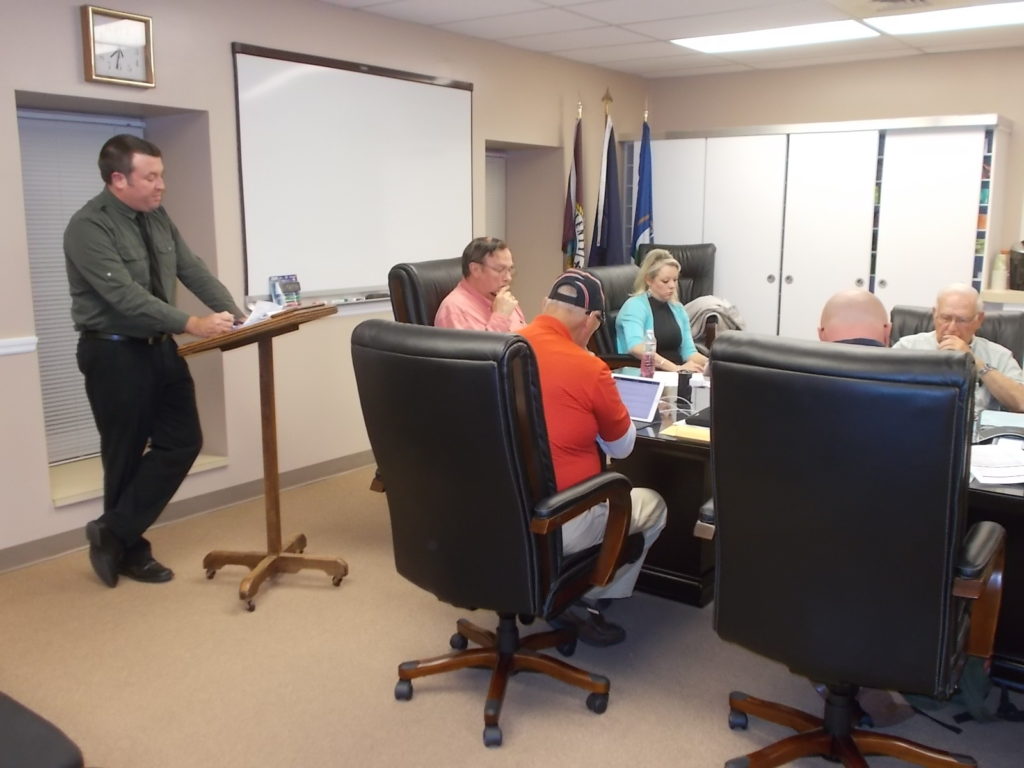
Town Finance Director B. J. Wilson delivers some sobering financial news to council on the status of fund balances. Photo/Roger Bianchini
Front Royal Finance Director B. J. Wilson gave the town council a troubling overview of the Town’s financial situation at a Monday, October 15 work session – unfortunately, two of council’s biggest proponents of “creative” or “alternate” ways to finance projects outside of increasing the Town’s revenue stream with tax increases weren’t there to hear it.
Absent were Jacob Meza and John Connolly, though fellow “creative financing” proponents Chris Morrison and Gary Gillespie were present.
Wilson’s report on the Town’s Enterprise Fund balances and reserves came as a preface on a staff recommendation on how to best finance the purchase of a $545,000 digital police radio system. Council was unanimous in agreeing the purchase is a necessary one to allow, not only improved internal, but inter-departmental communications with other jurisdictions and county law enforcement and emergency services.
Past council discussion has indicated a majority preference for a whole or partial internal loan in order to avoid interest payments. But with Wilson’s recent revelation that a preferred council “money pit”, the General Fund surplus, could soon be reduced to nothing due to unforeseen high retirement fund contributions, some council eyes had shifted toward enterprise fund surpluses as an internal funding alternative. Enterprise funds support utility and service operations, including water, sewer and electric service, as well as trash and recycling collection; the general fund supports non-revenue generating operations such as administrative functions.
Wilson reported that factoring in mandated three-month operating reserves, carry-over purchase orders, and in the General Fund’s case the known coming retirement system deductions, three of the Town’s operating fund balances – general (-$3.39 million), electric (-$1.69 million) and solid waste (-$403,908) – were facing negative unassigned fund balances.
The two enterprise funds with positive unencumbered balances – water ($5.3 million) and sewer ($7.05 million) – are facing coming or anticipated capital improvement projects that could significantly eat away at those surpluses.
In fact, council received an earlier briefing Monday evening on the status of the 522 North Corridor backup water line study. And while the corridor and likely the Town’s largest water user Dominion Power (estimated at 50 million gallons per year/$1 million annual bill) has committed $3.5 million to the redundant water line project, consultant CHA representative Steve Steel said there is no current total project cost estimate. Town Manager Joe Waltz noted that a past project cost estimate of $5.5 million was made two years ago before construction costs began skyrocketing.
Following his two-pronged report, Finance Director Wilson’s recommendation was to leave what enterprise fund surpluses do remain, alone; and to finance the FRPD radio purchase through a 10-year loan at an interest rate of 3.389% acquired through the Virginia Municipal League/Virginia Association of Counties (VML/VACO).
Wilson explained that reasonably low interest rate had already been negotiated through VML/VACO but would time out if a decision by council to participate in the current group municipal loan acquisition wasn’t made soon. Wilson noted that since that last VML/VACO group loan acquisition, interest rates have gone up.
And speaking of interest rates, Wilson responded to a question from Vice-Mayor Eugene Tewalt, acknowledging that if Town fund balances fall below recommended 15% surplus levels it will negatively impact the Town’s bond rating, raising the level of interest payments on future Town bond issues.
The staff suggested option of the VML/VACO loan would require a decade of annual payments of $65,305.46, with a 10-year interest payment total of about $106,650.
Chris Morrison, one of the “creative financing” above tax hikes to raise revenue proponents, asked Wilson why the VML-driven, interest-paid, outside loan was his suggested option. Wilson pointed to “major projects on the horizon” for the water and sewer departments where surpluses do exist, as well as a favorable interest rate acquired through the VML/VACO municipal group bid.
Wilson also reiterated the need to provide mandated fund surpluses to assure operational funding in emergency situations, as well as to acquire the above-mentioned favorable bond ratings and consequently lower interest rates on outside loans.
“I want the people in this room to understand – we’re supposed to have all these reserves around … No, we’re in the red,” Vice-Mayor Tewalt said pointedly to his younger colleagues on council.
Tewalt, along with another senior council member William Sealock, have been critical of a younger council majority’s willingness to approve capital improvement or service projects that will eventually require additional town staff, without committing to increasing town revenue streams.
In fact, the two pro-alternatives-to-tax-hike proponents present, Morrison and Gillespie, were fresh off lending their voices to a Chamber of Commerce Candidates Forum consensus opposing future tax increases to meet Town revenue needs.
Well, pledging NOT to raise taxes, even if they are among the lowest in the commonwealth, DOES play well in an election campaign.
But it remains to be seen how that no-tax-hike pledge plays in long-term municipal financing and the continued provision of infrastructure and services desired by your constituents, not to mention necessary for the continued successful operations of your commercial tax base, or in Dominion Power’s case – your commercial enterprise fund fee base.

Cultures Around the World Mark the Spring Equinox With Unique Traditions

Laurel Ridge to Host 46th Annual Spring Follies: “Back to the ’90s”

Love Revival to Host Free Community Easter Celebration in Front Royal

Salvation Army of Front Royal Plans Annual Dinner and Raffle Fundraiser

Stephen Paul Sill (1955 – 2026)

Virginia Seeks Public Input for 2026 Statewide Rail Plan

Front Royal Craftsmen Revive Centuries-Old Timber Framing Tradition

Local NewsVDOT: Warren County Traffic Alert for March 16 – 20, 2026

Virginia Lawmakers End Session Without Final Budget

Your Personal Mission Statement: A Guide to Getting What You Want Out of Life

Disappointed In Our Olympic Spirit

How St. Patrick’s Day Became America’s Biggest Irish Party

Virginia State Police Urge Sober Plans for Saint Patrick’s Day Celebrations

In a One-Party County, Internal Party Decisions Affect Us All

Virginia State Police Seize Nearly 100 Pounds of Narcotics, Recover Firearms in Weekly Crime Suppression Effort

Barton Charles “Bart” Haller (1940 – 2026)

Dawn Lee Dodson (1970 – 2026)

Mary Helen “Nanny” Spires Johnt (1954 – 2026)

Another Round of ‘Momnibus’ Bills Are Headed Towards the Governor This Year

Virginia Joins States Challenging Trump Admin Regulations That Limit Free Birth Control Access

Update: Charlotte Swanson Smith (1951 – 2025)
Why We are Challenging the Republican Mass Meeting

Bruce Norman Showman (1954 – 2026)

EDA Relaunches Small Business Loan Program to Help Warren County Entrepreneurs Access Capital
