
National News
US Supreme Court Limits Use of Race in Congressional District Remaps, Diluting Voting Rights Act
Florida Gov. Ron DeSantis’ office on Monday invoked an upcoming landmark U.S. Supreme Court decision on the role of race in drawing congressional districts to justify the Republican’s proposed gerrymander.
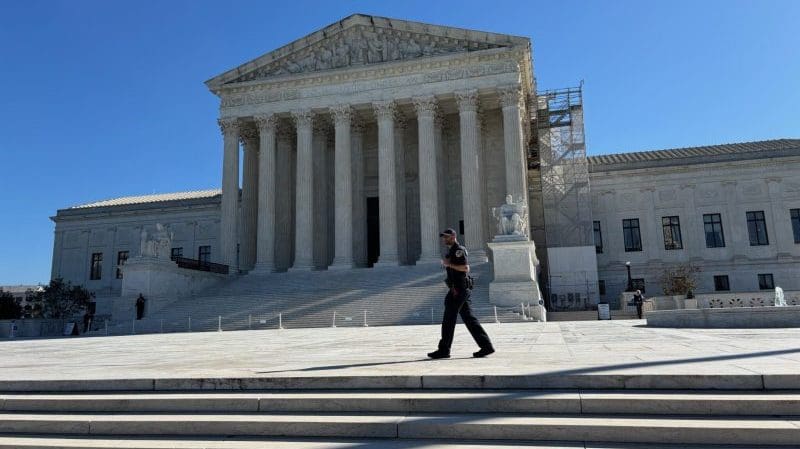
The U.S. Supreme Court on Oct. 29, 2024. (Photo by Jane Norman/States Newsroom)
“The use of race in redistricting should never happen,” the governor’s general counsel, David Axelman, wrote in a memo unveiling a map that aims to hand Republicans four additional U.S. House seats in Florida.
On Wednesday, the Supreme Court delivered an opinion sharply weakening a major portion of the federal Voting Rights Act.
Even before the decision, Republicans and Democrats across the country were scrambling to get ahead of the court’s anticipated ruling.
The rush comes even as state legislative sessions wind down and the window to redraw maps rapidly closes ahead of the midterm elections in November — likely pushing most redistricting battles into the 2028 election cycle.
The opinion in the case, Louisiana v. Callais, could reverberate for decades. The court’s conservative majority significantly curtailed the consideration of race when drawing legislative maps.

Protesters outside the U.S. Supreme Court when Louisiana v. Callais was argued on Oct. 15, 2025. (Photo by Ashley Murray/States Newsroom)
Until now, Section 2 of the Voting Rights Act has limited states from using maps that dilute the voting power of minority citizens.
“If the Supreme Court does decide to gut or significantly weaken Section 2 of the VRA, we’re very concerned that it would give, basically, the green light to states to racially gerrymander,” Michael McNulty, policy director at Issue One, a group focused on protecting American democracy, said in an interview ahead of the decision.

Republicans could ultimately secure up to 19 U.S. House seats nationally directly because of the Supreme Court’s decision, according to a projection by Fair Fight Action, a Georgia-based progressive voting rights group, and the Black Voters Matter Fund, which advocates on behalf of Black voters. At the state level, the groups have projected that Republicans could gain up to 200 state legislative seats across the South.
“It is hard to overstate what an earthquake this will be for American politics,” Rick Hasen, a professor at UCLA School of Law and director of the Safeguarding Democracy Project, wrote in a blog post following the opinion’s release on Wednesday.
Louisiana case
A group of white voters challenged Louisiana’s congressional map as an unconstitutional racial gerrymander after the state in 2024 created a second district where a majority of voters are Black.
The U.S. Supreme Court’s conservative justices agreed, ruling 6-3 that the map is an unconstitutional racial gerrymander because the state didn’t need to create a second majority-minority district.
In the majority opinion, Justice Samuel Alito wrote that “none of the historical evidence presented by plaintiffs came close to showing an objective likelihood that the State’s challenged map was the result of intentional racial discrimination.”

A protest sign outside the U.S. Supreme Court when Louisiana v. Callais was argued on Oct. 15, 2025. (Photo by Ashley Murray/States Newsroom)
Justice Elena Kagan, one of the court’s three liberal justices, wrote in a dissent that the Supreme Court has “had its sights set” on the Voting Rights Act for more than a decade.
“Under the Court’s new view of Section 2, a State can, without legal consequence, systematically dilute minority citizens’ voting power,” Kagan wrote.
Following the opinion, Republican-led legislatures across the South are expected to move to break apart Democratic districts where a majority of residents are Black or from other minority groups.
Mississippi Republican Gov. Tate Reeves last week announced a special session to redraw the state’s Supreme Court districts, to begin 21 days after the court releases its decision.

“It is a decision that could (and in my view should) forever change the way we draw electoral maps,” Reeves said in a statement announcing the session.
The redistricting wars of 2026
As of 2024, roughly a third of U.S. House seats represented majority-minority districts — 122 held by Democrats and 26 held by Republicans, according to estimates by Ballotpedia. Texas and California account for nearly half of all the districts.
Seven states have already taken the extraordinary step of redrawing their maps this year after President Donald Trump urged Republicans to draw lines that maximize partisan advantage ahead of the midterms. Maps are typically redrawn every 10 years after the census.
Texas and California struck first, followed by Missouri, North Carolina, Ohio, and Utah. Virginia voters last week approved a redraw, and Florida lawmakers could approve a new map as soon as this week.
All told, Republicans may emerge from the redistricting war with a small net advantage of a handful of seats if the Florida plan is enacted and the other maps are upheld.
The calendar will prove a major obstacle to additional gerrymanders this year. Primary elections have already been held in some southern states, and ballots have been distributed in others.
Mississippi, North Carolina, and Texas have already held primaries, while ballots have been distributed in Alabama, Georgia, and South Carolina.
But after November, the clock resets, giving states more than a year to pursue further changes to their maps before the 2028 election.
“We are much more concerned about the impact on 2028 and beyond that that would have, letting these politicians basically just pick their voters instead of the voters picking them,” McNulty said.
John R. Lewis bill
As Democrats look ahead to Callais’ likely fallout in the coming years, they have begun urgently calling for action in Congress and at the state level. They also say the decision emphasizes the stakes of this year’s elections.

“Today is a devastating day for democracy and a wake-up call for all those who seek to protect it,” Heather Williams, president of the Democratic Legislative Campaign Committee, said in a statement.
Democrats in Congress have repeatedly offered the John R. Lewis Voting Rights Advancement Act. Named after the civil rights activist and Georgia congressman who died in 2020, the legislation aims to strengthen Section 2 and other elements of the current Voting Rights Act, though it’s unclear whether the bill would be constitutional under the Callais decision.
The U.S. House, under Democratic control, passed the legislation in 2021, but it was filibustered in the Senate. Some lawmakers are speaking about the measure again, and Democrats may take control of Congress in November’s elections—though they would still face President Donald Trump in the White House.
“We can and must revive the Voting Rights Act,” Rep. Terri Sewell, an Alabama Democrat and the ranking member of the House Administration Subcommittee on Elections, said at a shadow hearing on voting rights on Monday.
Voting Rights Act over the years
Over more than a decade, the Supreme Court has narrowed the potency of the Voting Rights Act, a 1965 law banning racial discrimination in voting that came as Congress battled Jim Crow laws in southern states.
The measure was intended to help enforce the U.S. Constitution’s 14th and 15th amendments, which guarantee equal protection under the law and prohibit denying the right to vote on the basis of race.
In 2013, the court effectively halted preclearance — the requirement that some states and local governments with a history of discrimination obtain federal permission before changing their voting practices. At the time of the decision, most southern states and a handful of others were subject to preclearance.
The Supreme Court in 2019 ruled that federal courts cannot review allegations of partisan gerrymandering. The decision cleared the way for state lawmakers to gerrymander their maps for political advantage without fear that they would be second-guessed by federal judges.
The opinion helped empower a wave of gerrymanders after the 2020 census and set the stage for this year’s mid-decade redistricting.
Turning to the legislatures
Facing a bleak federal landscape, some voting rights advocates are increasingly turning to state legislatures. The Supreme Court decision undercutting Section 2 of the Voting Rights Act will likely intensify efforts to advance state-level legislation.

“Because political participation is inherently local, it is imperative to press for protections at the ground level,” Todd Cox, associate director counsel at the Legal Defense Fund, a racial justice legal organization, said at the shadow hearing.
Some Democratic state lawmakers already introduced measures in anticipation of an unfavorable Supreme Court decision.
The Illinois House last week approved a state constitutional amendment that would require districts to be drawn “to ensure that no citizen is denied an equal opportunity to participate in the political process and to elect representatives of his or her choice on account of race.”
The Illinois amendment would also require, where practical, the creation of racial coalitions or influence districts — terms that refer to districts where racial minorities together constitute a majority of residents. The measure, which must also pass the state Senate before going to voters, was a pre-response to the Callais opinion.
“This will ensure that Illinois will always recognize the fundamental principle that a democracy of the people, by the people, and for the people must include all the people,” Illinois Democratic House Speaker Emanuel Welch told reporters after the amendment advanced.
Illinois Republicans have cast the amendment as a Democratic power grab. The state has some of the most gerrymandered maps in the nation, Illinois House Minority Leader Tony McCombie, a Republican, said in a statement. The Princeton Gerrymandering Project has given Illinois’ maps an overall “F” grade.
“Let’s be clear: this has nothing to do with strengthening democracy,” McCombie said. “It’s about locking in one-party control at any cost.”
by Jonathan Shorman, Virginia Mercury
Virginia Mercury is part of States Newsroom, a nonprofit news network supported by grants and a coalition of donors as a 501c(3) public charity. Virginia Mercury maintains editorial independence. Contact Editor Samantha Willis for questions: info@virginiamercury.com.




This Week’s Showtimes at Royal Cinemas as of October 22nd

Debbie’s Lighthouse Combats Food Insecurity While Helping Small Businesses Grow in Front Royal

Decision on ‘EagleView’ Contractual Oversight of Photographic Assessment Technology Delayed to November 17

Blue Ridge Wildlife Center Patient of the Week: Great Horned Owl

Dominion-NextEra Merger Hits Turbulence, Faces Opposition from Virginia Leaders, SCC Staff

Cheaper Manufactured Homes Could Be Having a Moment, If Only States Can Catch Up

POLICE: 7 Day FRPD Arrest Report 10/19/2026

Sight & Sound’s JOSHUA LIVE! Comes to Royal Cinemas — Limited Run, October 29 – November 4

You Are Not Wasting the AI’s Time

The ‘Beer Belly’ Isn’t Really About Beer

Virginia State Police Launch Two-Day Interstate 81 Safety Enforcement Campaign October 21–22

Everybody Is a Leader Somewhere

Warren County Wildcats Host Meridian in Girls Volleyball Match Tuesday Night – October 20

Closing Virginia’s Childcare Affordability Gap Could Cost Up To $4.5B a Year

New Coalition Aims to Keep Virginians Covered as Medicaid Rules Tighten

General Assembly Calls Off Oct. 26 Special Session to Elect Judges

Trump Order Sets Up New Women’s Health Research Initiative at NIH, White House Task Force

What Is Puberty?

First New Class of Pain Medicine in Decades Comes with A 14-Day Limit

Front Royal Man Charged with Two Counts of Forcible Sodomy Following RSW Regional Jail Investigation

James Edward “Jimmy” Mahoney (1953 – 2026)

Ask Stewart: Are There Any Scary Trees?

Janet Denny Casarotti (1933 – 2026)

Virginia Breeders Championship Series Opens at Shenandoah Downs with Impressive Performances
