
State News
Virginia’s highest tax bracket starts at $17K. Some say it’s time for an update.
Under Virginia’s state income tax system, the highest tax bracket starts at just $17,000, a number that hasn’t changed since 1990.
Because the brackets stayed the same as incomes rose over three decades of inflation, more and more of the money Virginians make is now taxed at the highest rate of 5.75%, according to a new state report. Since 1990, the report found, the state’s median income rose 108%. Over the same period, taxes owed by single filers making the median income went up 173%.
“Tax experts refer to this dynamic as ‘bracket creep,’” the state’s Joint Legislative Audit and Review Commission wrote in the report on how Virginia could make its tax system fairer. “Incomes rise over time, but income tax brackets do not.”
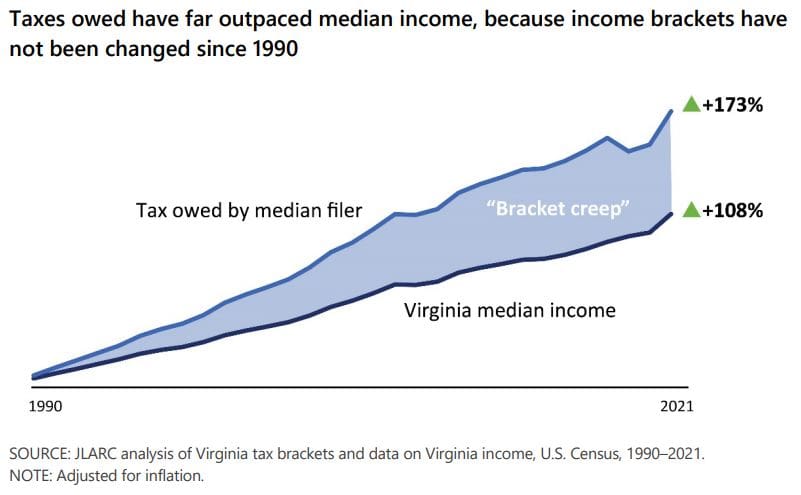
Bracket creep hits low- and middle-income filers the hardest, the report says, because people at the lower end would pay less if Virginia adjusted its tax brackets for inflation, as the federal government and many other states do.
“Thirty-two years ago, you were considered rich at $17,000 and hit the top tax bracket,” Del. Joe McNamara, R-Salem, a certified public accountant who sponsored an unsuccessful bill to start adjusting the brackets for inflation, said at a legislative hearing earlier this year. “We are now still considered rich at $17,000.”
Adjusting the brackets for inflation, JLARC found, would start the top bracket at $35,348 of adjusted gross income, with similar increases for the three brackets below. Because less of Virginians’ income would be taxed at the highest rate, that change would mean a $959 million hit to the state budget.

The JLARC report released last month laid out a variety of options for how Virginia’s tax code could be made more progressive. In the tax context, progressivity means taxing people according to their ability to pay, instead of setting the same tax rates for rich and poor or disproportionately taxing the poor.
Virginia has grown increasingly reliant on individual income taxes to fund state government. The $17.2 billion collected in the fiscal year 2021 amounted to 70% of the state’s general fund revenue, up from 63% in 2000. Corporate income taxes made up 6% of general fund revenue in fiscal 2021, according to JLARC.
The report also quantified the state-level rise in income inequality, showing the state’s wealthiest 1% accounted for 16% of total income in Virginia for 2018, up from 11% in 1990. Meanwhile, the bottom 90% of earners made up 55% of 2018 income, down from 65% in 1990.

The JLARC study found that the bipartisan tax deal Gov. Glenn Youngkin and the General Assembly struck earlier this year already made the state’s tax system substantially more progressive by nearly doubling the standard deduction on state income taxes and making the earned-income tax credit partially refundable.

For the lowest-income filers (up to $14,000 in income), those changes reduced the effective tax rate from 0.8% to -1.2%, since those workers can now expect to get money back that they weren’t eligible for before. For filers with $14,000 to $36,000 in income, the effective tax rate dropped from 2.4% to 1.2%.
Combined, those changes made Virginia’s tax code more progressive than average when compared with other states, according to JLARC. Historically, Virginia’s tax structure has been rated as less progressive than average and less progressive than tax structures in neighboring North Carolina, West Virginia, Maryland and the District of Columbia, according to the report.
The state hasn’t raised taxes on the wealthy, but the JLARC report lays out several options for doing so by setting higher rates for the top 1% of filers, people with incomes above $600,000, or the smaller group of filers with incomes over $1 million. Of all the ways to increase progressivity, raising taxes on the rich is the only option the report envisions that also increases state revenue.
That doesn’t seem likely to happen, with Gov. Glenn Youngkin and the Republican House of Delegates emphasizing broad tax cuts instead of tax hikes.
In a letter responding to the JLARC report, Youngkin Secretary of Finance Stephen Cummings said many of the states Virginia competes with to attract people and businesses either have no state income tax or are working to reduce their rates. Cummings wrote that lower-tax states to the south are seeing stronger recoveries from the COVID-19 pandemic than higher-tax states to the north.
“The tax burden on Virginia families is a critical factor in businesses’ decisions to create well-paying, high-quality jobs in the Commonwealth,” Cummings wrote.
Youngkin has said he’ll push for more tax cuts in the 2023 General Assembly session.
Asked whether Youngkin supports adjusting the tax brackets for inflation, the governor’s office didn’t lay out a clear position, saying Youngkin is in the process of preparing a budget proposal to be presented in December.
In an interview after JLARC’s report was released, Del. Vivian Watts, D-Fairfax, said proposals to raise taxes on the rich probably won’t go anywhere given the current political environment. But the facts and figures in the report, she said, create “a base of information” for future debate on Youngkin’s proposals.
“This helps keep the dialogue more honest, more accurate,” Watts said.

Watts said that the more modest steps of addressing bracket creep and indexing brackets to inflation could be bipartisan priorities.
“When you don’t index, and you let time fly … here we are 30 years later, and you’ve got a huge hit,” Watts said.
Lawmakers who serve on the commission that received the tax report didn’t immediately indicate which tax changes they’re inclined to pursue, but the report will likely factor into whatever tax debates are coming next year.
“There’s no question in my mind this is going to be a topic we’re going to wrestle with during the upcoming regular session,” said Sen. Janet Howell, D-Fairfax, who chairs JLARC and co-chairs the Senate Finance Committee. “So we appreciate all of this work.”
In an interview, McNamara said he plans to reintroduce his bill to start indexing the brackets to inflation going forward, avoiding the budget hit from adjusting for 32 years of inflation all at once. However, he argued the issue can also be addressed through more increases to the standard deduction.
“I don’t think there’s going to be an appetite to do both,” McNamara said.
According to the JLARC report, the biggest boost in progressivity would come through a bigger overhaul of the tax brackets. That option would involve growing from four income brackets to six, with lower tax rates for everyone with less than $50,000 in income and higher tax rates for everyone over $50,000. In that scenario, the highest tax bracket would cover income over $93,000, which would be taxed at 7.5%.
“For a married taxpayer with an annual income of $50,000 (approximately the average for the middle-income group), this would translate into a $770 reduction in tax liability — a 1.5% increase in after-tax income,” the JLARC report says. “In contrast, a married taxpayer with an annual income of $300,000 (approximately the average for the highest 20% of taxpayers) would see their tax liability increase by about $2,700, a 0.9% reduction in income.”

Watts said she’s skeptical of adjusting the brackets to assess higher rates on people in the middle to upper middle of the income spectrum, given Virginia’s steep variability in cost of living, which makes $60,000 in income in Northern Virginia far different from $60,000 in Southwest Virginia. For that reason, Watts said she’s more inclined to support creating new tax brackets covering the highest earners.
“At that level, I’m not talking about basic living,” she said.

A 10% tax rate on the roughly 17,700 Virginia filers with incomes over $1 million, according to JLARC, would generate an extra $1 billion per year for the state.
by Graham Moomaw, Virginia Mercury
Virginia Mercury is part of States Newsroom, a network of news bureaus supported by grants and a coalition of donors as a 501c(3) public charity. Virginia Mercury maintains editorial independence. Contact Editor Sarah Vogelsong for questions: info@virginiamercury.com. Follow Virginia Mercury on Facebook and Twitter.




Winsome Earle-Sears Warns of Consequences of Virginia’s Proposed Constitutional Amendments

Federal Emergency Order Aims to Prevent Power Outages Across Mid-Atlantic, Including Virginia

Warren County Grand Jury Returns 17 Indictments Against 10 Individuals in October Session

Virginia Lawmakers, Spanberger Grapple With Loss of Federal Healthcare Funds for Trans Youth

Virginia Sees Gains in Kindergarten Readiness, But Gaps Persist for Underserved Students

One Health: Why Animal Health Is Also Your Health

The Real Winnie-The-Pooh Was a Girl from Ontario

Defense Counsel and Special Prosecutor Reach Plea Agreement on Carter DUI Cases

Betty Jean Menefee (1937 – 2026)

Trump Administration Appeals Judge’s Order Blocking White House Ban of 3 News Outlets

Town Council Discusses a Potential Joint Town-County Tourism MOU in Advance of Liaison Meeting

Loudoun Superintendent Pushes Back After Virginia Delegate Slams LGBTQ+ History Acknowledgment

Chesapeake Bay Gets a C+ in Overall Health, Virginia and Maryland Leaders Say Work to Protect It Must Continue

Allen Neel Says Front Royal Needs More Than Plans — It Needs Action

Warner Seeks a Final Term as Mizusawa Makes His Case for Change

New Homes Stopped Shrinking. The Rooms Didn’t Stop Changing

Lord Fairfax Health District Urges Residents To Prepare For Respiratory Virus Season

Blue Ridge Wildlife Center Patient of the Week: Ruddy Duck

This Week’s Showtimes at Royal Cinemas as of October 15th

POLICE: 7 Day FRPD Arrest Report 10/12/2026

Trial Date of January 6, 2027, Set in Misdemeanor Assault & Battery Case Against Hugh Henry

Virginia AG Launches Voter Protection Unit Ahead of Midterm Elections

US Senators from Both Parties Blast Trump Order to Import Russian Diesel as Illegal

The Four-Year-Old Stage: When Your Preschooler Tests The Limits
