
Local Government
With EDA Dissolution on the Table and Urgent Call for Additional Health Care Options, Town Council Recognizes Excellence
“I know there are many people who want to wish you well.”
That is what Town Manager Joe Waltz, during his report to council, said to Chief of Police for the Front Royal Police Department, Kahle Magalis, at a regular meeting of the Town Council on the evening of Monday, September 23. On Thursday, October 31, Magalis will enter retirement, and on Thursday, October 24, from 2:00 to 5:00 p.m., residents of Front Royal are invited to attend a celebration the Town is holding in his honor at the Front Royal Volunteer Fire Department Company 1 at 221 North Commerce Avenue. Chief Magalis has served Front Royal as chief of police for seven years and leaves his position with a reputation for integrity and effectiveness.

Front Royal Town Council gathers for an eventful evening on Monday, September 23. Royal Examiner Photo Credits: Brenden McHugh.
Amid the number of weighty issues that faced the council that night, the opportunity to recognize and reward excellence was not lost. Other pivotal people, whether in the police force or the finance department, people who work tirelessly behind the scenes to make daily life possible in Front Royal, were asked to step into the light. Heavy hitting items on the agenda were easier to digest with that bedrock sense that Front Royal is a good place and those people working tirelessly behind the scenes have not failed the community they serve and have no intention of doing so in the future.
Two calls went out from the council that night, one for the dissolution of the Economic Development Authority and another for health care practitioners to migrate to Warren County and supply a critical need not only for maternal care but also for anything and everything that could range from injuries sustained in a car accident to all the other emergencies for which Valley Health is telling patients they need appointments sometimes months in advance. This statement, gathered from testimonies of citizens before the town council, like Melanie Salins who was told after her car crash that she could be seen in November, stands in alignment with the failure of the EDA. While nobody wants to deny that good people are working tirelessly in the Valley Health system, the existence of a “maternity desert” and the absence of available service for other critical care leads one to believe that as the EDA has failed politically, the executives of our local health care providers are sounding a similarly dismal note.

After leading the gathering in the pledge of allegiance, Audrey Veitenthal stands with Mayor Lori Cockrell to receive a certificate thanking her for her patriotism.
The EDA, known also as the Industrial Development Authority of the Town of Front Royal and the County of Warren, Virginia, is a pain so deeply embedded in the collective consciousness of this town that it may not generate tears so much as a dull ache and an intense wish for the whole thing to be over. Established in 1967 at a time when the country was absorbed in the initial waves of action in Vietnam, the EDA is an entity that has survived many pivotal changes in its fifty-seven-year history; currently it sits as an abject failure, considering former executive director Jennifer McDonald’s criminal mishandling of money that represented this humble town’s blood, sweat, and tears. As she begins her prison sentence, the EDA is insolvent, for reasons not limited to her criminal negligence.

Father and son Scott and Benjamin Baker receive promotions from the Front Royal Police Department and are recognized by the Town Council.


So. The council unanimously passed the resolution calling for additional health care providers to open practice in Warren County. It also unanimously passed the resolution calling for the dissolution of the EDA. Regardless of the fashion in which the EDA potentially dissolves, the Town still has a claim to EDA assets “both now and upon dissolution”, the resolution reads. This facet of the resolution is in lockstep with the 1991 agreement between Town, County, and EDA that upon dissolution of the EDA, the latter’s property will be divided equally between Town and County and any property or profits the EDA may possess, while it is still in existence, that surpasses what is necessary to its function, will be divided equally between Town and County.
If indeed the EDA cannot retire the debts before such a dissolving, the resolution continues: “the governing bodies should petition the Circuit Court to dissolve and abolish the EDA with the appointment of a receiver in equity.” The EDA, insolvent, unable to meet its obligations, still represents a bundle of assets. The banks involved have become de facto receivers of the EDA assets. But there is still this receiver in equity, necessarily to be appointed by the court upon dissolution in the case that the debts are not retired. This receiver, whatever portrait that word is supposed to sketch in our minds, is necessary that the public trust might be maintained, and public assets are not wasted.
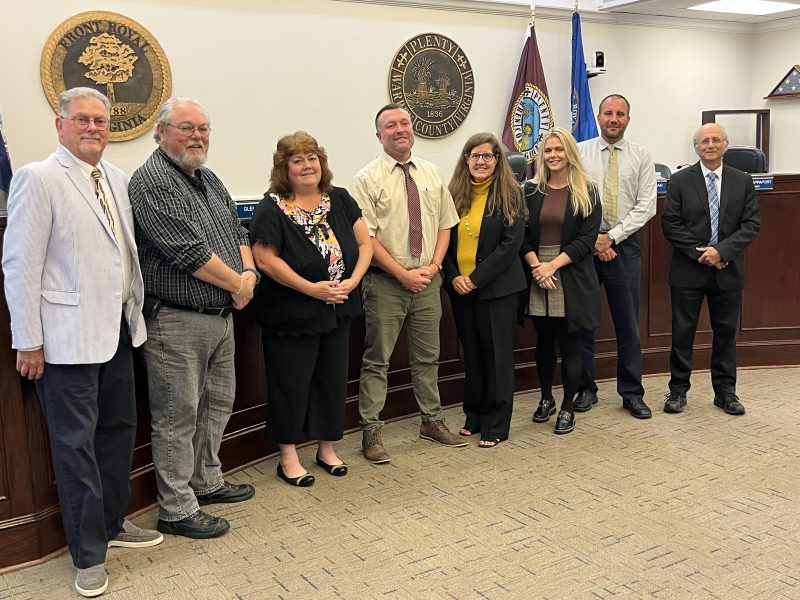
B.J. Wilson, fourth from (L), accepts an award for excellence in financial reporting on behalf of the finance department and stands with the Town Council.
The language of the resolution invites the County to join the Town in supporting the resolution. The resolution being passed, the council proceeded to lay the foundation for further discussion of an appeal that came before them that evening of a decision of the Board of Architectural Review. Having sustained an evening that ranged from ordinance amendments to the two issues that have been the focus of this article, the council went into closed session.

Blue Ridge Wildlife Center Acknowledges a Quarter of a Century of Work in Wildlife Preservation & Human Education

What Does A ‘Fair Share’ Really Mean?

South Warren Ruritan Club Hosts 20th Annual Spaghetti Dinner Fuels Scholarships for Local Teens

Trees Take Root as Virginia’s Frontline Defense Against Urban Heat

Virginia Set to Rejoin RGGI as Utilities Prepare to Pass the Cost Back to Ratepayers

Virginia Joins Multi-State Lawsuit Challenging Trump’s Election Order

Trump Budget Seeks 43% Boost in Defense Spending, Cuts in Many Domestic Programs

Virginia Sees 33,000 ACA Enrollment Drop Since Subsidies Expired, More Likely on the Way

Annual Dental Checkups and Cleanings: Essential Appointments

4 Stimulating Activities for a Healthy Brain After 50
The First Amendment: America’s Unique Foundation of Freedom

How to Tackle Credit Card Debt

Summer Enrichment Camp Gives Teens Hands-On Learning Opportunities

VDOT: Warren County Traffic Alert for April 6 – 10, 2026

David Silek to Remain in Chairman’s Seat of WC Republican Committee Pending 6th District Appeal Decision

Sales Set to Bloom Like Daffodils This Spring

America 250: The Bookseller Who Helped Save the Revolution

Business Growth Series: Why Good Businesses Still Struggle to Grow

Brownies with Mini Chocolate Easter Eggs

Shenandoah Downs Opens 11th Season April 11 with Tribute to Roger Hammer

We Don’t Know Everything About DNA

How PAAS Came to Dominate the Easter Egg Dye Tradition

Spanberger Signs Bipartisan School-Safety, Student Support Bills Into Law

Melanie J. Pomeroy (1958 – 2026)
