
State News
Youngkin Looks Back on Four Years as Governor and Sees Transformation, Not Regret
As he prepares to hand the keys of the Executive Mansion to his Democratic successor, Gov. Glenn Youngkin says his four years leading Virginia exceeded even his own expectations — a tenure he describes as transformative, results-driven, and largely free of regret.
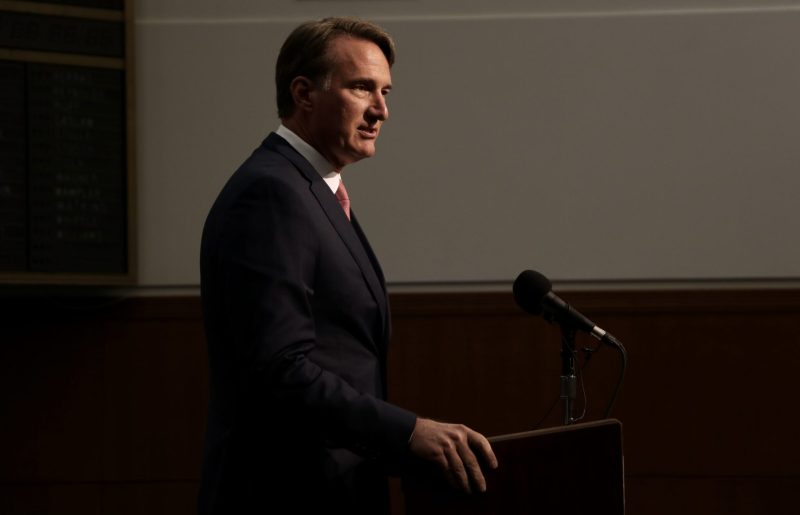
During an interview with the Virginia Mercury conducted days before the inauguration of his successor, outgoing Gov. Glenn Youngkin reflected on his four-year term. (Photo by Charlotte Rene Woods/Virginia Mercury)
In an expansive interview with the Virginia Mercury on Thursday in the governor’s Cabinet Conference Room at the Patrick Henry Building in Richmond — less than 48 hours before Abigail Spanberger is sworn in as Virginia’s 75th governor — Youngkin framed his administration as one that fundamentally changed how state government operates, despite four years of divided government.
“I really don’t like the question about people’s legacy. What I think most about is, what is the impact that we’ve had on Virginia going forward,” Youngkin said. “And it really is a comprehensive transformation of the state, and where it’s going.”
Youngkin, a former private-equity executive who entered public office as a political outsider, said he rejected the idea that governors must limit their ambitions to a narrow set of achievable goals.
Instead, he said, his administration pursued broad changes across nearly every area of state government — from education and public safety to economic development, behavioral health and core state services.
“We came in with a mindset of transforming the way government works, and defining success as delivering results as opposed to activity,” Youngkin said. “That transformation is not defined by a bill or a single program. It is a comprehensive effort that changes the way things are done and delivers results.”
The remarks echoed themes from Youngkin’s final State of the Commonwealth address Wednesday, in which he highlighted record economic investment, regulatory rollbacks, education reforms and public safety initiatives.
A businessman governor grappling with divided government
Youngkin, 59, was elected in 2021 by narrowly defeating former Democratic Gov. Terry McAuliffe, winning a then-purple state at a moment of pandemic-era frustration over school closures and remote learning.
He governed for four years, with Democrats controlling both chambers of the General Assembly for part of his tenure — a dynamic that shaped both his accomplishments and his conflicts.
“I am encouraged by the fact that we have this comprehensive transformation … while we have a divided government,” Youngkin said. “Because we never had the General Assembly aligned with us. And we still were able to accomplish all of this.”
Youngkin said divided government forced negotiation but did not derail his administration’s fiscal agenda, pointing to budgets approved with bipartisan support and the ability to fund major initiatives.
“We generated $10 billion in surplus revenue, $9 billion in tax relief, in a divided government,” he said. “We delivered the funding to support the transformation in education, and behavioral health, and made sure that we could change the way we do business development.”
At the same time, Youngkin used his veto power aggressively during his tenure — a fact Democrats say underscores how often the governor clashed with the legislature.
House Speaker Don Scott, D-Portsmouth, said Youngkin struggled to define a clear governing vision and often prioritized cultural fights over affordability.
“He vetoed a record number of bills,” Scott said in an interview Thursday. “So what did voters do? They hired me to be speaker in the middle of his term, they fired his Republican speaker, and they gave us the majority.”
Scott said Democrats frequently pushed back against what he described as Youngkin’s emphasis on cultural issues rather than kitchen-table concerns.
“The governor wanted less teacher pay; we got more teacher pay. He wanted less for health care; we got more for health care,” Scott said. “He spent most of his time fighting culture wars.”
Scott said Youngkin’s rise was tied to a specific set of circumstances rather than a durable realignment of Virginia politics.
“I think his legacy will be, for Virginia, that he was a flash-in-the-pan governor,” Scott said.
Despite those disagreements, Scott said his personal working relationship with Youngkin improved after Democrats re-took control of the House in 2023, and he credited the governor with making a consistent effort to engage once Scott became speaker.
Scott said Youngkin regularly attended his weekly interfaith prayer breakfasts — early-morning gatherings held every Wednesday at 7 a.m. during the legislative session.
“He didn’t miss one, ever, when I was speaker,” Scott said. “So I give him a lot of credit for that.”
Scott also said he respected Youngkin for entering public life from a position of professional and financial success.
“He could have stayed rich and continued to do his thing,” Scott said. “But the fact that he put his name in the hat and entered the arena, I admire that as well.”
Economic development and deregulation
In the interview, Youngkin framed his record primarily around jobs, investment and what he described as a fundamental reshaping of how Virginia competes for business.
He pointed to what his administration says is $157 billion in committed capital investment, record job growth and a sweeping effort to reduce state regulations.
“When I wrote that executive order on day one to get 25% of our regulations either removed or streamlined, there was the big question, ‘Sir, how do we do this?’” Youngkin said. “And before you know it, we not only got through 25%, we got through 35% of regulations, streamlined saving Virginians $1.4 billion a year.”
Although it’s still not clear exactly how his administration calculated those reductions, Youngkin emphasized that they were accomplished entirely within the executive branch. “There was no bill,” Youngkin said. “It was a managerial exercise.”
Youngkin also pointed to decisions by major companies to locate or expand advanced manufacturing and pharmaceutical operations in Virginia, including facilities announced by AstraZeneca, Eli Lilly and Merck.
These businesses, he said, “made a decision to come and build their futures, their largest facilities in the world, right here in Virginia. That ecosystem is now so strong that we’ll continue to see great companies come.”
House Minority Leader Terry Kilgore, R-Scott, said those corporate commitments — along with Youngkin’s sustained attention to Southwest Virginia — shape how the governor is viewed in much of rural Virginia.
“I think his legacy for Virginia is he’s been our job creator,” Kilgore told The Mercury in an interview Thursday. “On a personal note, he really helped Southwest Virginia during the disasters. He showed up.”
Kilgore said Youngkin’s visibility during the devastating flooding spurred by Hurricane Helene in 2024 and the ensuing human suffering left a lasting impression.
“Seeing him in action when people lost everything, and here Governor Youngkin was praying with them and talking to them — that was really impressive,” Kilgore said.
Education, behavioral health and public safety
Youngkin said education reform was another defining feature of his administration, citing new accreditation standards, revised academic benchmarks, cellphone restrictions in classrooms and expanded tutoring initiatives.
“We established expectations of excellence,” he said. “We overhauled the entire accreditation system.”
But some of Youngkin’s education changes drew sharp criticism, particularly his administration’s initial overhaul of the state’s K-12 history and social science standards.
Early drafts were widely criticized by educators, historians and civil rights groups for omitting context on race and slavery and for what opponents described as political bias, prompting delays and significant revisions after a contentious public review process.
Youngkin also pointed to investments in behavioral health, calling the system “broken” when he took office and crediting his administration with fundamentally changing how services are delivered.
Veteran Virginia political analyst Bob Holsworth said those efforts may be among Youngkin’s most durable accomplishments.
“I think he can take some credit for making further progress on addressing the behavioral health issues in Virginia,” Holsworth said. “And he was very popular in Southwest Virginia for the fact that he showed up a lot.”
Still, Holsworth argued that Youngkin’s governing style relied heavily on executive authority rather than legislation.
“When you look at his legacy, he has no legislative legacy. What you saw on Wednesday was a list of executive actions,” Holsworth said, referring to Youngkin’s final speech before the joint legislature this week, where he touted his accomplishments.
Controversies and regrets
Asked whether he regretted any decisions, Youngkin said he did not — though he expressed frustration over the collapse of a proposed Northern Virginia sports and entertainment complex, which Senate Democrats blocked amid opposition led by Sen. Louise Lucas, D-Portsmouth.
“That was a once-in-a-lifetime opportunity. It would have benefited Virginia hugely,” Youngkin said. “And it was blocked wrongly.”
The proposal would have brought an estimated $12 billion in economic development and 30,000 jobs, according to the administration. Opponents said it wasn’t a project citizens should be responsible for financing, and pointed to possible transportation and environmental challenges with the arena plan.
Youngkin also defended his approach to higher education governance, where his board appointments at UVA and other institutions sparked partisan battles.
“I’m so proud of the board work that our team has done,” he said, criticizing Senate Democrats for blocking nominees he described as highly qualified.
Trump, national politics and political fallout
Youngkin rejected the premise that he distanced himself from Donald Trump during his 2021 campaign, saying Trump’s 2016 victory influenced his decision to run while his own race remained focused on state issues.
“One of the primary influences on my decision to do that was the fact that a businessman named Donald Trump had stepped out of his life, run for president, and won,” Youngkin said, echoing sentiments he shared in a speech at the Republican National Convention in 2024 where Trump became his party’s nominee for president.
“In my race, the key was focusing on state issues, local issues, and not a federal race, because at the end of the day, governor is a state job.”
Youngkin said his relationship with the Trump administration during the president’s second term benefited Virginia through preserved grant funding and federal cooperation.
Holsworth said that embrace ultimately proved costly for Republicans in Virginia, who lost all three statewide races in November.
“That turned out to be a debacle of historic proportions for his own party,” he said. “He essentially made the Democrats’ argument.”
Scott echoed that view, saying Youngkin’s political pivot was noticeable.
“It took him almost four years to begin mentioning Trump’s name,” Scott said.
Leaving office
As he prepares to leave public office, Youngkin said he was surprised by how much his administration was able to accomplish — and by how much he enjoyed serving alongside his wife, Suzanne, whose work on fentanyl prevention he repeatedly praised.
“I didn’t expect we could get this much done,” Youngkin said. “I had ambitions and dreams of what we might be able to do, but I was told by everybody, there’s no way you could do it.”
With his term ending and a transition underway, Youngkin said he is ready to step away from public office, at least for now.
“We’re taking a break,” Youngkin said. “Suzanne and I are going on vacation to an undisclosed location.”

Gov. Glenn Youngkin (left) and Markus Schmidt, senior politics reporter and deputy editor of the Virginia Mercury, during an interview at the Patrick Henry Building in Richmond on Thursday. Schmidt was the first Virginia politics reporter to interview Youngkin after he assumed office in 2022 and the last to sit down with the governor, two days before the end of his term. (Photo by Peter Finocchio/Office of Gov. Glenn Youngkin)
by Markus Schmidt, Virginia Mercury
Virginia Mercury is part of States Newsroom, a nonprofit news network supported by grants and a coalition of donors as a 501c(3) public charity. Virginia Mercury maintains editorial independence. Contact Editor Samantha Willis for questions: info@virginiamercury.com.

3 Ways to Extend the Life of Your Electric Vehicle Battery

Serious Charges Highlight Warren County Grand Jury Indictments

Ducks, Flowers, and Fun: Redbud Festival Returns to Browntown

Potato-Crust Quiche Makes a Lovely Brunch

Faye Barr Vance (1930 – 2026)

James Christopher “Chris” Sain (1948 – 2026)
Alice “Maybelle” Henson (1938 – 2026)

How Sleep and Stress Affect Cancer Risk

Spanberger Signs Sweeping Public Safety and Gun Violence Bills

Horses, Fans Return as Shenandoah Downs Season Begins

Skill Games Halted Again as Spanberger Issues Veto

VDOT: Warren County Traffic Alert for April 13 – 17, 2026

The Cat Who Outlasted Six Prime Ministers

Front Royal, Virginia. Vacation Destination?

Virginia State Police Report Major Drug Seizures in Weekly Crime Suppression Effort

Virginia Secures Birth Control Access as Other Southern States Eye Abortion Pill Manufacturers

SCC Approves Loudoun Transmission Line, Nixes Undergrounding; Final Route to be Determined

Slate of New Virginia Laws Address Health Care and Housing Affordability
James J. Coverston Sr. (1942 – 2026)

Business Growth Series: Your Biggest Problem Isn’t Competition — It’s Being Overlooked

Why Many Experts Say a Concussion Should Be Called a Brain Injury

Missouri Man Arrested in Undercover Operation Targeting Online Crimes Against Children

Trump Tax Plan Credited With Higher Refunds, Lower Taxes

Spanberger Vetoes Fairfax Casino Bill, Citing Local Opposition
