
State News
Report recommends eliminating dual enrollment tuition, fees for high schools
Virginia’s legislative watchdog commission recommends that policymakers consider eliminating tuition and fees for public high school students who simultaneously enroll in community college courses.
The change could improve access for economically disadvantaged students interested in the state’s Dual Enrollment Program, the Joint Legislative Audit and Review Commission concluded in a report released Monday.
Data collected by JLARC indicates that all community colleges and most school divisions have sufficient state and local funding to cover the program’s expenses. Last year, community colleges each received an average of $2.2 million in state general funds and collected an average of $1.7 million in revenue after covering all their dual enrollment expenses.
The study resulted from JLARC Subject Topic Selection Subcommittee members expressing concern about higher education affordability, student debt, and variable costs for dual enrollment across the commonwealth in November 2021.

“I’ve had concerns addressed to me from constituents over the years, and it’s nice to see that we should be able to bring some parity and some closure,” said Del. Terry Austin, R-Botetourt, at Monday’s presentation. “The people that are suffering the most are the students who don’t have the ability [and] their parents [who] do not have the ability to pay, and they should not be affected in that way in the Commonwealth.”
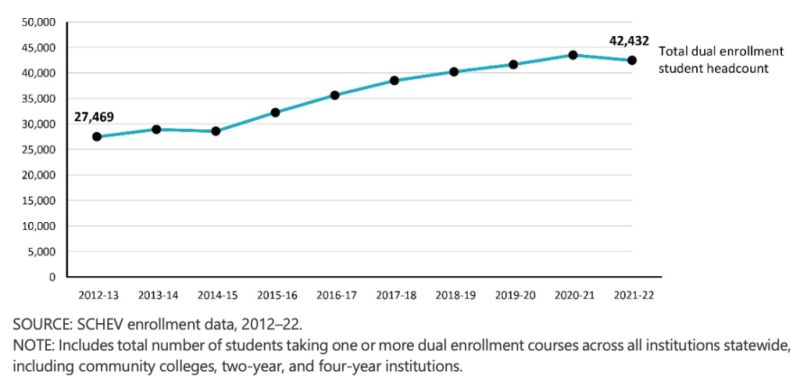
The total number of students participating in dual enrollment has grown over the past decade, according to a Dec. 12 report released by the Joint Legislative Audit and Review Commission.
Participation in the Dual Enrollment Program, which allows students to earn college credits before graduating high school, has increased by 54% since the 2012-13 school year, according to JLARC. Approximately 42,000 students took one or more dual enrollment courses during the 2021-22 school year, with most courses taught on high school campuses.
The study was conducted alongside a review of Virginia’s financial aid policies and practices focused on non-career and technical education dual enrollment courses. That study also found community colleges have substantially more state funds than needed to cover program expenses, while school divisions have sufficient state and local funding for dual enrollment. Most expenses consist of personnel costs and are five times higher for school divisions than community colleges.

Impact of eliminating fees
Researchers said eliminating tuition and fees charged by colleges to school divisions for student participation in the program would save schools approximately $81,000 annually.
Currently, most school divisions absorb the costs of student participation. Costs can change depending on the program’s size and staff, but on average, divisions pay around $200 in tuition costs for each student taking three courses of three credit hours each.
Other school divisions partially absorb tuition and fee costs while passing on the remainder to the students themselves.
Colleges with the highest tuition and fees are in the northern and eastern regions. Tuition rates ranged from $1.50 to $46.50 per credit hour.


On Dec. 12, the Joint Legislative Audit and Review Commission published a chart on how dual enrollment expenses are split among colleges, school divisions, and students.
Sharon Morrissey, interim chancellor for the Virginia Community College System, said in a Dec. 6 letter to JLARC that community colleges are interested in expanding access to the Dual Enrollment Program. However, she expressed concern that the recommendations only apply to community colleges and not other public institutions of higher education.
Morrissey said the recommendations if adopted, could financially impact other students.
“The elimination of these fees for dual enrollment students would shift the burden to exclusively non-dual enrollment students, thus likely causing an increase in mandatory fees to non-dual enrollment students,” Morrissey wrote.

If lawmakers decide to do away with tuition and fees for high school students, JLARC proposed that the General Assembly consider appropriating $6.2 million to replace the lost revenue for colleges. Lawmakers could also provide funds for grants to school divisions that demonstrate the need for financial assistance for their dual enrollment programs, the commission noted.
Addressing teacher shortages
JLARC also found that providing annual bonuses for high school teachers who teach dual enrollment courses could address shortages of qualified educators in such programs.
According to Monday’s report, the number of credentialed dual enrollment teachers dropped by 7% from the 2018-19 school year to 2021-22, which could limit the courses school divisions can offer.
Virginia’s K-12 school system is also feeling the pinch of losing teachers. Data from a previous JLARC report indicated that 10,900 teachers left the workforce ahead of the current school year, while only 7,208 first-time licensed teachers were hired.

Researchers also proposed additional funding to pay community college faculty to teach dual enrollment courses at high schools that lack sufficient credentialed teachers in their geographic area.
Youngkin to announce dual enrollment plan Thursday
On Thursday, Gov. Glenn Youngkin is expected to announce funding for multiple dual enrollment acceleration programs in his budget proposal, allowing students to graduate with an industry-recognized credential or a two-year associate’s degree.
He said in October that “this is a big moment for Virginia to chart a new path that we recognize that our high school students are the future and we need to help them be prepared to take that future.”
Macaulay Porter, a spokeswoman for the governor, did not directly answer a question about whether the plan will require every student to have an industry credential to graduate.
by Nathaniel Cline, Virginia Mercury
Virginia Mercury is part of States Newsroom, a network of news bureaus supported by grants and a coalition of donors as a 501c(3) public charity. Virginia Mercury maintains editorial independence. Contact Editor Sarah Vogelsong for questions: info@virginiamercury.com. Follow Virginia Mercury on Facebook and Twitter.




Warren County Volleyball Set to Host Fauquier Tuesday Night – September 8

Virginia Voters to Decide Reproductive Freedom Amendment in November

South Fork Fly Fishing Tournament Set for Sept. 12 at Shenandoah River State Park

Stone Branch Center for the Arts Welcomes Artist-in-Residence Linda L. Anderson

Amtrak to Suspend Virginia-to-D.C. Service for Critical Track Upgrades Oct. 16–26

Commentary: The Energy Virginia Needs is the Energy We Can Build Now

Labor Unions Are Growing, But Where Depends On State Politics

Phillip Ray Knight (1953 – 2026)

Governor Spanberger Believes Tariffs Are Taxes, Until Virginia Cattlemen Want Tariff Protection

Avtex Remembrance Walk: A Solemn Theme for Labor Day Weekend

Pitch Burst Volunteers Support Warren Coalition Children’s Programs

Never Forget: Front Royal Marks 25 Years Since 9/11 — A Time to Gather, Reflect and Pass It On

National Preparedness Month: How to Get Through a Multi-Day Power Outage

From Workers’ Parades to Backyard Cookouts: How Labor Day Began

Is It Too Late to Sign Up for the All About Trees Class This Year?

The Envelope That Decides Next Year

The Emergency Fund You’ll Actually Build

Stronger, Not Bigger: Rethinking Economic Development in Warren County

Kenneth Lewis Smith (1939 – 2026)

Strong Families Build a Stronger Warren County

The Science Prizes That Make You Laugh, Then Think

Grill the Perfect Corn on the Cob, Then Dress It Up

The Famous Last Words No One Wrote Down

US Supreme Court Again Urged to Permit Trump Vote-by-Mail Restrictions
