
Health
Lung Cancer Often Has No Early Warning Signs: UVA Health Expert Urges Virginians to Get Screened
A persistent cough. A little shortness of breath. Losing weight without trying.
These symptoms may seem harmless or easy to explain away, but they can sometimes signal something much more serious.
As November marks Lung Cancer Awareness Month, UVA Health nurse practitioner Aimee Strong encourages Virginians to watch for changes in their health and learn whether they qualify for potentially lifesaving lung cancer screening.
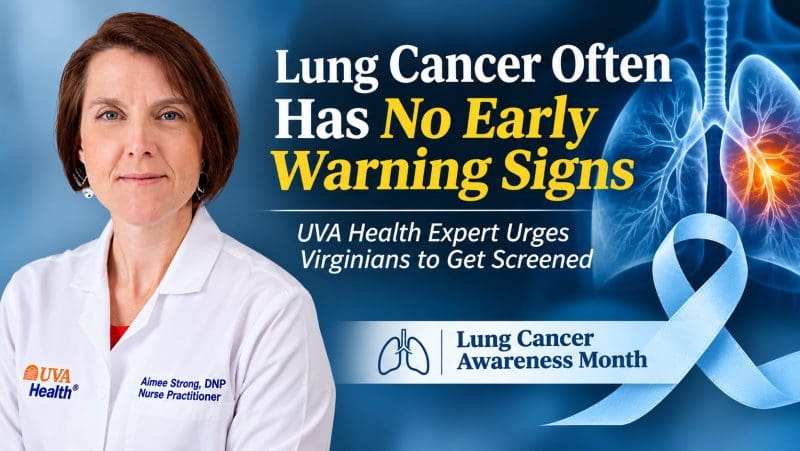
Strong, who holds a Doctor of Nursing Practice degree and specializes in thoracic surgery, lung cancer screening, and pulmonary nodule management, recently discussed warning signs, risk factors, and treatment advances during a UVA Health media briefing.
Her central message was that lung cancer often develops without obvious symptoms, making early detection particularly important.
According to the American Cancer Society, lung cancer remains the leading cause of cancer-related deaths in the United States. The organization estimates that approximately 229,410 Americans will be diagnosed with the disease in 2026, and about 124,990 will die from it.
A Specialist in Lung Cancer Screening and Thoracic Care
Aimee Strong, DNP, AG-ACNP, is a nurse practitioner in thoracic surgery at UVA Health, where she cares for patients with cancers affecting the chest, including lung and esophageal cancer, as well as noncancerous conditions.
She also works closely with people at increased risk of developing lung cancer, helping them navigate screening, prevention, pulmonary nodule evaluation, and smoking cessation.
Strong earned her bachelor’s degree in nursing from Virginia Commonwealth University, followed by a master’s degree from the University of Virginia.

Her nursing career has included experience in psychiatry, digestive health, and hepatobiliary surgery. She later continued her education at Old Dominion University, where she earned her Doctor of Nursing Practice degree.
Through her work in thoracic surgery and lung cancer screening, Strong helps patients understand their risk factors, evaluate suspicious findings, and access appropriate care.
That experience gives her a firsthand perspective on why identifying lung cancer before symptoms develop can make such an important difference.
Warning Signs That Are Easy to Miss
One reason lung cancer can be especially dangerous is that symptoms may not appear until the disease has progressed.
Even when warning signs develop, they can resemble common respiratory problems.
Strong said people should watch for a new cough that doesn’t go away, changes in an existing cough, unexplained shortness of breath, chest pain when breathing, or unexpected weight loss.
For longtime smokers, recognizing a change can be particularly difficult.
Someone accustomed to coughing every morning may assume a worsening cough is simply part of their normal routine.
Similarly, people living with chronic obstructive pulmonary disease (COPD) or emphysema may attribute increasing breathing difficulties to those conditions.

Strong cautioned that people should not automatically dismiss changes.
“So a change to their breathing pattern could be very subtle and easy to ignore,” she explained.
Unexplained weight loss can also develop gradually, making it easy to overlook.
If someone loses five or ten pounds without changing eating habits or increasing physical activity, they should discuss the change with a health care provider, especially if other symptoms are present.
When Should Someone See a Doctor?
Among the more concerning symptoms is coughing up blood.
Strong said even small amounts of blood in mucus deserve medical attention.
“If you’re coughing up large amounts of blood, that’s an emergency,” she said.
Patients experiencing significant bleeding should seek emergency medical care.
A persistent or changing cough, unexplained weight loss, and new breathing problems also warrant a medical appointment.

Importantly, someone experiencing possible lung cancer symptoms needs a medical evaluation, not simply a routine screening appointment.
Screening is designed to find cancer in people who do not yet have symptoms.
Lung Cancer Is Not Limited to Smokers
Although cigarette smoking remains the leading risk factor, Strong emphasized that people who have never smoked can also develop lung cancer.
According to the Centers for Disease Control and Prevention, approximately 10% to 20% of lung cancers in the United States occur among people who have never smoked.
Environmental exposure, inherited risk factors, and certain medical histories can contribute to the disease.
One particularly important concern for Virginia residents is radon.
Radon is a naturally occurring radioactive gas that can enter homes through cracks and openings in foundations.
You cannot see, smell, or taste it.
People can live in a home with elevated radon levels for years without realizing it.

Radon exposure is the second leading cause of lung cancer in the United States.
The Virginia Department of Health reports that elevated radon levels have been detected in every Virginia county, making home testing an important preventive step.
That includes the Shenandoah Valley, where residents should not assume their homes are free of radon simply because no previous problems have been identified.
Radon testing kits are available at hardware stores and through the Virginia Department of Health, which offers discounted kits while supplies last.
If testing reveals elevated levels, qualified radon mitigation professionals can help reduce exposure.
Other risk factors include a family history of lung cancer, exposure to asbestos or silica dust, long-term diesel exhaust exposure, air pollution, and previous radiation treatment to the chest.
Strong encouraged people working in occupations involving dust, fumes, or chemicals to use appropriate protective equipment and ventilation.
Avoiding secondhand smoke and quitting smoking also help reduce risk.
Who Qualifies for Lung Cancer Screening?
Despite the importance of screening, Strong said many people who qualify do not realize the service is available to them.

During the briefing, she estimated that only about 15% of eligible Americans undergo lung cancer screening.
Current U.S. Preventive Services Task Force recommendations call for annual low-dose CT screening for adults who meet all three conditions:
- They are between 50 and 80 years old.
- They have a smoking history of at least 20 pack-years.
- They currently smoke or quit within the past 15 years.
A pack-year measures cigarette exposure over time. Smoking one pack daily for 20 years equals 20 pack-years. Smoking two packs daily for 10 years also equals 20 pack-years.
The screening recommendations were expanded in 2021 to include younger adults and people with shorter smoking histories than previously required.
Strong said those changes improved access to screening, particularly for women and certain minority populations who may develop lung cancer at younger ages or with less smoking exposure.
The American Cancer Society has a somewhat different recommendation, advising annual screening for eligible adults ages 50 to 80 with at least 20 pack-years of smoking history, regardless of how many years have passed since they quit.
Because screening recommendations and insurance coverage rules can differ, patients should discuss their individual circumstances with their health care provider.
What Happens During a Lung Cancer Screening?
For people unfamiliar with the procedure, Strong said the examination is much simpler than many expect.
Lung cancer screening uses low-dose computed tomography, commonly called a low-dose CT scan.
The machine takes detailed images of the lungs using less radiation than a standard diagnostic chest CT.
The patient lies on a table that moves through a large, doughnut-shaped scanner.
Unlike some other imaging examinations, routine lung cancer screening does not require needles, injected contrast dye, or a lengthy procedure.
“There are no needles involved, so there’s no contrast or dye,” Strong explained.
She said the actual scan can be completed in approximately 10 to 30 seconds.
The images allow specialists to look for suspicious lung nodules that may indicate early cancer.
Most lung nodules are not cancerous, but some require additional imaging or testing.
Low-dose CT screening also has limitations, including false-positive findings, radiation exposure, and the possibility of additional testing. Patients should discuss the potential benefits and risks with their health care provider.
Is Screening Covered by Insurance?
For many eligible patients, insurance covers lung cancer screening as a preventive service.
Medicare Part B covers annual low-dose CT screening for eligible beneficiaries ages 50 through 77 who meet the program’s smoking-history and other requirements.
Patients generally pay nothing for the covered screening when their health care provider accepts Medicare assignment.
Many commercial insurance plans and Medicaid programs also cover qualifying patients.
However, eligibility requirements, provider networks, and follow-up testing costs can vary.
Patients should confirm their coverage before scheduling an appointment.
Strong emphasized that patients should not overlook screening simply because they assume it will be expensive or complicated.
For many eligible individuals, the examination is covered and requires only a brief visit.
New Treatments Are Improving Options for Patients
Strong also discussed how lung cancer treatment has changed over the past decade.
For patients whose cancer is discovered early and has not spread, surgery may be an option.
UVA Health offers minimally invasive approaches, including robotic-assisted surgery and video-assisted thoracic surgery, which can remove cancerous tissue through smaller incisions.
These techniques can allow surgeons to remove affected portions of the lung while preserving as much healthy tissue as possible.
For certain patients who cannot undergo surgery, stereotactic body radiation therapy may be an alternative.
The technique delivers highly focused radiation to a lung tumor, often over three to five treatment sessions.
Additional therapies include chemotherapy and immunotherapy, which uses the body’s immune system to help fight cancer.
Treatment depends on the type and stage of cancer and the patient’s overall health.
Strong said UVA Health uses a multidisciplinary approach, bringing together surgeons, medical oncologists, radiation specialists, and other professionals to develop individualized treatment plans.
That means patients may receive recommendations from several specialists working together rather than navigating treatment options separately.
Another advancement is robotic bronchoscopy, which lets specialists reach and biopsy small or hard-to-access lung nodules through the airways.
UVA Health’s interventional pulmonology team is highlighted for using advanced robotic bronchoscopy to help diagnose suspicious nodules.
The procedure may allow doctors to obtain tissue samples with less risk than some traditional biopsy methods.
These advancements give patients access to diagnostic and treatment options that were not widely available just a decade ago.
Prevention and Early Detection Remain Essential
Although treatment options continue to improve, Strong emphasized that preventing lung cancer and finding it early remain critical.
People who smoke can reduce their future risk by quitting. Those who have never smoked can reduce exposure by avoiding secondhand smoke and addressing environmental hazards.
Homeowners can test for radon, while workers exposed to potentially harmful substances can take appropriate safety precautions.
And people who qualify for screening should talk with their health care providers about scheduling an examination.
For many patients, the process may be easier and more affordable than they realize.
The important thing is not to wait for obvious symptoms before learning about personal risk.
With lung cancer frequently developing silently, a conversation with a doctor about screening could make a significant difference.
Residents interested in learning more about the UVA Health Lung Cancer Screening Program can visit UVA Health’s lung cancer screening page or call 434-924-9333.
For information about radon testing, visit the Virginia Department of Health Indoor Radon Program.




Ever Wonder How Front Royal Runs? Citizens Academy Opens Applications for New Class

Mary Ann “Molly” Harrison (1939 – 2026)

Master Gardeners Invite Public to November 14 Symposium on Birds, Native Plants, and Healthy Gardens

Why Some Small Towns Become Destinations (and Others Don’t)

Israel: Through World War I

Virginia Report Reveals Major Gaps in Access to Career and Technical Education Courses, Credentials

You May Be Paying Too Much for Prescriptions: One Question at the Pharmacy Could Save You Money

Fay G. Ingles (1937 – 2026)

John McLane “Johnny” Cole (1943 – 2026)

Joyce Ellen Meadows Powell (1947 – 2026)

Oops All Berries Takes Spotlight in Virginia Breeders Fund “Day of Champions” Card at Shenandoah Downs

Lung Cancer Often Has No Early Warning Signs: UVA Health Expert Urges Virginians to Get Screened

Virginia Governor Pledges Overhaul of Outdated K-12 School Funding Formula

Explosive Spending, Ugly Ads and Courtroom Battles Set Stage for Tense Midterm Elections

Girl Scout Cookie Season Is Going to the Dogs in 2027

Rules for Me, But Not for Thee?

‘Medically Frail’ Medicaid Enrollees Won’t Have to Prove Their Inability to Work to Keep Coverage

Ask Stewart: Why Is Front Royal a Tree City USA?

A Fallen Tree in Washington, D.C., Becomes an Unlikely Memorial

Costumes, Candy and Community Spirit Fill Downtown Front Royal for Hometown Halloween

Leslie Fox Keyser Elementary School Students Celebrate Heroes Day at the End of Red Ribbon Week
One More Parking Space. At What Cost?

VDOT: Warren County Traffic Alert for Nov. 2 – 6, 2026

Reforming Virginia’s School Funding Formula an Idea Whose Time Has Come