
State News
Why groups are fighting over obscure 1960s-era ‘slot and perimeter’ rules at a Virginia airport
This spring has seen increased bickering in Northern Virginia over two little-known aviation regulations called the slot and perimeter rules, which govern operations at Ronald Reagan Washington National Airport in Arlington County. What exactly are they — and why are people fighting over them? Read on to figure out what you need to know.
What is the perimeter rule?
The perimeter rule limits the distance of nonstop flights to and from Reagan National to 1,250 miles — roughly the distance westward to Kansas and Nebraska and as far north as Quebec and Newfoundland.
Initially set at 650 miles in 1966 and then later increased, the perimeter was intended to help reduce congestion at Reagan National and encourage use of the much larger Dulles International Airport in Fairfax and Loudoun counties.
The rule allowed Congress to pass exemptions to the perimeter, which it has done three times in 2000, 2003, and 2012. (Congress has a special interest in both Reagan National and Dulles because the federal government owns them, with operations managed by the Metropolitan Washington Airport Authority, known as MWAA.)

Those exemptions have opened up Reagan to 40 daily flights — or 20 round trips — to and from Seattle, Portland, Salt Lake City, San Francisco, Denver, Las Vegas, Los Angeles, Phoenix, Austin and San Juan. A November 2020 report from the U.S. Government Accountability Office found these flights increased passenger traffic at Reagan National and “likely reduced” some of the airport’s existing capacity.
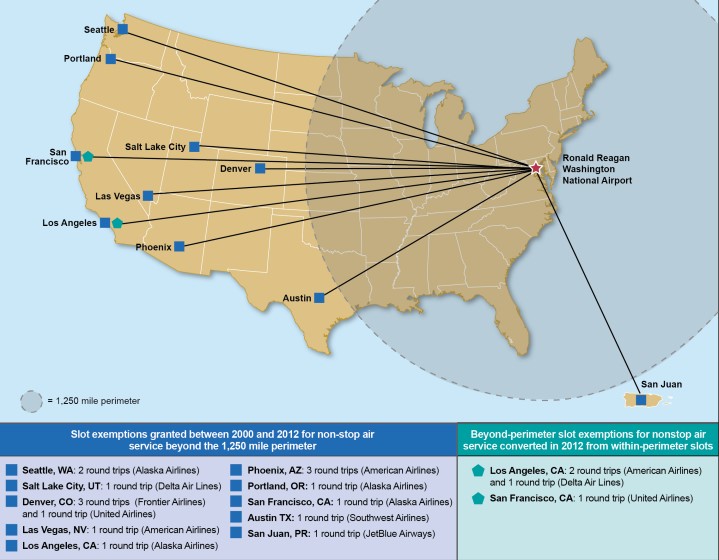
Beyond-perimeter flight exemptions at Ronald Reagan Washington National Airport. (U.S. Government Accountability Office)
What is the slot rule?
The slot rule also called the high-density rule, was created in 1969 to control congestion at five high-traffic airports, including Reagan National. It requires airlines to obtain a “slot,” or authorization, for every takeoff from and landing at the airport; Reagan is currently limited to a maximum of 67 slots per hour.
Slots are allocated by the Federal Aviation Administration, and the GAO noted in its 2020 report that “airlines consider their slots and slot exemptions to be valuable assets.” In 2009, JetBlue co-founder Dave Barger pitched then-Gov. Tim Kaine on a proposal to let airlines “slide” more slots between different hours of the day, arguing it would give more low-cost airlines access to the airport. The Kaine administration directed Barger to discuss the idea with the MWAA.

Why do some people want to change the rules?
Debates over the slot and perimeter rules aren’t new. They typically occur every five years when Congress reauthorizes the Federal Aviation Administration, which it’s slated to do by the end of September. But this year, the issue is getting more attention after U.S. Reps. Hank Johnson of Georgia and Burgess Owens of Utah introduced legislation last month to add 28 additional flights to Reagan National both within and beyond its current perimeter.
“Five years ago, there wasn’t as much of an organized effort,” said Brian Walsh, a Fairfax resident who serves as the spokesperson for the Capital Access Alliance, a coalition of business organizations that most notably includes Delta Air Lines. Since then, he says, “more people are flying than ever before,” and the population in Northern Virginia and around Dulles has grown.
“Nothing has been changed in a number of years, and so with this year’s authorization bill, we see an opportunity to modernize what many of us see as an antiquated” system, he said.
The Capital Access Alliance has mounted an aggressive campaign to get Congress to authorize the additional flights, which it argues will allow up to 1 million more passengers to fly to and from locations outside the perimeter, drive down ticket prices and create over 1,000 new jobs. An analysis by the group concludes Reagan National is “under-utilizing its capacity compared to other major airports in the top ten U.S. metros,” and prior additions of beyond-perimeter flights there have “not negatively impacted the overall passenger growth at” Dulles.

“Dulles is fully equipped to survive on its own. There are hundreds of thousands of people who live around it today,” said Walsh. “This is about giving air travelers more choices.”
Why do others want to keep the current system in place?
Not everyone agrees. A counter-organization is known as the Coalition to Protect America’s Regional Airports has emerged to oppose the proposal, saying adding flights from Reagan National “would create unnecessary gridlock, threaten jobs and local businesses, risk connectivity for countless communities, and increase congestion, delays, and noise.”
The coalition, which includes the MWAA as well as United Airlines, several Virginia chambers of commerce and 17 Virginia airports, points in its defense to a May 25 memo from the Federal Aviation Administration that called the Capital Access Alliance report “flawed.” Instead, the FAA wrote, additional flights “would likely have a negative impact on operational performance and passenger experience,” and Reagan National “is more delay prone than most other airports.”
Furthermore, argued coalition director Scott York in a release on the group’s formation, “if the slot and perimeter rules are removed or changed, airlines will be incentivized to replace routes that promote and sustain nationwide connectivity with longer-haul, more profitable flights. These lost connections will have a significant impact on the local communities that rely on regional airports for economic development as well as safe and convenient travel.”

The MWAA contends that Reagan National is already operating at full capacity and has the busiest runway in the nation, with 819 daily takeoffs and landings on average.
“While [Reagan National] is very popular because of its proximity to Capitol Hill, it simply cannot accommodate all the flights that airlines want to send to Washington,” said MWAA President and CEO Jack Potter in a statement urging Congress to reject the increases.
What’s next?
The debate could continue at least through the summer. The current FAA authorization is set to expire at the end of September, but it’s not unusual for Congress to extend the deadline.
Walsh said the Capital Access Alliance is currently focused on “educating” the public and members of Congress about the newest slot and perimeter proposal. It will have to win over a number of key votes, including those of Virginia’s U.S. senators, Democrats Mark Warner and Kaine. This spring, the two joined with Maryland Sens. Ben Cardin and Chris Van Hollen to convey their “strong opposition to any attempts at changing” the current slot and perimeter rules. Virginia’s six Democratic members of the U.S. House of Representatives are also opposing the measure.

“With the expansion of Metro access to Dulles, long-distance flights from the Washington region have never been more accessible or competitive,” Warner and Kaine wrote in an April statement. “The slot and perimeter rules help to balance consistent world-class aviation services at the region’s three major airports, which has in turn allowed for billions of dollars in private-sector capital investment in the metropolitan Washington area.”
by Sarah Vogelsong, Virginia Mercury
Virginia Mercury is part of States Newsroom, a network of news bureaus supported by grants and a coalition of donors as a 501c(3) public charity. Virginia Mercury maintains editorial independence. Contact Editor Sarah Vogelsong for questions: info@virginiamercury.com. Follow Virginia Mercury on Facebook and Twitter.




What the Power to Prohibit Actually Requires

Anthony Dale “Tony” Pullen

Coolidge’s Vision of Prosperity Through Free Trade

ORDER OF PUBLICATION: In the Circuit Court for Warren County, Virginia

Business Growth Series: If You’re Burned Out, Your Business Shows It
Support Scott Lloyd in Warren GOP Leadership Vote

Mexican-Style Grilled Corn on the Cob Adds Bold Flavor to Summer Cookouts

This Week’s Showtimes at Royal Cinemas as of July 31st

Definition and Prohibition of Data Centers Recommended Unanimously at Special Town Planning Commission Meeting

Assistant F&R Chief Gerry Maiatico Responds to South Warren Citizen Concerns About Service Reduction

Virginia Launches New Unit Targeting Illegal Vapes and Intoxicants

Charity, Refugees & Our Constitution

How the 8th Congressional District Democratic Primary Reflects Party’s Shifting Identity and Priorities

Virginia’s Disability Services Gap Persists Despite Progress, Leaves Young Adults Vulnerable

Loudoun County, Other Virginia Localities Consider Hitting the Brakes on Data Center Development

Opposite Shores to Perform July 30 at Gazebo Gatherings

‘People Movers’ Out, More Parking In: Trump Announces $22.5B Washington Dulles Makeover

TSA Shares Passengers’ Personal Information With Immigration Enforcement, Documents Show

Obamacare Enrollment Declines in 49 States; Virginia Saw 8% Drop

Virginia Voters Could Gain a Bigger Voice in Choosing the 2028 Presidential Nominees

Virginia Education Department Seeks New Student Assessment Vendor

Pro-Data Center Industry Group Behind Ad Campaign in Oregon, Virginia, Five Other States

Grilled Beef Salad Makes a Fresh, Protein-Rich Summer Meal

Warren County Welcomes Nearly 50 New Teachers, Looks Ahead to New School Year
