
State News
Commentary: Bills to Bring More Solar to Virginia Are Moving This Year
Virginia’s desire to be a leader on clean energy has faced numerous challenges over the past few years, coming from many different directions. Landowners who want utility-scale solar on their rural property face increasingly hostile county boards, with no provisions for relief.
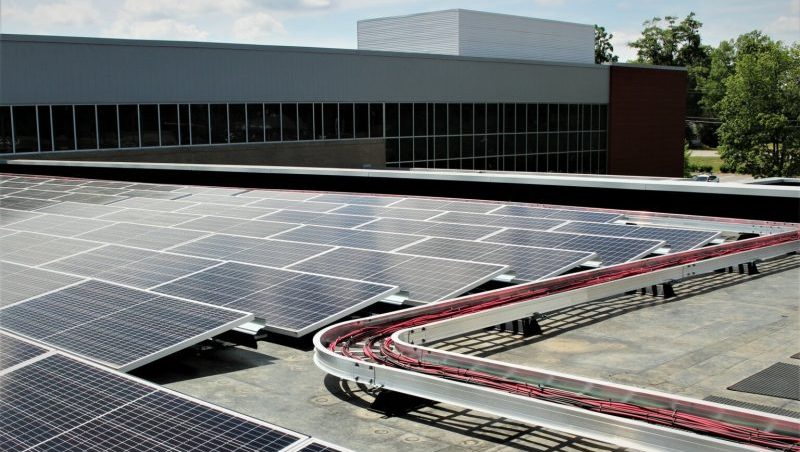
Solar panels on the roof of Powhatan Elementary School. A bill in the state Senate would exempt public schools from having to pay the high costs of interconnecting small-scale solar facilities. (Sarah Vogelsong/Virginia Mercury)
School systems, local governments and commercial customers that want solar on their buildings have been blocked by expensive new interconnection requirements imposed by Dominion Energy. And the clock is ticking on net metering, the program that gives customers with solar panels a one-for-one credit on surplus electricity they feed back into the grid.
The solar industry is used to struggling for every foothold it gets in Virginia, but these new challenges come at a particularly bad time. With data center growth creating huge pressures on our electricity supply, Virginia needs more clean energy in every size range, and needs it now. Any coherent approach to meeting demand has to include removing unnecessary barriers to both utility-scale and distributed solar. That both are facing more barriers, rather than less, suggests the state still hasn’t figured out what it takes to be an energy leader.

None of the legislation at the General Assembly this year addresses this fundamental failing head-on, but several bills take on some of the barriers. The ones that seem most likely to make it through the gauntlet of committee votes are already much weakened from their former selves, but are that much more likely to make their way eventually to the governor’s desk.
The biggest impact for utility solar projects could come from siting legislation developed by the Commission on Electric Utility Regulation (CEUR) and carried by Del. Rip Sullivan, D-Fairfax, and Sen. Creigh Deeds, D-Charlottesville. The legislation tackles the biggest obstacle to unleashing gigawatts of clean, low-cost energy across Virginia: local governments that deny permits to solar and energy storage facilities, acceding to neighbors who don’t want to have to look at solar panels where they once saw fields and forests. (Anti-solar fossil fuel front groups don’t help matters either.)
The local governments have many legislators on their side, even those anxious to attract power-hungry data centers and industrial development, and even the ones who usually side with property owners against local government. CEUR executive director Carrie Hearne produced draft after draft of legislation seeking some sort of compromise, each a little weaker than the last.
The latest version of Senate Bill 1190 has made it to the Senate Floor. It pressures local governments but stops short of coercing them. They are required to include in their comprehensive plans targets for energy production and energy efficiency (the latter an interesting addition), and the targets are supposed to be consistent with regional strategic plans that are also now required to take energy into account. In evaluating specific projects, localities must consider advisory opinions that will be issued by a new interagency panel of experts recruited from Virginia universities.

Perhaps of greatest import, localities can no longer adopt ordinances that ban all projects outright or place unreasonable restrictions on them; nor can they deny permits “without a reasonable basis.” On the other hand, a tacked-on enactment clause also states that “Nothing in this act shall be construed to require a locality to approve an application for a solar facility or energy storage facility.”
The Senate bill “incorporates” (by which is meant, it jettisons the provisions of) another solar siting bill from Sen. Jeremy McPike, D-Woodbridge, and a separate piece of legislation from Sen. Schuyler VanValkenburg, D-Richmond, that would have prescribed rigorous best practices for utility solar projects. The failure of VanValkenburg’s industry-led bill to move forward on its own, or to have its provisions actually incorporated into the Deeds bill, mystifies me, though a companion to VanValkenburg’s bill in the House from Del. Candi Munyon King, D-Dumfries, HB2438, passed the House 48-46.
If you are left wondering how much Deeds’ bill actually advances the cause, you’re not alone. But even with so much ambiguity in the language, all the Republican members of the Senate Commerce and Labor committee voted against the revised bill, leaving only Democrats to move it along. The bill awaits a vote in the full Senate.
On the House side, Sullivan’s HB2126 was killed in a subcommittee vote after both the Virginia Association of Counties and members of the solar industry testified against it (foolishly, in my opinion, as they will not get a better deal).

Bills advancing small-scale solar move forward
Legislation promoting distributed generation did not go through the CEUR pipe, but these bills show some wear and tear of their own. A loose-knit group of advocates under the banner of the Equitable Solar Alliance came in with a package of three bills, all of which remain alive after favorable committee votes.
HB1883, from Del. Katrina Callsen, D-Charlottesville, increases the tiny carve-out for distributed solar that is part of Dominion’s obligation to buy renewable energy certificates in compliance with Virginia’s renewable portfolio standard. The bill has been pared down since it was introduced but still makes several changes benefiting behind-the-meter solar and battery storage systems under 3 MW. The distributed generation carve-out, currently 1% of the renewable standard target, will get bumped to 3% in 2026 and 5% in 2028, with further changes possible later if the the State Corporation Commission (SCC) decides on it. Third-party power purchase agreements, which had been restricted to commercial projects, will now be available to residential customers. And whereas currently only projects smaller than 1 MW can earn up to $75 per renewable energy certificate, the bill now makes that amount available for projects up to 3 MW. (Certificates for larger solar projects are effectively capped at $45 per certificate.)
Callsen’s bill also raises to 600 MW, from 200 MW currently, the target for solar on previously developed sites. It also specifies that 65% of distributed projects qualifying for the Virginia Clean Economy Act’s 1,100 MW target for solar under 3 MW should be developed by non-utility providers.
HB1883 passed the House unanimously. Its Senate companion, SB1040 from Valkenburg, made it through committee without Republican support but passed the Senate 26-14.

Two other bills, HB2346 from Del. Phil Hernandez, D-Norfolk, and SB1100 from Sen. Ghazala Hashmi, D-Richmond, establish a pilot program for virtual power plants (VPPs), which aggregate customer solar and storage resources and demand response capabilities. In concept, a VPP allows a utility to pay customers to let it make use of these capabilities, enabling it to meet peak demand without having to increase generation. (If you are familiar with programs in which your utility pays you to let it cycle your air conditioner off for a few minutes at a time on hot summer days, you have the idea.) VPPs are becoming popular in other states as a way to subsidize customers’ investments in things like battery storage, while reducing utility costs and saving money for all ratepayers.
The original hope for this legislation was ambitious: a vision of energy democracy that would reshape the way utilities interact with residential and commercial customers and make the most efficient use of new technologies like electric vehicle charging and smart appliances. The financial benefits to customers could even be enough to offset the costs of investments like home batteries, potentially offering a way for rooftop solar to remain affordable even if the SCC guts Virginia’s net metering program.
But, this being Virginia, the legislation making its way through committee calls only for pilot programs that utilities design and largely control, although they will be voluntary for participants. After 2028, however, the SCC may create permanent programs. SB1100 passed the Senate 22-18. HB2346 reported from House Labor and Commerce 16-6 and awaits a floor vote.
The third bill in the package, HB2356 from Del. Candi Munyon King, establishes an apprenticeship program to help develop a clean energy workforce, and requires participants to be paid prevailing wages. This bill is more politically divisive than the first two, and it advanced only on party-line votes from Labor and Commerce and Appropriations. A companion bill passed the Senate on a party-line vote as well. With Republicans unified in opposition, we are likely to see amendments or a veto from the governor.

A couple of other bills seek to address the costs of interconnecting small-scale solar facilities, including those on schools and government buildings. After Dominion Energy changed its rules in late 2022, customers found the cost of connecting solar facilities to the distribution grid was suddenly so high as to make it impossible to pursue projects in the affected size range. SB1058 from Sen. Adam Ebbin, D-Alexandria, would simply exempt public schools from interconnection costs. It has not yet been heard in committee.
HB2266 from Del. Kathy Tran, D-Springfield, takes a more nuanced approach that does not exempt any customers from interconnection costs, but does require the SCC to approve upgrades to the distribution system that are needed to accommodate grid-connected solar — a safeguard designed to prevent the utility from larding on costs. The utility must then spread the costs across all projects that benefit from the expanded capacity. This strikes me as a pretty elegant solution to the interconnection muddle. HB2266 reported from Labor and Commerce on a 14-8 vote.
Finally, a bill from Del. David Bulova, D-Fairfax, would allow local governments to include in their land development ordinances a requirement that certain non-residential applicants install solar on a portion of a parking lot. HB2037 passed the House on a 64-32 vote and will now go to the Senate.
by Ivy Main, Virginia Mercury
Virginia Mercury is part of States Newsroom, a nonprofit news network supported by grants and a coalition of donors as a 501c(3) public charity. Virginia Mercury maintains editorial independence. Contact Editor Samantha Willis for questions: info@virginiamercury.com.




The Signer Who Paid the Price

Right Trees Can Make Windbreaks Stronger and Longer Lasting

The Declaration of Independence at 250

Coolidge’s 1926 Warning Still Echoes Nearly a Century Later

VDOT: Warren County Traffic Alert for July 6 – 10 2026

Business Growth Series: If You’re Not Creating Opportunities, You’re Losing Them

Virginia Launches Nation’s First Court-Ordered Speed Limiter Program for Reckless Drivers

Virginia’s Reproductive Rights Amendment Faces Legal Challenges Over Procedural Step, Language

Cities, Towns in Virginia and Across the Nation Revive Teen Curfews Amid Summer Crowds

Tick Bites Are Surging in the US This Year. Here’s What To Know.

Three Founders – One Day – One Destiny

Samuels Public Library Unveils Packed July Schedule for Children, Teens and Adults

Quiz: 250 years of American history

The Founder Who Actually Freed All Slaves

July 1 Marked Statewide Start of a Ban on the Use of Certain Plastic Foam Foodware Containers

Technology Business Versus Data Center: Town Planning Commission Deep Dives into Definitions

Celebrate Independence Day Close to Home

Middletown Announces Grand Marshals for America 250 Independence Day Parade

Virginia Braces for Dangerous Heat Wave Ahead of Fourth of July Weekend

Cardinals Host Woodstock River Bandits Friday, July 3 at Bing Crosby Stadium

Medicaid Again to Cover Non-Abortion Care at Planned Parenthood as GOP Ban Ends

Justice Department Sues Virginia Over New Semi-Automatic Rifle Ban

Warren County Sheriff’s Foundation Working to Strengthen Community Connections

Dr. Arthur Gaillard Gower III (1933 – 2026)
