
State News
How the Virginia Department of Health is Healing Internal Issues Amid Federal Funding Cuts
This article, Part One of the Mercury’s Pulse Check series, was produced as a project for the USC Annenberg Center for Health Journalism’s 2025 Impact Fund for Reporting on Health Equity and Health Systems.
In late March of this year the Virginia Department of Health (VDH) was notified that three COVID-19-era grants were being prematurely cancelled. This resulted in a loss of $219 million dollars the state had used to support public health initiatives, the layoff of hundreds of employees around Virginia and the compounding of existing challenges, including a $33 million deficit and burned-out staff.
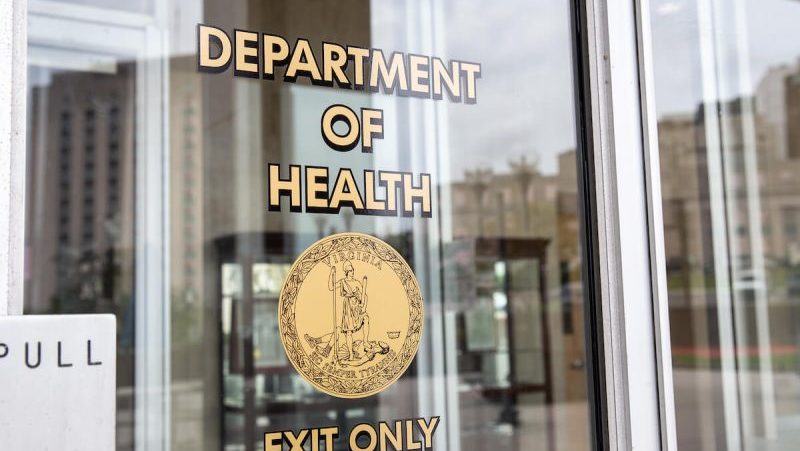
Virginia Department of Health offices in Richmond. (Photo by Parker Michels-Boyce for The Virginia Mercury)
VDH is a state agency with several branches of public service, not all of which are as publicly-facing as local health districts were at the height of the pandemic and COVID vaccine rollout in 2020 and 2021. VDH plays many roles in public health; it performs safety inspections of public facilities and long-term care centers, conducts water quality testing, oversees local health districts around the state that operate clinics, and disburses state and federal funding to nonprofit organizations and free clinics.

For Alexandria’s health district, the sudden cancellation of three federal grants meant 11 people were laid off.
As he cleared his throat and stared at a note offscreen on a recent Zoom call with The Mercury, district director Dr. David Rose listed out the numerous duties those workers had carried out.
“I’m just gonna read it because I can’t do it justice,” he said, describing how staff assisted in community immunization clinics, operated IT systems, and connected clients between the VDH district and local community resources. He explained how community health workers conducted public health outreach to various groups in the region as well.
Alexandria, like much of Northern Virginia, typically has many affluent residents and a sizable portion of federal employees that commute to Washington D.C. for work. But the area is also home to immigrants from many countries like Afghanistan, El Salvador and other South American countries as well as those in East Africa, Rose explained. As such, VDH’s health district there offers information in multiple languages.

The shock to the system didn’t last too long, he said, as he was able to tap into another federal funding source — the American Rescue Plan Act, a 2021 law that dispensed public health funding to states and localities. Rose said he was able to shift some people’s salaries into ARPA funds and in a Hail Mary, Alexandria’s city council earmarked some funding for the local health district as well. This means that nine of the employees were able to return to work for the time being.
While Rose’s district has been able to pivot, he emphasized that each local health district around the state has different needs unique to their populations.
“If you’ve seen one health district, you’ve seen one health district,” Rose said. “You can’t make too many generalizations about what their finances are like, what the politics are like, what the needs are.”
‘Billiard balls hitting each other’
Rose likened the grant cancellations and various federal health care changes to “billiard balls hitting each other.”

This is because he’s also watching for the looming impact of changes to hospital funding mechanisms and Medicaid that were outlined in a reconciliation bill that Congress passed and President Donald Trump signed this summer. As thousands of Virginians stand to potentially lose health coverage through Medicaid and hospitals brace for cost increases that may lead to service cuts, staffing issues, or in some cases, closures, patients may rely even more heavily on local health districts, free clinics and nonprofit organizations.
Additionally, long before state health departments across the country had to grapple with changes in federal funding, Virginia’s already had a grim diagnosis — staffing issues, low morale and a $33 million dollar deficit in its emergency office, $4 million of which stemmed from fraudulent spending.
An audit of VDH’s Office of Emergency Medical Services revealed embezzlement by a former department head and lack of accountability among staff. Millions of dollars had gone towards unnecessary spending and the ousted manager has since been convicted.
Issues upstream meant that trauma centers had received critical funding late and an annual educational symposium for first responders was cancelled last year. A study of VDH at-large conducted by the state’s Joint Legislative Audit and Review Commission in 2024 found high staff turnover and a problematic hiring process alongside low morale, training and procurement issues.

While the prominent issues plaguing the department came to light last year, they’d been developing for a while.
“Lack of accountability is contributing to low morale and high turnover,” JLARC analyst Andrew Dickinson told state lawmakers last year while presenting the audit.
Beyond staffing, financial mismanagement extended beyond the troubled emergency office. Following repeated procurement issues with the Environmental Protection Agency, VDH had to begin fronting its own cash and seek payback through grants later.
“In 2022 EPA was not happy with the way that we were handling our grants. So we went under a reimbursement system with them,” VDH Commissioner Karen Shelton told The Mercury in an interview.

As grim as the findings were, they also pointed to pathways for solutions — a healing process VDH has been undertaking for more than a year.
VDH’s treatment plan
JLARC outlined 30 recommendations for VDH to work on in its report, which revealed the range of issues state lawmakers deemed “disturbing.”
Some, Shelton emphasized, had been underway prior to the publication of the reports, but some “have definitely been concentrations over the last year.”
In restructuring how VDH operated, officials created a chief financial officer position as well as an office of grants applications.
The EPA grant was moved out of its reimbursement structure this summer, which Shelton pointed to as a benchmark of success.
The department has also worked to retain existing staff and fill vacancies with urgency.
“As we looked at coming out of (the pandemic), our agency had a lot of needs with employee burnout,” Shelton said.
She wanted to look at “employee resiliency and what we can do to kind of replenish and nourish from within.”
The agency created an employee advisory council and hired a workforce development and engagement director, actions Shelton believes have improved staff morale.
Chief Operating Officer Christopher Lindsey said that he began implementing monthly operating reviews in late 2022 to start fostering better communication between staff. Those meetings began to bring to light some of what would later come up in the audits, he said.
Shelton said that the whole agency has gone through training refreshers over the past winter and spring to “make sure we hold people accountable to do their jobs but also to make sure they have what they need.”
Shelton also credited ARPA funding and allocations from Virginia’s state budget with helping the department update its information technology systems.
VDH now monitors the emergency office more closely with new accountability measures. For example, an online dashboard that allows municipalities to track funding in real time helps ensure that the rescue squad funding indeed goes towards essential equipment and training that emergency responders need.
A 2022 change in state law also helped VDH broaden its candidate pool to fill local health district director positions in recent years. Previously, only physicians could helm the districts before state lawmakers allowed people with public health degrees to serve in those roles. Now, with all 35 health director positions hired, Shelton said VDH has had regional health directors report to the commissioner of community health service.
“Having the regional health directors on board has been a wonderful thing to help with our leadership and accountability and span of control,” Shelton said.
As VDH continues to rehabilitate itself so that it can continue to serve people around Virginia, Rose said district directors are watching how federal changes affect things locally, from regional economies to health care access needs.
“One thing impacts another and people don’t always see how they are all connected,” he said.
Rose used another analogy to liken VDH to part of a cork board of pins and strings that connect the agency with social service departments, religious institutions as well as public and private health care institutions.
“That really is public health,” he said. “We can’t do it alone.”
Part Two of the Virginia Mercury’s Pulse Check series, on how hospitals and free clinics are shoring up ahead of big federal health care changes and what it means for patients, will be published Tuesday, Oct. 21, 2025.
by Charlotte Rene Woods, Virginia Mercury
Virginia Mercury is part of States Newsroom, a nonprofit news network supported by grants and a coalition of donors as a 501c(3) public charity. Virginia Mercury maintains editorial independence. Contact Editor Samantha Willis for questions: info@virginiamercury.com.




Front Royal Cardinals Open Home Stand Against New Market Rebels Friday Night

From Service to Long-Term Health Risks: Reflecting on Warren County Veterans This Military Appreciation Month

Sleep and the Senior Years: What Actually Helps

Berry and Mascarpone Crepes Make a Sweet Start to the Day

Defensive Driving Helps Reduce Risk on the Road

Front Royal Gallery Extends Two Popular Art Exhibitions Through July 26

County Supervisors Unite in Movement Toward a Finalized Budget for Coming Fiscal and Calendar Years

Front Royal Cardinals to Host Youth Baseball Camps at Bing Crosby Stadium

Gazebo Gatherings Summer Concert Series Opens June 11 in Front Royal

State Report Finds 13 Rural Hospitals Vulnerable to Closure

Kaine Introduces Legislation to Address Teacher Shortage, Equip New Educators

Trump Launches New Strikes on Iran After US Army Helicopter Downed

Treating Cataracts: The Good News Keeps Getting Better

Cherry Mini-Clafoutis Offers a Simple Taste of Cherry Season

Electric Scooters: Why You Should Always Wear a Helmet

Blue Ridge Wildlife Center Patient of the Week: Barred Owl

Town Council Weighs Pros and Cons of Accommodating Special Events on Town Property

The Lee Resolution and the Road to Independence

State Police Seek Witnesses in Fatal I-95 Crash in Stafford County

POLICE: 7 Day FRPD Arrest Report 6/8/2026

Judge Approves Settlement Over Rejected Virginia Student Voter Registrations

High-Potency Cannabis Fuels State Debates Over Psychosis and Addiction Risks

Why Drills and Training Actually Save Lives

Racket Sports Offer Fitness, Fun and Friendship
