
State News
GOP’s Hope to Undo Virginia’s New Redistricting Power Grows After Judge Halts Maps
After losing Tuesday’s closely watched redistricting referendum, Virginia Republicans are now shifting their focus to the courts, arguing the legal fight — not the ballot box — will ultimately determine whether the measure stands.
That legal fight escalated late Wednesday, when a Tazewell County Circuit Court judge issued a new ruling halting implementation of the voter-approved amendment less than 24 hours after it passed.
With nearly all votes counted by Wednesday afternoon, the “yes” campaign prevailed by just over 3 percentage points, 51.45% to 48.55%, out of nearly 3.1 million ballots cast, according to unofficial data by the Virginia Department of Elections.
While the result initially cleared the way for newly drawn congressional maps to take effect, the latest ruling by Judge Jack C. Hurley pauses that process — at least for now — as the case ultimately heads to the Supreme Court of Virginia.

Virginia Attorney General Jay Jones said the state will move quickly to challenge the ruling, writing on X that his office “will immediately file an appeal in the Court of Appeals” and arguing that “an activist judge should not have veto power over the People’s vote.” He added that the state “look(s) forward to defending the outcome of last night’s election in court.”
And for GOP leaders, the narrow margin reinforces their case.
House Minority Leader Terry Kilgore, R-Scott, told reporters Wednesday that Republicans are now looking to the state’s highest court as their best chance to invalidate the result.
“I think the Supreme Court will expedite it because they know that we’ve got to have the decision sooner rather than later, because folks are going to be voting, folks are going to be trying to get their signatures to get on the ballot, and things of that nature,” Kilgore said.

He argued the close vote undercuts Democratic claims of a sweeping mandate.
“I actually think yesterday’s results helped us, because it shows how close Virginia is. We’re not a 10-1 state, we’re still a 6-5 state,” he said, adding that “for any Democrat to be going around here spiking the ball today is just disingenuous.”
Kilgore acknowledged the loss but said Republicans expected a difficult fight from the start.
“It was much closer than last year, (but) we still lost. We’re disappointed in losing,” he said, arguing that “misleading (ballot) language” and outside spending helped Democrats prevail by a narrow margin.

“We think we’re going to win in the courts,” he said.

House Minority Leader Terry Kilgore, R-Scott, says Republicans will continue to challenge Virginia’s redistricting referendum in court after voters approved the measure Tuesday. (Photo by Markus Schmidt/Virginia Mercury)
Legal challenges center on process
At least three lawsuits are moving forward in an effort to block or invalidate the referendum, including one that goes to the heart of how the amendment reached the ballot.
Wednesday’s ruling, however, stems from a separate lawsuit filed last year by the Republican National Committee, which alleges that the General Assembly violated constitutional requirements in advancing the amendment. Hurley’s decision in that case effectively halts implementation of the referendum while legal challenges continue.

RNC Chairman Joe Gruters called the ruling “a major victory for Virginians,” arguing that Democrats “attempted to force an unconstitutional scheme to tilt congressional maps in their favor.”
He said the court “recognized it for what it is – a blatant power grab,” adding that the GOP will continue to challenge what he described as an illegal process and pointing to the narrow margin of Tuesday’s vote.
That case is distinct from another closely watched challenge filed late October in the same court by Republican lawmakers and a member of the Virginia Redistricting Commission, which argues that Democrats violated state law when they expanded a special legislative session to take up the amendment.
Oral arguments in the case are on the state’s Supreme Court docket for Monday.

The plaintiffs — Sens. Ryan McDougle of Hanover and Bill Stanley of Franklin, Kilgore, and Commissioner Virginia Trost-Thornton — contend that only the governor can call a special session and that it must be limited to the topics originally set.
Their challenge focuses on a letter from House Speaker Don Scott, D-Portsmouth, reconvening a previously called session to consider redistricting. The same Tazewell judge initially sided with the plaintiffs, but the Supreme Court of Virginia later allowed the referendum to proceed while the case continues.
With multiple cases now active, it remains unclear whether the Supreme Court of Virginia will take them up individually or consolidate them into a single proceeding. But given the looming election calendar, legal observers expect the justices to move quickly.
The amendment itself allowed lawmakers to redraw Virginia’s congressional districts outside the normal once-a-decade census cycle. Democrats have described it as a temporary response to redistricting moves in other GOP-led states at the urging of President Donald Trump.
The new maps, which were expected to take effect immediately after Tuesday’s vote, are now in limbo pending further court action.
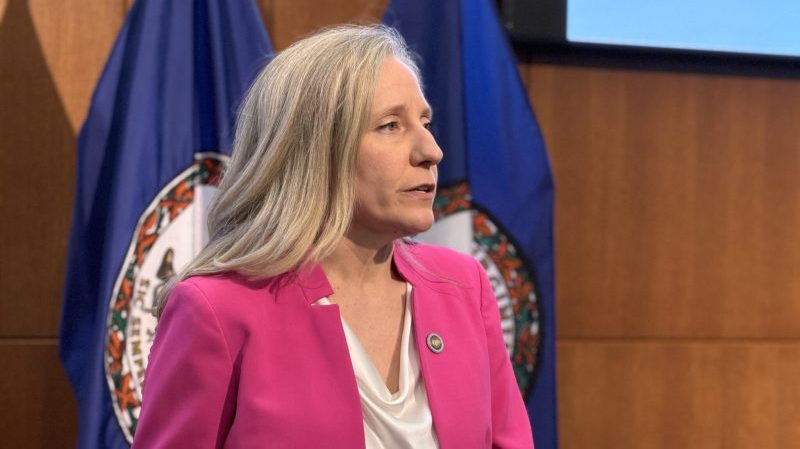
Gov. Abigail Spanberger speaks to reporters in Richmond Wednesday about the outcome of Virginia’s redistricting referendum and the path forward. (Photo by Markus Schmidt/Virginia Mercury)
xperts say overturning vote would be difficult
Legal scholars say that even with unresolved questions about the process, overturning a voter-approved referendum would be a steep climb.
Carl Tobias, a professor and expert in constitutional law at the University of Richmond, said the court will likely weigh both the legal claims and the broader implications of setting aside the result.
“I think that the justices appreciate that redistricting is a politicized issue and are sensitive to the fact that the General Assembly majority sent this issue to the voters,” Tobias said.
“The voters have now spoken at the polls with ‘yes’ winning by a comparatively small margin that was not close enough to trigger an automatic recount,” he added, saying the court may be reluctant to intervene “unless a majority of the court finds that there is something clearly illegal about the vote.”
Longtime Virginia political analyst Bob Holsworth said there is “certainly a chance” the court could act, noting that some objections raised by Republicans “are not insignificant.”
Still, he said the court will have to weigh those concerns against the fact that voters have already weighed in — a dynamic that could make judges cautious about contrary action.
At the same time, he said, history offers little precedent for overturning a statewide vote of this scale.
“Not that I can recall,” Holsworth said, adding that despite claims of confusion over ballot language and intent, the results suggest most voters understood what they were deciding.
Holsworth also pointed to the broader political ripple effects, particularly for Democratic Gov. Abigail Spanberger, whose pragmatic governing approach now faces a more sharply divided political landscape.
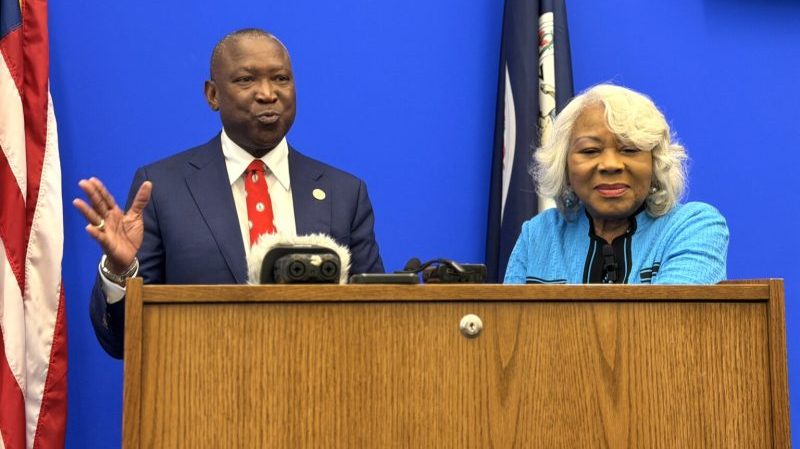
House Speaker Don Scott, D-Portsmouth, and Senate President Louise Lucas, D-Portsmouth, during a Wednesday press conference following voter approval of Virginia’s redistricting amendment. (Photo by Markus Schmidt/Virginia Mercury)
Democrats downplay legal threat
Democratic leaders dismissed the GOP’s legal push, casting it as an attempt to relitigate the outcome in court. Scott told reporters on Wednesday that Republicans moved quickly to challenge the result after losing.
“Republicans campaign on fairness, but the moment voters reject them … the first thing they say is … ‘we want to go to court,’” Scott said, calling the challenge a “frivolous, politically motivated attempt to overturn the will of the voters.”
“In Virginia, we respect the will of the voters … we don’t do kings … the power belongs to the people,” he added, saying he is not concerned about the Supreme Court’s role and will “let the court just play itself out.”
During a press conference earlier on Wednesday, Spanberger reiterated that the redistricting effort is limited in scope, describing it as a “temporary, one-time responsive action” and emphasizing that the state’s bipartisan redistricting commission will resume control after the 2030 census.
She also pushed back on concerns from rural voters who fear losing representation, arguing that elected officials should serve all constituents regardless of party.
“I think the reality is that the sort of construct where we accept this notion that there’s Democratic representatives who just represent Democrats and there are Republican representatives who just represent Republicans is … at the heart of the problems facing the United States Congress,” Spanberger said.
The governor, who was part of Virginia’s congressional delegation from 2019 to 2025, urged voters to “demand more” from candidates.
Kilgore rejected that view, arguing rural voters would be sidelined under the new maps.
“Rural Virginia is not going to be represented well by somebody from Fairfax,” he said, adding that voters in those areas “are fired up, they’re engaged.”
Virginia Mercury reporter Shannon Heckt contributed to this story.
by Markus Schmidt, Virginia Mercury
Virginia Mercury is part of States Newsroom, a nonprofit news network supported by grants and a coalition of donors as a 501c(3) public charity. Virginia Mercury maintains editorial independence. Contact Editor Samantha Willis for questions: info@virginiamercury.com.




Leisa Wood (1961 – 2026)

GO VOTE: Because Complaining Alone Isn’t a Good Strategy

The Third Most Important Gift Is Laughter

Skates, Treats and Safety: Warren County Sheriff’s Office Foundation Pack October with Community Events

Celebrate Kids Day Returns Sept. 27 With Family Fun, Activities and a New Train Ride

Survey Finds That More Than Half of Virginia Families With Children Face Food Insecurity

Could Virginia’s New Law Allowing 1% Sales Tax for School Construction Need a Fix?

Now They Want to Rein It In

From Oil Field to Gas Pump: What Really Determines What We Pay?

When Fields Flood: How Farmers Protect Crops and Plan for the Future

Draw Your Circles: A Map of the People Who Matter

A Heartfelt Farewell and Thank You
Data Centers Are Necessary. That Doesn’t Mean Warren County Needs One

Diesel Prices Shoot Upward as Top Farm-State GOP Senator Begs Trump for Export Embargo

From One Barrel of Oil: What Do We Actually Get?

CNN, MS Now, Politico Sue Trump Over White House Ban

Virginia-Made Marine Mattress Nominated for 2026 Manufacturing Cup

Virginia Works Plans October Job and Resource Fairs in Front Royal, Winchester

UVA Health Prince William Medical Center Earns Third Consecutive Magnet Recognition

Virginia Hunger Study Finds 37% of Blue Ridge Households Faced Food Insecurity

WCHS Volleyball Hosts Manassas Park on Sept. 22

ORDER OF PUBLICATION: In the Circuit Court for Warren County, Virginia

The Papers You Would Grab in Ten Minutes

Spanberger’s Carbon Tax Sets New Record, Could Add $1 Billion to Electricity Costs in One Year
