
Interesting Things to Know
Torpedo Junction: U-Boats attack the Outer Banks
Operation Drumbeat – Christmas 1941 was unlike any other in American history. The Japanese attack on Pearl Harbor on December 7th had shattered the Pacific Fleet, and within days Adolf Hitler compounded the shock by declaring war on the United States. America, still reeling from the Pacific disaster, was suddenly a nation at war on two fronts. While Washington scrambled to reinforce Admiral Nimitz in the Pacific – stripping the Atlantic coast of nearly all available warships in the process, Germany’s Grand Admiral Karl Doenitz saw opportunity. With the American eastern seaboard essentially unguarded, Doenitz launched five U-boats toward the Outer Banks of North Carolina in late December 1941. Operation Paukenschlag – “Drumbeat” had begun.
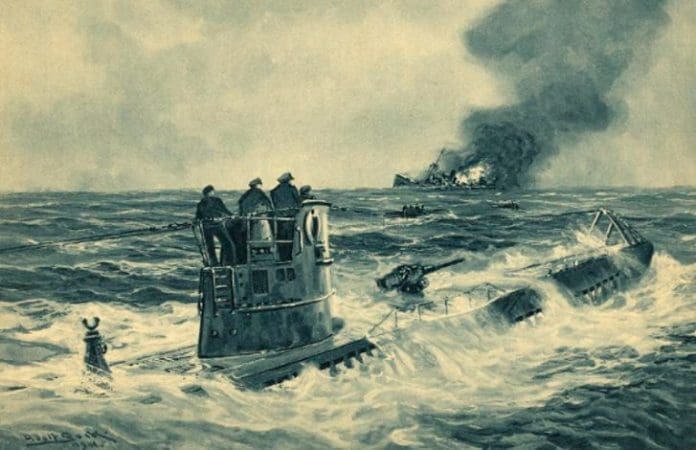
Photo courtesy of warfarehistory.com
Across the Atlantic, British Prime Minister Winston Churchill received the news of Hitler’s declaration of war on America as perhaps the finest Christmas gift of his life. Alas, the United States would join Britain in combatting Nazi Germany. He immediately shared hard-won lessons learned from three years of brutal U-boat warfare in the North Atlantic. The British urged two critical measures: convoy escort systems along the Carolina coast and strict coastal blackouts to deny enemy submarines the advantage of silhouetting merchant vessels against illuminated shorelines. U-boat attacks had already sunk more than a thousand Allied ships and had nearly strangled Britain into submission. The warnings could not have been more urgent.
Unfortunately, they were largely ignored. Admiral Ernest King, commanding the U.S. Navy, had little regard for the Royal Navy and dismissed British counsel. That decision would cost thousands of lives.
Torpedo Junction: The Slaughter Begins
On January 18, 1942, just 5 weeks after Pearl Harbor, the U-boats announced their arrival with brutal efficiency. The Esso tanker Allen Jackson exploded miles off Diamond Shoals, North Carolina, her fiery glow briefly illuminating a U-boat silhouette on the horizon. The killing season had officially opened. The first wave of U-boats sank eight ships in rapid succession, confirming Doenitz’s belief that America was wholly unprepared. Doenitz quickly capitalized on the momentum and poured in second and third waves. By February and March, forty ships had been sent to the bottom off the Outer Banks that would earn a grim new name: Torpedo Junction.
The scale of the disaster was staggering. Immediately after Pearl Harbor, the Navy had sent all available vessels from the Atlantic Fleet to shore up the devastated Pacific Fleet in Hawaii. America’s entire eastern seaboard was defended by ten aging World War I wooden subchasers, three converted yachts, four blimps, and six Army bombers. The U-boats brazenly hunted on the surface at night and exploited the silhouetted targets against the glow of coastal towns – picking off dozens of merchant vessels at will. The Rochester, Ocean Venture, City of Atlanta, Tiger, and dozens more went down. Oil slicks, debris, and the bodies of merchant sailors washed onto Carolina beaches. Residents could read newspapers by the light of burning tankers on the horizon. By March 1942, one ship was sinking every eight hours. Not a single U-boat had been destroyed. The American public had no idea this was happening.
Washington imposed strict censorship to suppress news of the carnage, fearing the public could not absorb another catastrophe so soon after Pearl Harbor. But along the barrier islands, the locals knew. Rumors circulated of U-boat crews slipping ashore for supplies, of strange lights in the dunes signaling offshore submarines, and of German sailors mingling with coastal communities. Officials largely dismissed such reports as wartime paranoia. But where there’s smoke, there is usually fire.
U-85: Saboteurs on the Outer Banks
Behind the scenes, a parallel and highly secretive dimension of the U-boat campaign was unfolding. Admiral Wilhelm Canaris, head of German military intelligence (the Abwehr), had been lobbying Hitler to use U-boats as insertion platforms for agents and saboteurs along the American coast. Admiral Doenitz opposed the idea fiercely – his submarines were weapons of commerce warfare, not spy taxis. Ultimately, Hitler sided with Canaris. Over the course of 1942, at least three U-boat insertion missions were launched against the American coastline.

One of these missions fell to U-85, commanded by Kapitänleutnant Eberhard Greger, a decorated and battle-hardened officer of the class of 1935. Greger had already built a legendary reputation. Earlier in the war, U-85 had survived a ferocious combined attack by two destroyers and an aircraft, escaping by lying silently on the seabed and allowing her pursuers to believe she had been sunk. Under cover of darkness, the battered submarine had limped back across the Atlantic to the safety of German submarine pens in France.
After a month of refit and shore leave, U-85 sailed again from occupied Europe on March 21, 1942, departing to the strains of a brass band playing on the pier. Two weeks later, she was prowling the waters off the Outer Banks.
The Insertion Mission – Bodie Island, OBX, April 1942
By April 13, 1942, Greger had navigated U-85 through Atlantic storms and surfaced within sight of the Bodie Island lighthouse near Nags Head on the North Carolina coast. His mission: insert a party of Abwehr saboteurs tasked with destroying the Manteo Boat Building Company – the only local shipyard capable of rapidly producing anti-submarine vessels to defend the Hatteras approaches. As pre-dawn shrimp trawlers moved through the area, Greger submerged for the day and waited for darkness.
After nightfall on April 14, U-85 surfaced, and Greger navigated toward shore using the Bodie Island lighthouse beam as a guide. When the submarine’s alarms clanged warning of dangerously shallow water, Greger ordered all stop. He then made the extraordinary decision to personally lead the advance shore party. Dressed in fishermen’s clothing and slickers, Greger and two Abwehr agents rowed rubber dinghies to the beach, coming ashore around 11:00 p.m. They hid their boat in the dunes and conducted reconnaissance.
Greger’s orders to his Executive Officer were clear: take U-85 out to deep water, return the following night, and await a lantern signal in Morse code after which the main body of saboteurs would be disembarked. Until the insertion was complete, the submarine was not to attack any shipping. Greger was the only member of the advance party trained in Morse code signaling; the mission’s success rested entirely on a successful reconnaissance ashore and the U-Boat’s return the following night.
Kapitänleutnant Eberhard Greger and his two companions were never heard from again.
USS Roper Patrolling the Outer Banks
As U-85 slipped away from the shallows near Bodie Island, she appeared as a small, moving contact on the sonar screen of USS Roper, a four-stack destroyer running southward along the coast after departing Hampton Roads, Virginia. Lieutenant Commander Hamilton W. Howe, the Roper‘s commanding officer, was asleep in his bunk. On the bridge, Ensign Ken Tebo, the Officer of the Deck, watched the contact with growing suspicion. It wasn’t paralleling the shoreline like a Coast Guard vessel – it was heading due east, straight out to deep water, at midnight. Strange.
Ensign Tebo adjusted course to close on the contact and sent a runner to wake the captain. When Howe arrived on the bridge, the two officers watched as a narrow white phosphorescent wake materialized out of the darkness ahead. At approximately 2,100 yards, the wake’s source remained ambiguous. It was too small to be an obvious submarine. Howe ordered speed increased to 20 knots. General Quarters was sounded, and the Roper‘s crew scrambled to battle stations.

Aboard U-85, the lookouts spotted the closing warship. The XO, now commanding with Greger ashore, faced a stark tactical reality: the continental shelf and safe diving depth were still fifteen minutes away. The Roper was closing fast. Submerging in 100 feet of water against a destroyer with depth charges was tantamount to suicide. The XO was out of options. U-85 must turn and fight.
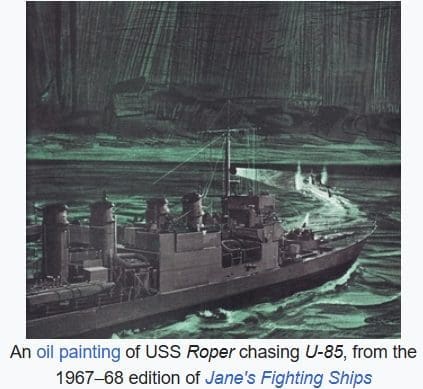
U-85 swung hard to bring her stern torpedo tubes to bear. A torpedo leaped from the U-boat and streaked toward the Roper. Howe saw it coming and swung his ship clear, watching the torpedo pass harmlessly down the starboard side. All doubt evaporated. This was obviously an enemy vessel. Howe ordered the searchlight illuminated.
The beam swept across the water and found the low, dark silhouette of U-85’s conning tower, with five crewmen running along the half-submerged deck toward the deck gun. The Roper‘s .50-caliber machine guns opened up immediately, tracers walking across the ballast tanks and sweeping the exposed deck crew. A second machine gun joined the fusillade. At barely 300 yards, the engagement was point-blank and savage. The German sailors attempting to man the deck gun were cut down. U-85 continued turning, trying to bring her bow tubes to bear, but she was taking devastating fire. Then she began to submerge.
“Keep firing!” Howe ordered. If U-85 slipped beneath the surface and launched a bow torpedo at this range, the Roper would be destroyed. As the conning tower sank below the waves, the Roper‘s gunners sent one final round crashing into the junction of the conning tower and the pressure hull – a killing blow.
The Death of U-85
Inside the stricken U-85, the crew knew their fight was over. The XO ordered the submarine scuttled immediately. Two Enigma cipher machines were aboard; one destined for delivery to the saboteur team the following night and one for communications with Naval Command. The Enigma machines could not be allowed to fall into American hands. Demolition charges were set. As the crew poured out of the sinking vessel and into the frigid Atlantic water, U-85 settled permanently onto the sandy bottom in roughly 100 feet of water.
From the Roper‘s deck, sailors watched German sailors struggling in the water and calling out. Then sonar reported a new contact – possibly a second U-boat. Captain Howe, unwilling to risk his ship and crew, ordered a broad pattern of depth charges dropped across the area where U-85 had gone down. The last sensation the surviving German sailors experienced was the sea erupting around them as 3,300 pounds of TNT detonated among the floating men. None survived.
At sunrise, the Roper surveyed the battlefield. Oil slicks spread across the wave tops. Life jackets and bodies drifted in slow circles. Howe ordered six more depth charges over the largest air bubble columns seeping from the sunken wreck, then concluded that U-85 was truly destroyed. Rubber boats were lowered, and 29 of the 48 estimated crew were retrieved from the water; several were too badly mangled to recover. Among the dead, searchers found men wearing civilian clothes and carrying American identity papers and U.S. currency – the material evidence of an insertion mission intercepted at the last possible moment.
Aftermath and Legacy
The sinking of U-85 on April 14–15, 1942, was electrifying news within the U.S. Navy. This was the first U-boat destroyed in American waters. Censorship kept the story from the public for three weeks, and even then no identifying details of the vessel or its crew were released.

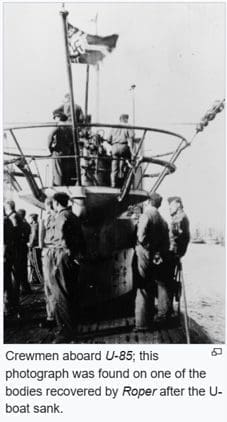 American divers subsequently explored the wreck, hoping to recover an Enigma machine. Working at 100 feet off Nags Head, they found the boat too damaged and impossible to raise under wartime conditions. The Enigma machines remained on the bottom. The XO’s scuttling had succeeded. A few crewmembers remained sealed inside the hull.
The 29 recovered bodies were transported to Hampton National Cemetery in Virginia, where they were buried with full military honors. U.S. Army soldiers served as pallbearers, a firing party fired three volleys, and Taps was played. They rest in plots 687 through 715, enemies in war, honored in death.
Ironically, the dive team that surveyed U-85 had been transported to the site by HMT Bedfordshire, a British trawler loaned by Churchill to help combat the U-boat menace. Three weeks later, Bedfordshire was herself sunk by U-558 off Ocracoke Island with the loss of all hands. Four of her British sailors who washed ashore remain interred in a small British cemetery on Ocracoke Island to this day.
The sinking of U-85 did not end Operation Drumbeat, but it marked a turning point. For the first time, it showed that the U-boats could be killed. More would follow off the Carolina coast: U-352, U-576, U-701, and others, as America finally implemented convoy systems and coastal blackouts. The first six months of 1942 cost over 5,000 Allied sailors and merchant mariners their lives and saw more than 60 ships destroyed off the American coast – a catastrophe known, quietly, as the second Pearl Harbor.
Lieutenant Commander Hamilton Howe retired as a Rear Admiral in 1956 and lived out his days in Winston-Salem, North Carolina. Ensign Kenneth Tebo retired in 1961 and settled in Falls Church, Virginia. Both men were awarded the Navy Cross for the destruction of U-85.
Kapitänleutnant Eberhard Greger was never found. Years later, an elderly woman on the barrier islands left behind a manuscript and a U-boat ring upon her death – a tantalizing story that history never fully recovered. Today, U-85 rests on a white sandy bottom fifteen miles east of Bodie Island, her rusted hull a war grave still watched over by the lighthouse that guided her to her fate.




Torpedo Junction: U-Boats attack the Outer Banks

Planting for the Future: Two Endowment Funds Established to Support Front Royal/Warren County Tree Stewards

Have America’s Political Labels Lost Their Meaning?

Washington Football Legend Dexter Manley to Help Light Middletown’s Christmas Tree Friday Evening

Virginia Vies to Host NASA’s First U.S. Space Academy in Hampton

Newborn Vaccination Rates for Hepatitis B Drop Sharply

Business Growth Series: Multitasking Is Killing Your Productivity

Virginia Health Officials Say Communities Have ‘Stepped Up’ to Combat Measles Uptick

Golden Girls Bills Could Bring Together Older and Younger Roommates

Julie Mullins (1962 – 2026)

Israel: The Fifth Wave

Kratom: No Established Safe Dose for Powerful Concentrates, Experts Warn

What Those Car Repair Plans Advertised on TV Actually Pay For

Skyline Drive Music Guide: Holiday Shows and Live Entertainment for December 2026

Giving Your Children Their Inheritance Early: A Generous Gift or a Financial Risk?

Give Thanksgiving Leftovers a Second Life With Turkey and Sweet Potato Shepherd’s Pie

Petition to Remove Supervisor Hugh Henry Filed, but Signature Shortfall Prevents It from Moving Forward

Federal Court Blocks Second Trump Order on Birthright Citizenship

Turkey Production Bounces Back but Prices Still Rise

Town Council Unanimously Passes Joint Tourism MOU

Developing: Army Detonates Degraded Lead Azide in Middletown, Iowa

22 States Including Virginia Sue Feds Over the Rule Stripping Housing Aid from Mixed-Status Immigrant Families

Judge to Decide Dec. 4 If Virginia’s Reproductive Rights Constitutional Amendment Will Stand

Dominion-NextEra Merger Hearings Wrap Up at the SCC, Decision Expected by Jan. 11