
State News
Virginia Vies to Host NASA’s First U.S. Space Academy in Hampton
Virginia wants to become home to NASA’s first United States Space Academy in Hampton, a move that would strengthen the commonwealth as a training ground for a multidisciplinary space workforce.
This comes after President Donald Trump signed an executive order in August directing the establishment of the academy, creating a new federal educational enterprise. Multiple states, including Texas, Pennsylvania, Louisiana, and Maryland, have submitted proposals.
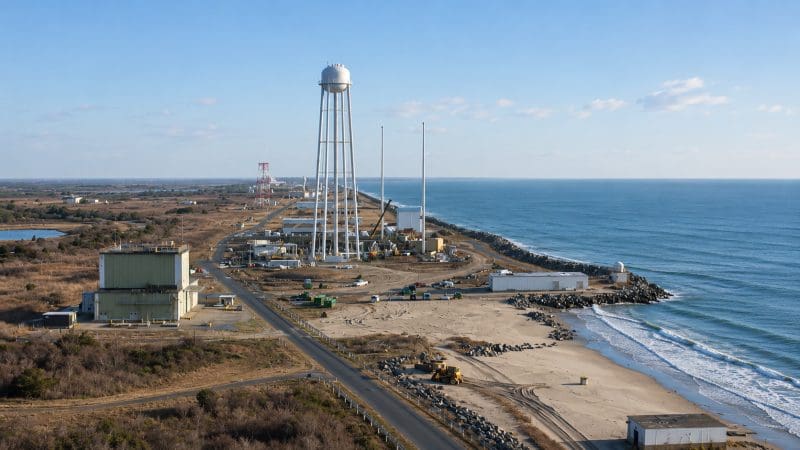
The Mid-Atlantic Regional Spaceport at the NASA Wallops Flight Facility on the Eastern Shore. (Photo courtesy of MARS)
Virginia’s proposal is rooted in a 600-acre campus at NASA Langley and Fort Monroe, with a Wallops satellite campus and a goal of welcoming 300 cadets in 2028.
“Virginia is a world leader in aerospace innovation and national defense, and the commonwealth is best positioned to be the future home of the United States Space Academy,” said Gov. Abigail Spanberger in a statement on Nov. 16.
She said that with Virginia’s “unparalleled defense footprint” and “world-class research assets,” she is confident Virginia can meet the federal government’s ambitious goal and begin training the first class of cadets by 2028.
NASA’s invitation to states calls for “a NASA-led, civilian Federal academic institution that combines rigorous technical education with disciplined leadership development, civic responsibility, and a lasting commitment to public service.”
The invitation adds that the academy will prepare the future multidisciplinary space workforce, including astronauts, engineers, operators and scientists, to “advance American interests across the aerospace sector.”
In its proposal, Virginia said NASA Langley would provide the academy’s research, engineering, flight, innovation and technical core, while Fort Monroe would support residential life, instruction, leadership development, ceremonies, administration and public engagement.
Virginia Spaceport Authority’s Mid-Atlantic Regional Spaceport (MARS), located at Wallops Island, would also serve as a satellite learning campus, providing field-based experience in payload integration, space launch and range operations, mission planning, flight safety, uncrewed systems and post-mission analysis.

Virginia’s proposal outlines a path to welcome approximately 300 cadets in 2028, using existing academic, residential, laboratory and student support capacity.
“Through adaptive reuse of existing facilities and a network of industry, research, and academic leaders, Virginia will work with NASA to rapidly realize its vision and meet its needs,” Secretary of Commerce and Trade Carrie Chenery said in a Nov. 16 statement. “Together, we will build an academy capable of cultivating our next generation of space visionaries.”
Virginia’s congressional delegation has all signed on in support of the proposal to bring the academy to Hampton. Multiple universities also support a unified academy curriculum spanning fields such as aerospace engineering, aviation, cybersecurity, data science and power systems.
House Technology Committee Chair Cliff Hayes, D-Chesapeake, said landing the academy would be “spectacular” for Hampton Roads, the commonwealth and the nation.
“Hampton Roads has long helped defend America’s interests on the seas with the world’s largest naval base and through the air with Oceana Naval Air Force presence,” Hayes said in a statement. “With the United States Space Academy, we have an opportunity to help prepare the scientists, engineers, and innovators who will advance America’s interests among the stars.”
NASA is located in Washington, D.C., and has operations across the country, including Wallops Flight Facility and Langley Research Center in the Commonwealth.
This project is Virginia’s most prominent new federal-site competition since the FBI headquarters fight that began almost a decade ago. Ultimately, the project was awarded to Maryland in 2023, under President Joe Biden’s administration.
But last year, Trump reversed course after being elected and kept the FBI in Washington, D.C. His administration later lost in court after Maryland challenged the decision.
An announcement on where the academy will be headquartered is expected in late December.
By Nathaniel Cline, Virginia Mercury

Virginia Mercury is part of States Newsroom, a nonprofit news network supported by grants and a coalition of donors as a 501c(3) public charity. Virginia Mercury maintains editorial independence. Contact Editor Samantha Willis for questions: info@virginiamercury.com.




Virginia Vies to Host NASA’s First U.S. Space Academy in Hampton

Newborn Vaccination Rates for Hepatitis B Drop Sharply

Business Growth Series: Multitasking Is Killing Your Productivity

Virginia Health Officials Say Communities Have ‘Stepped Up’ to Combat Measles Uptick

Golden Girls Bills Could Bring Together Older and Younger Roommates

Julie Mullins (1962 – 2026)

Israel: The Fifth Wave

Kratom: No Established Safe Dose for Powerful Concentrates, Experts Warn

What Those Car Repair Plans Advertised on TV Actually Pay For

Skyline Drive Music Guide: Holiday Shows and Live Entertainment for December 2026

Giving Your Children Their Inheritance Early: A Generous Gift or a Financial Risk?

Give Thanksgiving Leftovers a Second Life With Turkey and Sweet Potato Shepherd’s Pie

Petition to Remove Supervisor Hugh Henry Filed, but Signature Shortfall Prevents It from Moving Forward

Federal Court Blocks Second Trump Order on Birthright Citizenship

Turkey Production Bounces Back but Prices Still Rise

Developing: Army Detonates Degraded Lead Azide in Middletown, Iowa

22 States Including Virginia Sue Feds Over the Rule Stripping Housing Aid from Mixed-Status Immigrant Families

Judge to Decide Dec. 4 If Virginia’s Reproductive Rights Constitutional Amendment Will Stand

Dominion-NextEra Merger Hearings Wrap Up at the SCC, Decision Expected by Jan. 11
And a River Runs Through It: Thoughts About Fathers and Sons

Teachers in Detention? Warren County Educators Join $30,000 Giving Tuesday Challenge

Democrats Plan Investigations of Trump. Here’s How His Justice Department Is Fighting Back.

After the Trees Are Pruned, Show Front Royal the Plan for Their Future

Does Artificial Intelligence Need a Thank You? The Answer May Surprise You
