
Automotive
A history of roads in Virginia: Strengthening the organization
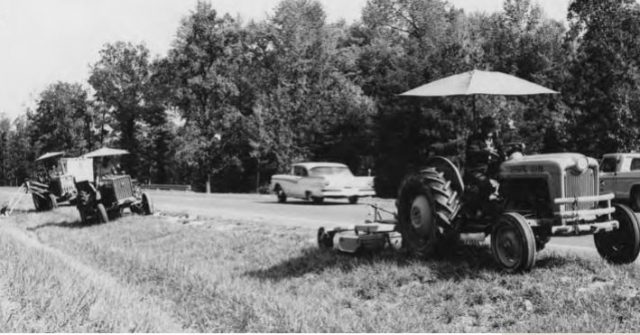
A mowing crew works on the median of I-95 north of Ashland in 1965.
Other study commission recommendations led in 1964 to steps aimed at equipping the Department of Highways to better meet the growing challenge. The General Assembly established the urban street system as a separate entity for the distribution of highway funds and directed that it receive a minimum of 14 percent of all revenue exclusive of federal interstate funds.
The urban system was to include extensions of the state’s primary routes within cities and towns and other local streets of adequate width and surface. Eighty-five percent of the cost of building improvements on this system was to be paid for with state highway funds or with a combination of state and federal funds, with the local governments providing the remaining 15 percent. In addition, millions of dollars in state road-user revenue were to be returned to the cities and towns each year for maintenance of local streets.
As another result of the study commission, the Department of Highways was reorganized to reduce the number of individuals reporting directly to the commissioner, giving him more hours a day to concentrate on broad policy and administrative issues.
The new organizational structure provided for the commissioner to carry out his assignment largely through the delegation of responsibility to two persons — a deputy commissioner-chief engineer and a director of administration. The division organization also was to be changed somewhat to more effectively meet the public’s highway needs. Its landscape division, organized in 1930 to deal mainly with erosion control, beautification, and outdoor advertising control, was expanded into an environmental quality division to coordinate increasing ecological considerations. A metropolitan transportation planning division was established to prepare long-range, comprehensive plans for more than 45 cities and towns and to aid in development of urban mass transit improvements. A data processing division was formed to take maximum advantage of the remarkable time savings permitted through computers. A management services division became responsible for ensuring implementation of internal policies and procedures.
Through the 1960s and into the ‘70s, the emphasis of the organization continued largely on the interstate and arterial programs, and on upgrading older routes by elimination of obsolete bridges, poor alignment, and curves. The factor of “need” was added to others, such as population, land area, miles of road, and vehicular miles of travel, which long had been considered in apportioning funds.
Improvements also continued on the secondary road system. By 1972, four decades after the system was established, 27,000 secondary roads were hard-surfaced, compared to 2,000 miles at the outset. Only 400 miles remained unsurfaced, and most of them served fewer than a dozen vehicles daily. The public’s investment in Virginia’s highways was valued at more than $5 billion. With nearly 12,000 employees, the Department of Highways was the largest agency in state government and was among the half-dozen largest employers in the commonwealth.
A strong corps of private contractors had developed, and major construction projects were built under contracts awarded on a low-bid basis. Prospective bidders on this work were required to be “pre-qualified” on the basis of their experience, manpower, equipment, and financial resources, to ensure satisfactory completion of contracts.
Questions about the importance of road and bridge maintenance had vanished long before, and millions of dollars were spent annually to protect the public’s investment and to keep the facilities in safe condition.
Some 5,000 department employees were assigned to maintenance operations — snow and ice control, roadside mowing, as well as resurfacing, clearing side ditches, collecting litter, and a multitude of other jobs. The road system they maintained had become the nation’s third-largest, covering about 51,000 miles. But for maintenance personnel, the demands sometimes were far from routine. The night of Aug. 19, 1969, was an example.
It was then that rains from Hurricane Camille touched off flooding that swept across large portions of western and central Virginia, striking while people slept. The U.S. Weather Bureau said later that 27 inches of rain had fallen in about eight hours near the little community of Massies Mill in Nelson County. Great torrents of water streamed down the mountainsides, uprooting trees that became battering rams against the houses below. Ordinarily tranquil rivers and creeks poured out of their banks and rushed ahead with massive destruction. Some said it was the worst storm in America’s history, and it struck hard at much of the nation’s East Coast. In Virginia 114 persons were killed, 37 others were missing, and more than 100 were injured.
Two hundred miles of the state’s roads were destroyed, and nearly 100 bridges were wrecked. The cost of repairing the facilities alone would exceed $20 million. Less than three years later, on the night of June 19, 1972, rain from a new hurricane — one called Agnes and considered a tropical storm by the time it reached Virginia — caused similar destruction over a wider area from the western regions to the coast.
At least 13 people died; dozens were injured. The property damage climbed above that of Camille, and estimates placed the toll at $160.7 million. Six hundred miles of roads were damaged; 104 bridges were left useless — washed away, heavily damaged, or without passable approaches.
Road maintenance crews hadn’t seen problems of these proportions before. Yet, they worked around the clock, and traffic was moving again within hours in many of the flood-wrecked areas and within a few days in most other places. The urgency was underscored because frequently other emergency and rescue operations could not proceed until roads were reopened and river and creek crossings were restored.
Produced by the
Virginia Department of Transportation
Office of Public Affairs
1401 E. Broad Street
Richmond, VA 23219
VirginiaDOT.org

Spanberger Joins Other Governors in Push for PJM to Prioritize Ratepayer Protections

Cannabis Testing Challenges Persist as Virginia Retail Market Nears

Quick Quiz on Tooth Decay

The Fat Facts: Busting Common Food Myths

Importance of Chiles v. Salazar and the Protection of Free Speech

MAGA Suicide?

Warnick Posts Natural Hat Trick as Shenandoah Downs Opens Spring Meet

Youngkin Returns to Campaign Trail, Calls for Court to Strike Redistricting Vote

‘We Have To Do Something’: Former U.S. Attorney General Eric Holder Supports Virginia Redistricting

3 Ways to Extend the Life of Your Electric Vehicle Battery

Serious Charges Highlight Warren County Grand Jury Indictments

Ducks, Flowers, and Fun: Redbud Festival Returns to Browntown

Potato-Crust Quiche Makes a Lovely Brunch

Faye Barr Vance (1930 – 2026)

James Christopher “Chris” Sain (1948 – 2026)
Alice “Maybelle” Henson (1938 – 2026)

How Sleep and Stress Affect Cancer Risk

Spanberger Signs Sweeping Public Safety and Gun Violence Bills

Horses, Fans Return as Shenandoah Downs Season Begins

Skill Games Halted Again as Spanberger Issues Veto

VDOT: Warren County Traffic Alert for April 13 – 17, 2026

The Cat Who Outlasted Six Prime Ministers
Front Royal, Virginia. Vacation Destination?

Virginia State Police Report Major Drug Seizures in Weekly Crime Suppression Effort
