
Automotive
A history of roads in Virginia: A new study, a new network
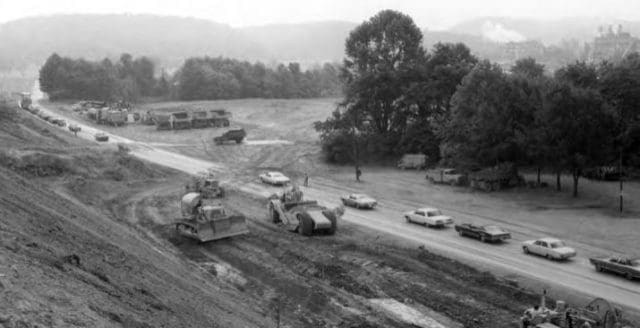
Two additional lanes are constructed parallel with the lanes of Route 460 in Giles County in 1969 to create a divided arterial highway.
It soon became evident, however, that the interstate routes alone would not adequately serve the burgeoning population and the increasing desire for mobility by Virginians in the second half of the 20th century. The spreading suburban growth that marked Virginia and other states in the years after World War II was induced in large part by the flexible mobility permitted by the family auto. Suburban housing development was followed by suburban shopping centers and office buildings. It all placed new demands on the state’s roads and streets. The 20-year improvement plan that had been implemented by the commission in the immediate post-war years had to be revised and updated frequently to keep pace with changing needs and growth patterns.
In 1962, the General Assembly established a new study commission to examine and evaluate highway needs, revenue, fund distribution procedures, and the organization of the Department of Highways. It consisted of one member from each of the eight construction districts and two citizens at large. The study commission members were appointed by Gov. Albertis S. Harrison Jr., in May 1962, with Sen. William F. Stone of Martinsville, an experienced legislator who had been a chief patron of the act calling for the study, chosen as chairman.
For more than a year, the study commission went about its assignment, reviewing nearly every aspect of the highway program. The commission itself probably was the most important highway study group since the 1916 committee that recommended the establishment of the first state highway system.

The Stone commission submitted its report to the governor and the General Assembly in December 1963, in time for its recommendations to be considered at the legislative session beginning the following month. Among its points: “One of the prime factors in inducing business management to select a state for expansion or a new location is a good highway system, which not only is needed for transportation of goods and raw materials but enables employees to be drawn from a wide radius. Some other states have moved ahead of Virginia in expanding their highway systems. We cannot afford to be left behind.”
The study commission also described the motor vehicle as “an essential and integral part of our everyday life. Its impact upon our economy and way of life has reached dimensions which have exceeded all forecasts.”
In an effort to keep up, the commission said, a new arterial network should be developed to supplement the interstate system.
Douglas B. Fugate, who joined the department shortly after graduating from VMI with a degree in civil engineering in 1927, was serving as assistant chief engineer at the time and in 1964, was appointed commissioner by Gov. Harrison. Fugate proposed the arterial network concept to the study commission and thus became chief architect of the network.
“The arterial road program, when completed, will in conjunction with the interstate system connect every city within the commonwealth of 5,000 or more and nearly every town having a population of 3,500 to 5,000. When completed, there will be an arterial route or interstate route within a 40-mile radius of every town in Virginia,” the study commission said.

Development of the network was authorized by the 1964 General Assembly, which also provided additional revenue through increases in the state’s motor vehicle registration and operator’s license fees. As approved, it totaled more than 1,700 miles and was to be developed chiefly by building new two-lane roadways parallel to existing two-lane primary routes to create four-lane, divided facilities. More than 70 bypasses of cities and towns were to be constructed, to free local streets for local traffic, and many of the bypasses would be constructed virtually to interstate standards.
The arterial network was half-finished within seven years after it was begun. In some quarters, the network was described as a “model for the nation because of the orderly way in which it ensured up-grading of older primary roads while the interstate system development was still under way.”
In the mid-1950s, when the interstate program was beginning, Virginia had about 300 miles of multi-lane divided highways. With interstate and arterial completion, it later would have slightly more than 3,000 miles of such roads.

Produced by the
Virginia Department of Transportation
Office of Public Affairs
1401 E. Broad Street
Richmond, VA 23219
VirginiaDOT.org




“Can’t We Just Watch the Movie at Home?” A Question About the Future of Movie Theaters

Two Front Royal Churches Plan Joint Oct. 25 Gathering Focused on Faith and Virginia Ballot Issues

Robert Arthur Babineau (1961 – 2026)

Here’s Where Doctors Diverge on Virginia’s Pending Reproductive Rights Constitutional Amendment

Virginia Teachers Balance AI Innovation with Student Creativity Amid Rising Academic Pressure

Donna Kersey Deavers Smith (1945 – 2026)

William Franklin “Rocky” Walker (1959 – 2026)

Measles Cases Reach 4,080 for the Year — the Highest in Decades

Data Center Backlash Set to Sway Midterm Elections

Mary Ann Williams (1942 – 2026)

Winston Richard Summers (1946 – 2026)

With Mother Nature’s Cooperation Festival of Leaves Draws Another Huge Crowd to Greet the Fall Season

Turning Off an Airbag Is Allowed in Limited Circumstances

A Retirement Account for a Grandchild Starts With a Summer Job

Your Photos Survive A Lost Phone, But Not A Wrong Tap

Walking Malls Don’t Solve Problems

Festival of Leaves 2026 Wraps Up a Successful Day in Downtown Front Royal

Autumn Delights: Spotlight On Pumpkins!

Lord Fairfax Health District Receives $5,000 Grant To Support Local EMS Crews

Why an AI Bubble Could Reach Your Savings

The Platypus: A Truly Amazing Animal!

A Thing of the Heart: Two-Fold Outreach to Children and Award Presentation Brings Hike Kidz to Stone Branch Arts Center

Virginia State Police Seize Drugs Valued at More Than $830,000, Recover 13 Firearms

Commentary: We Hate Technology. Please Like and Share
