
Local News
Blue Ridge Heritage Project breaks ground on Warren County memorial site
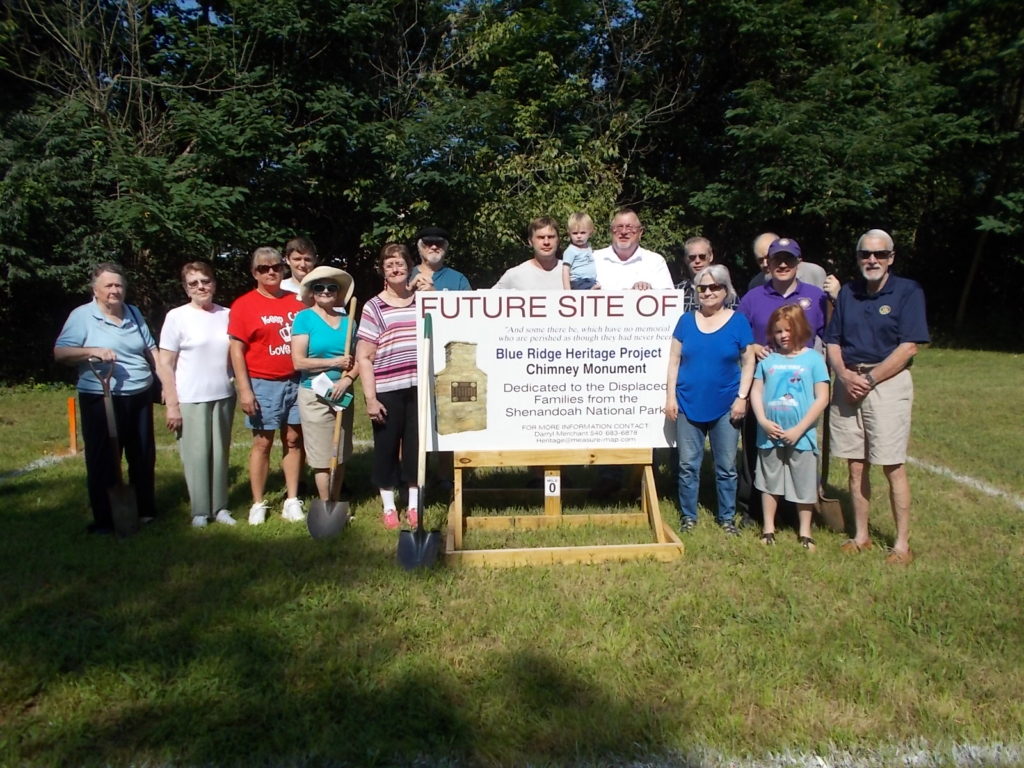
Descendants gathered at the Warren County Blue Ridge Heritage Project memorial site on Saturday, Aug. 11. – Photos/Roger Bianchini
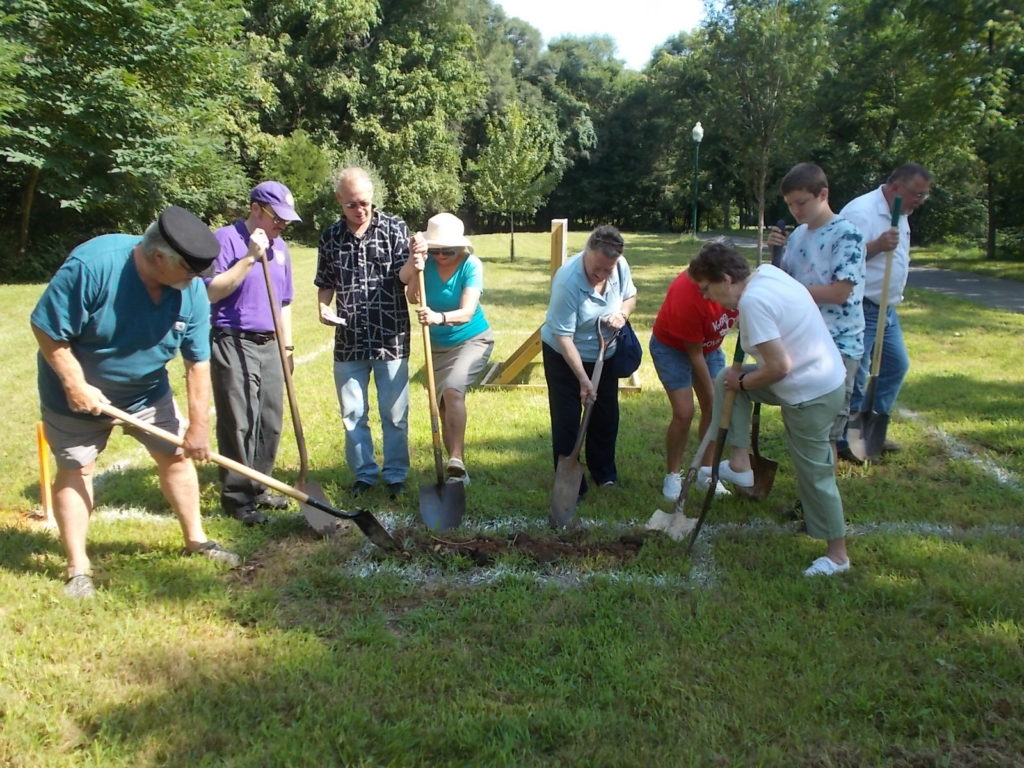
On Saturday morning, August 11, local descendants of Warren County families displaced by the creation of Shenandoah National Park gathered to break ground at the site of a memorial to their families’ collective experience.
That Blue Ridge Heritage Project site is on the Town walking path along Happy Creek just north of Criser Road, adjacent to Burrell Brooks Park and the current Criser Road Bridge replacement project. The Town of Front Royal donated the land for the project.
Hosting the event was local project committee Chairman Darryl Merchant. Merchant was joined by Blue Ridge Heritage Project Founder Bill Henry. Both addressed the project’s impetus, goals and status.
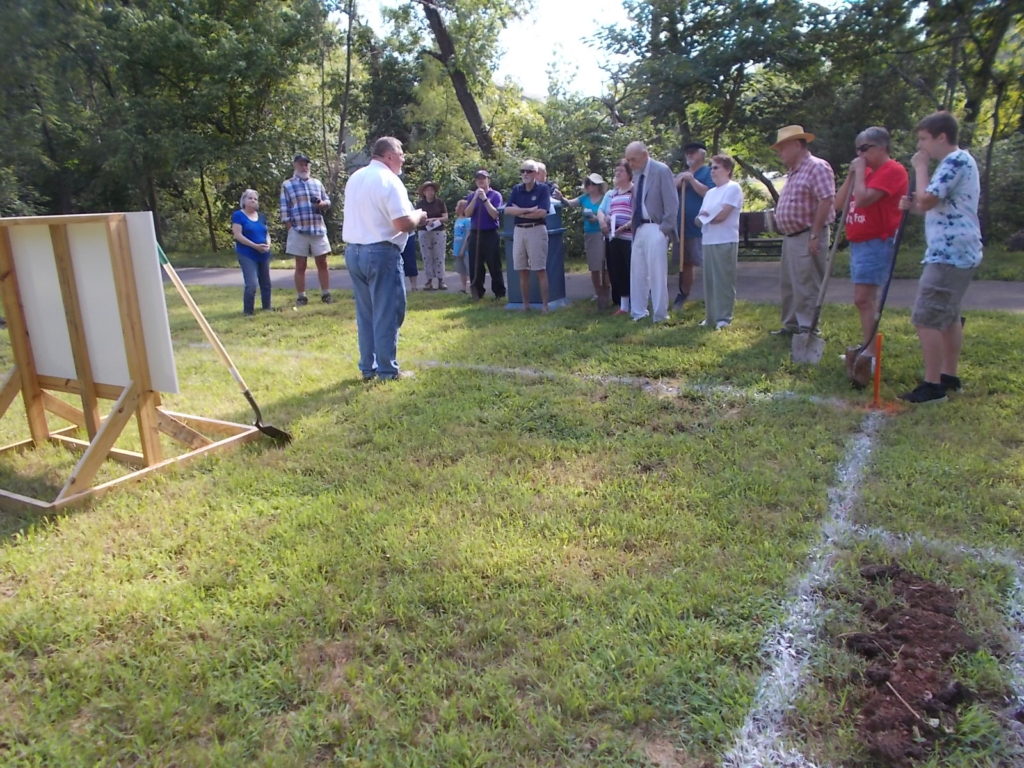
Darryl Merchant, himself a descendant of a displaced Warren County family, is heading the local project and fundraising effort.
Last year Warren County joined the seven other Virginia counties that Shenandoah National Park runs through in a joint effort to shed light on an often-ignored part of those counties’ collective histories. And while federal officials heading the national park service may previously have been lax in acknowledging those histories, Merchant noted they are now active supporters of the Blue Ridge Heritage Project effort to bring that story to the forefront in the communities that were impacted.
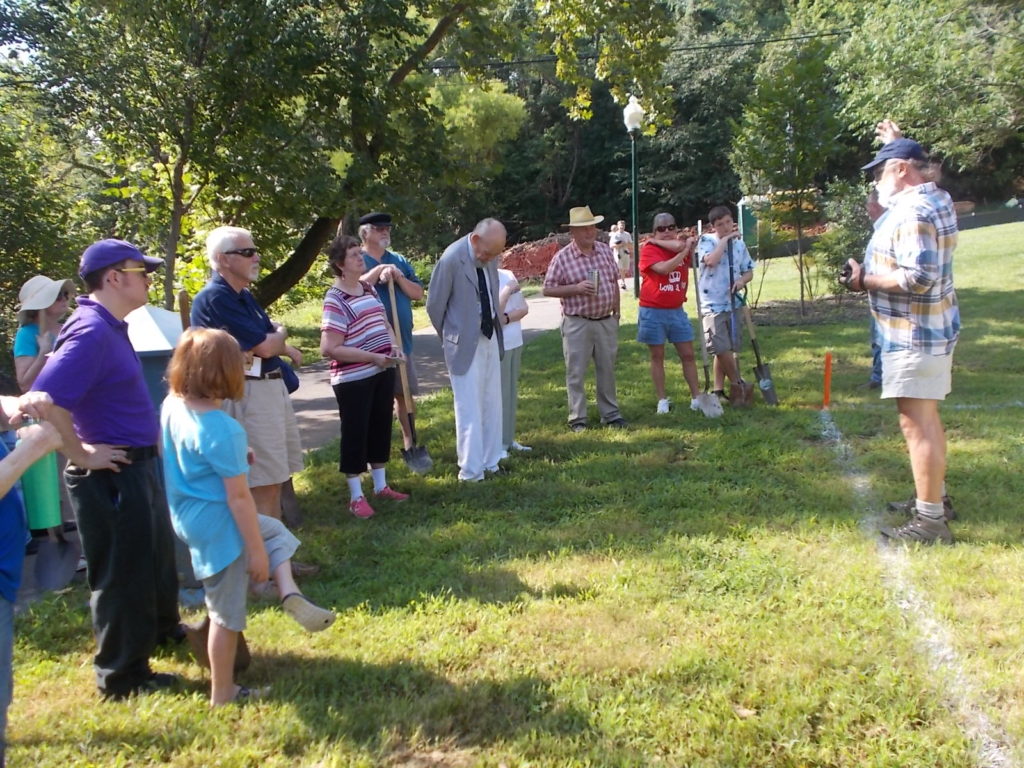
Blue Ridge Heritage Project founder Bill Henry, of Greene County, welcomes Warren County into the eight-county project.
The Blue Ridge Heritage Project is a non-profit, 501-c 3 founded by Greene County resident Bill Henry. Of the eight-county project, the organizational literature states: “To establish a memorial site in each of the eight counties where land was acquired for Shenandoah National Park (Albermarle, Augusta, Greene, Madison, Page, Rappahannock, Rockingham and Warren) to acknowledge the sacrifice of involved families in those communities.
“In order to recognize their contributions and their losses, each site will contain a memorial to the people from that county whose land was acquired for the park. Through educational displays, cultural displays and demonstrations the project hopes to accurately depict the people’s lives and to help preserve their lifestyle, crafts, music, and traditions.”

The ultimate goal, as of the broad study of history itself, is to give visitors to this particular series of memorials “a greater appreciation for the impact the park had on individual lives in general and for that particular community. – Altogether, the eight sites will create an understanding of life in the Blue Ridge Mountains,” project literature states.
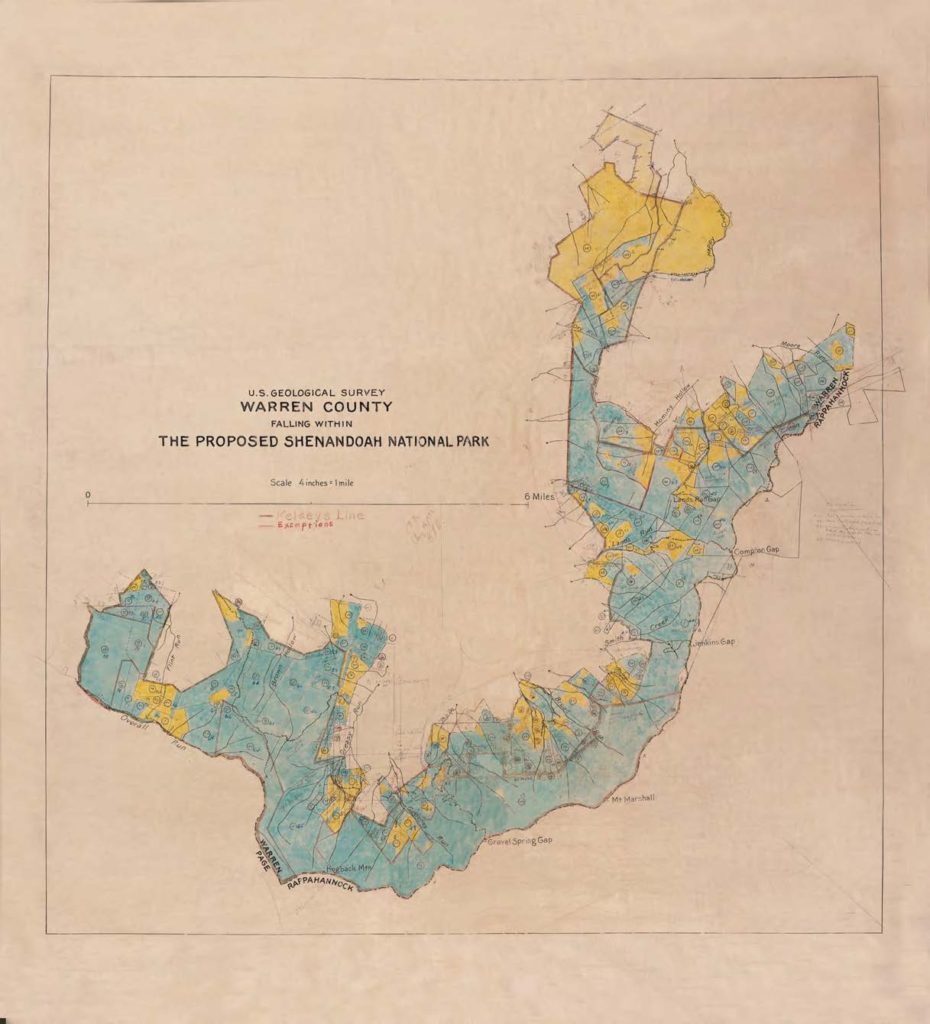
U.S. geological service map of the ‘proposed Shenandoah National Park’s’ path through Warren County. Originally envisioned as taking 30,000 of the county’s 138,380 acres, that number was later reduced to 13,500 acres. Graphic Courtesy of Blue Ridge Heritage Project

An actual surviving chimney of a past home in the park. Graphic Courtesy of Blue Ridge Heritage Project
Project & costs
The ground broken this past Saturday in Warren County is for Phase One of a three-phased local project. Phase One will see construction of 2-foot x 5-foot x 9-foot stone chimney memorial with a bronze plaque holding the family names of county citizens who lost their land to allow establishment of a pristine national park that is now a major regional tourism and economic asset.
Phase two will add a 16 x 22-foot concrete patio and phase three, two benches, a flagpole and informational kiosk. Total cost of all three phases is estimated at $25,000, with phase one priced at $12,000, including $9,000 for the stone chimney and $3,000 for the bronze plaque bearing the displaced family names. Merchant said $3,500 has been raised so far.
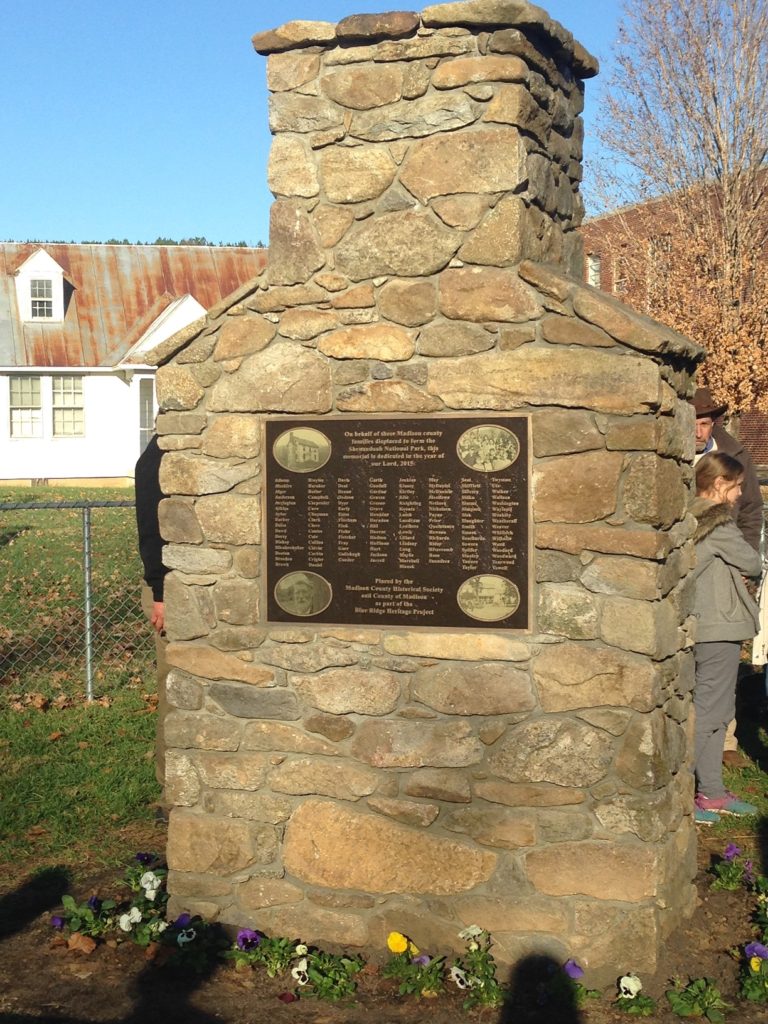
The Madison County monument – Graphic Courtesy of Blue Ridge Heritage Project
Consequently, the August 11 event also marked the launch of a more aggressive fundraising campaign, including direct contact, mail and online efforts. Donations can be mailed to the: Warren Blue Ridge Heritage Project, PO Box 1508, Front Royal, Va. 22630.
Online, one can access additional information, including on fundraising, at either the Blue Ridge Heritage Project Facebook page and website www.blueridgeheritageproject.com – click the “Warren County” tab – and a new local Facebook page, the “Front Royal Warren County Blue Ridge Heritage Project”. Merchant, who serves as chairman of the local project committee may also be reached at (540) 683-6878.
In another update in numbers, also as of August 11 Warren County’s contribution to the project will commemorate the sacrifice made by what is now counted at 67 local families who lost their homes and land as part of the federal effort to preserve large swaths of America’s natural resources for the enjoyment of all Americans for generations to come.
Merchant said that number has risen from an originally-cited 32 families. But he added, that initial number based on information in park service archives included only those families who had legal title to their land taken for the park. Those 32 families were the lucky ones.
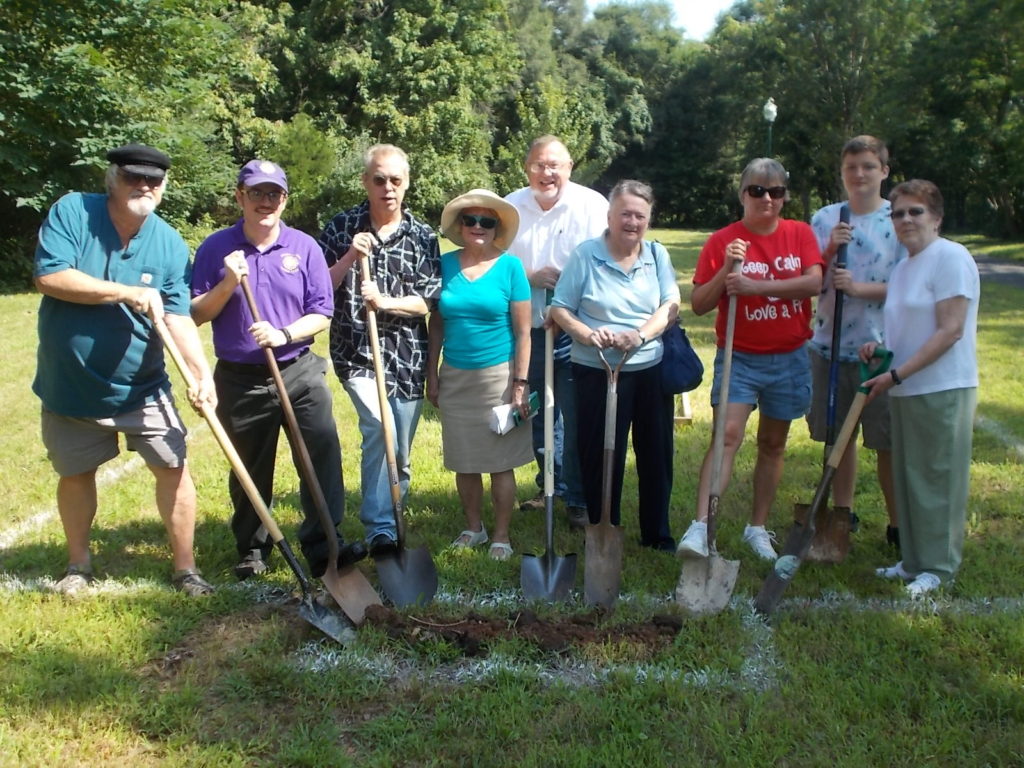
Ready to dig some dirt – the small marked rectangle under attack marks location of the chimney memorial and plaque that will be specific to Warren County’s commemorative site
As Merchant noted at the August 11 groundbreaking, the families with deeded proof of ownership of their land in what was to become Shenandoah National Park were compensated for their lost property. However, others who were tenants or who may have thought they owned the land they settled but had no legal record of that ownership, were not compensated for their loss.
And while the goal of natural resource preservation for accessible and affordable regional tourism may be good one, it was often painful for those told they must leave their homes for a greater national good.
A brief history of SNP
Literature handed out at the Saturday groundbreaking documented the creation of Shenandoah National Park (SNP) as a process stretching from 1924 to 1938. That process involved federal and state officials, as well as a private-sector businessman and his associates. Most prominent on that list were President Franklin D. Roosevelt on the back end and Virginia Governor Harry F. Byrd and summer resort “Skyland Lodge” owner George Freeman Pollock at the front.
This chronology is summarized from the Blue Ridge Heritage Project informational packet distributed at the Warren County site groundbreaking:
- “The idea for the SNP began in 1924. The federal government decided that the east coast region of the U.S. needed a park similar to Yosemite or Yellowstone out west.
- The owner of Skyland Lodge, a summer resort (located at what would become Skyline Drive mile post 42) for wealthy clients and politically-connected residents of Washington, D.C., thought a national park would bring visitors to the Shenandoah Valley.
- That resort owner, George Freeman Pollock, recruited guests and business friends to nominate this area of the Blue Ridge Mountains as a potential site of the eastern national park.
- Government specifications required the proposed park to be visually stunning and have amenities like fishing and hiking, access to roads; and essentially be a wilderness – in other words “FREE OF HUMANS”.
- However, the selected site was not free of humans; it was home to over 500 “mountain families”.
- Public and pseudo-science stereotyping of those somewhat isolated “mountain families” as backwards and in need of a push into “normal” society was used as justification for their removal from their mountain homesteads. Later sociological studies concluded that those “mountain folk were no better or worse off than the valley folk” they were said to need social integration with.
- In 1926, during the presidency of Republican Calvin Coolidge, the U.S. government approved the proposed eastern national park site.
- In April 1926, Virginia Governor Harry F. Byrd established the Virginia Conservation & Development Commission, headed by William E. Carson of Front Royal. The commission was created to acquire the land for the park, which would then be transferred to the federal government.
- Carson convinced the State Legislature to enact a blanket condemnation law, which was promptly challenged and not resolved until 1935 when the U.S. Supreme Court refused to hear the case.
- Originally, many land owners were told they would be allowed to remain in the park. However, that changed on February 1, 1934, when a new commission director decreed that “all inhabitants must leave.”
- Federal officials initially tried to dump the relocation problem on state officials, who resisted taking on the final step in a politically-volatile matter they had helped create. Eventually responsibility was transferred to the U.S. Department of Agriculture’s Resettlement Administration.
- By 1938, some 175 of the estimated 500 impacted families had been resettled to over 6,000 acres of land purchased by the U.S. government for use as resettlement communities.
- As the relocation continued, as quoted by Nancy Martin-Purdue – “And people came in and moved them out. Burned their house down in some cases. Took their things and carried them off to some other place.”
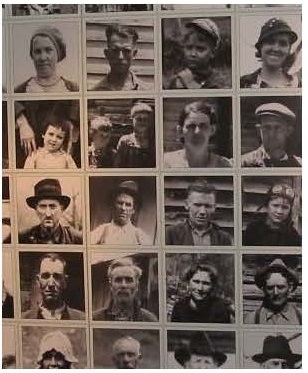
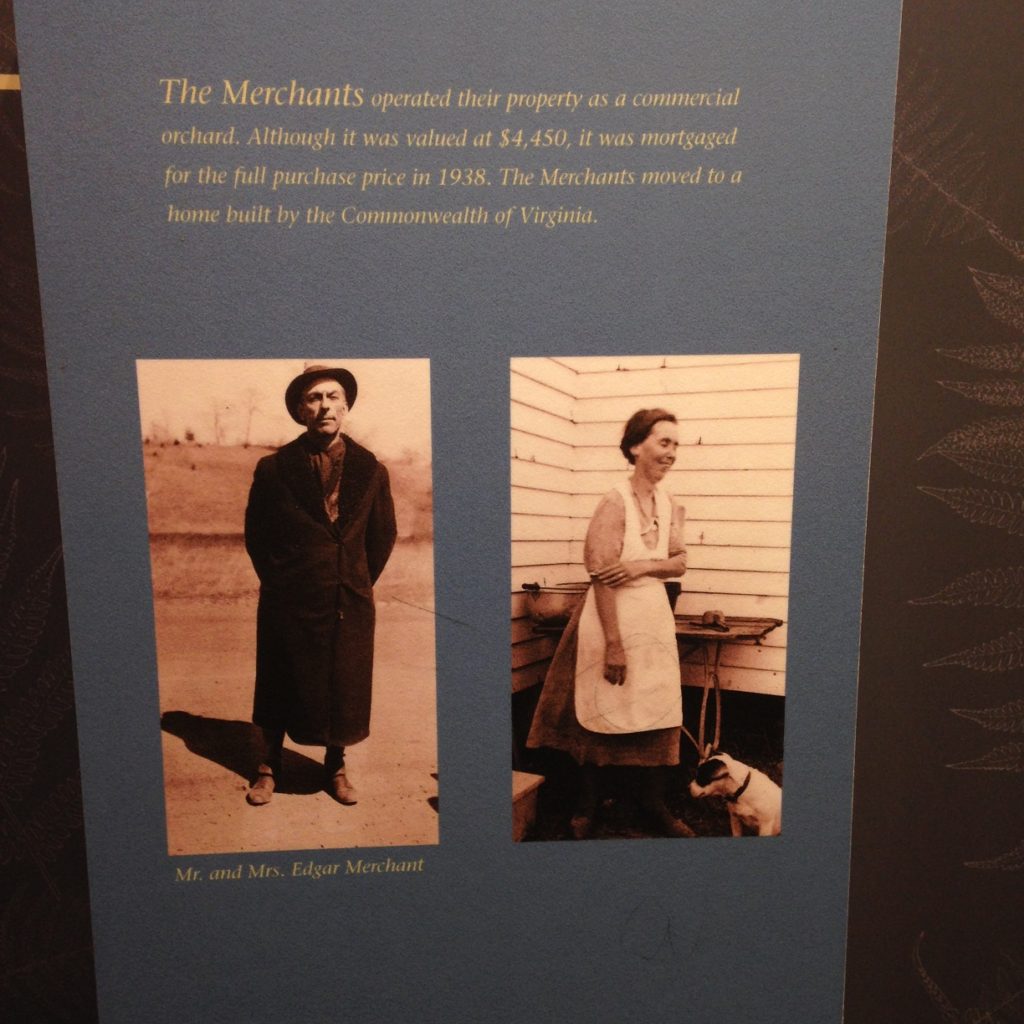
Above, faces of the displaced; below, a personal interest for one project committee member. The committee is currently chaired by Darryl Merchant, and includes Patricia Brinklow, Cheryl Fox-Wyrick, Daryl Funk, Suzanne Wood Silek and Dewey Vaughan. – Graphics Courtesy of Blue Ridge Heritage Project
The bottom line assessment: “The FORCED RESETTLEMENT represents a classic case of bureaucratic ineptitude.”
And as the ever-wise “they” say, “Those who refuse to learn from history are doomed to repeat its mistakes.”
So this humble observer urges all who are able, to help realize the Blue Ridge Heritage Project mission of seeing that this part of our collective history is NOT forgotten or NOT learned from.
Hey, there are around 40,000 people in Warren County, albeit some too young to earn a living yet. But 55-cents per person would more than cover the $21,500 balance necessary to fully fund the project. We can figure a way out to accomplish that, can’t we?
That might be a topic of conversation at the next meeting of the Warren Blue Ridge Heritage Project Committee, slated for this Thursday, August 16, at 7 p.m. at the Warren Rifles Confederate Museum at 95 Chester Street, Front Royal.

Faye Barr Vance (1930 – 2026)

James Christopher “Chris” Sain (1948 – 2026)
Alice “Maybelle” Henson (1938 – 2026)

How Sleep and Stress Affect Cancer Risk

Spanberger Signs Sweeping Public Safety and Gun Violence Bills

Horses, Fans Return as Shenandoah Downs Season Begins

Skill Games Halted Again as Spanberger Issues Veto

VDOT: Warren County Traffic Alert for April 13 – 17, 2026

The Cat Who Outlasted Six Prime Ministers

Front Royal, Virginia. Vacation Destination?

Virginia State Police Report Major Drug Seizures in Weekly Crime Suppression Effort

Virginia Secures Birth Control Access as Other Southern States Eye Abortion Pill Manufacturers

SCC Approves Loudoun Transmission Line, Nixes Undergrounding; Final Route to be Determined

Slate of New Virginia Laws Address Health Care and Housing Affordability
James J. Coverston Sr. (1942 – 2026)

Business Growth Series: Your Biggest Problem Isn’t Competition — It’s Being Overlooked

Why Many Experts Say a Concussion Should Be Called a Brain Injury

Missouri Man Arrested in Undercover Operation Targeting Online Crimes Against Children

Trump Tax Plan Credited With Higher Refunds, Lower Taxes

Spanberger Vetoes Fairfax Casino Bill, Citing Local Opposition

Blue Ridge Point-to-Point Races Return Saturday at Woodley Farm

Legislative Effort to Buy Monroe’s Loudoun Estate on Pause, Budget Effort Underway

US House Democrats Call for Congress to Come Back Into Session for Iran War Debate

Virginia to Raise Minimum Wage to $15 by 2028 Under New Law
