
Local News
Blue Ridge Wildlife Center Patient of the Week: Woodland Box Turtle
WARNING: Graphic surgical photos.
Abscesses are a fairly common problem in wildlife medicine. About 13% of the box turtles we admit have an abscess, but the overwhelming majority are aural abscesses, meaning they occur in the ear. The image above shows a previous box turtle patient with aural abscesses in both ears.

So, why are abscesses so common in turtles?
An abscess forms when bacteria enter the body and the immune system walls off the infection. This can happen following a bite, puncture, or other injury, which is what we suspect happened with this patient.
Aural abscesses can be a little more complicated.

In box turtles, they have been associated with environmental and nutritional factors, including exposure to pesticides or herbicides, that can affect the tissues lining the middle ear and make infection more likely. That’s one reason we see those characteristic swollen “ears” so frequently in this species.
This patient, however, was different.
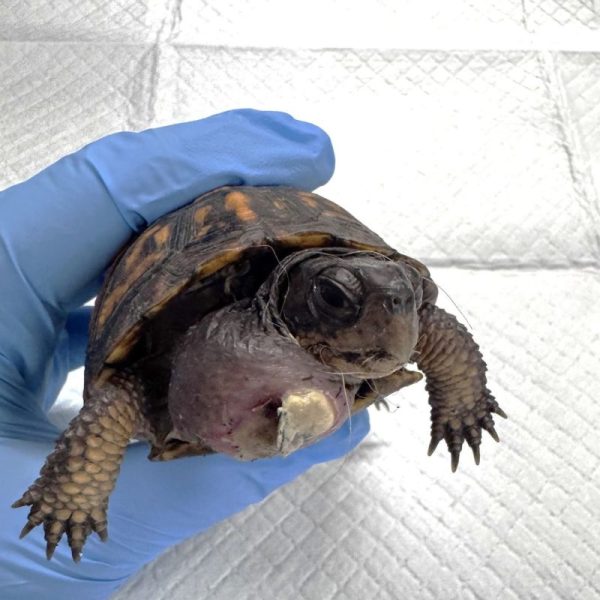
This box turtle arrived with a large abscess between the base of the neck and the right forearm, likely caused by a penetrating injury. Like an aural abscess, it needed to be lanced and thoroughly flushed while the patient was under anesthesia. But this abscess also had a thick capsule surrounding it that had to be surgically removed.
Once the capsule was gone and the area was thoroughly cleaned, our veterinary team was able to close the incision completely.

That’s different from many aural abscesses, which are typically left open to allow continued drainage.

And here’s where reptile medicine gets especially interesting: pus isn’t always liquid.
Mammals, including humans, have enzymes that help break down and liquefy purulent material. Birds and reptiles do not. As a result, the material inside their abscesses is often thick and solid rather than the liquid pus we typically associate with an infection.
That’s why a ruptured abscess on a turtle may reveal firm, “cheesy” material like what you can see in this patient’s intake photo rather than draining fluid.

And treating an individual turtle like this matters.
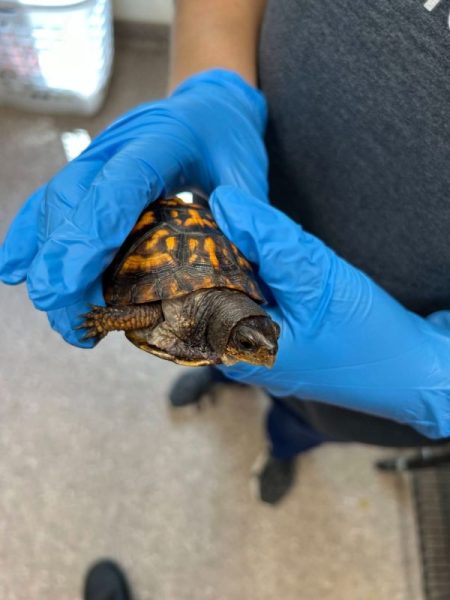
Eastern Box Turtles are long-lived animals that take years to reach reproductive maturity and produce relatively few young that survive to adulthood. That means losing breeding-age adults can have an outsized impact on local populations.
Box turtles also face increasing pressures from habitat loss and fragmentation, vehicle strikes, illegal collection, lawn equipment, and other human-related threats.
Turtles are important members of the ecosystems they inhabit. As omnivores, box turtles eat a wide variety of plants, fungi, insects, carrion, and other foods, helping with nutrient cycling and even dispersing seeds as they move through the landscape.

Because they can live for decades and often spend their entire lives within a relatively small home range, every healthy adult represents years of survival and an important part of its local population.
If you ever see a turtle with an unusual swelling, especially around the ears but potentially elsewhere on the body, an abscess could be the culprit. Contact a permitted wildlife rehabilitator (like BRWC) for guidance rather than attempting to treat or remove it yourself.
Fortunately, abscesses are often very treatable. This patient is recovering well so far, and we’re hopeful he’ll continue healing and be able to return to his home territory soon!
Looking for an easy way to help native wildlife? Become a monthly BRWC donor! For as little as $5/month, you can provide year-round, sustainable support that helps us fulfill our mission.





Front Royal Outdoors Founder Don Roberts Named 2026 Protector of the Shenandoah

Front Royal Man Held Without Bond Following Child Sexual Abuse Material Investigation

Performing Arts Center Pointing to 2027 Opening as Local Entertainment, Business, and Educational Partner

Town Planning Commission Continues to Prepare for the Arrival of Cannabis on the Local Market

Warren County Schools Improve, But Federal Rules Lower Seven Ratings

Spanberger Announces $1.3 Million in Scholarships and Incentives for Nursing Students

The First Long-Distance Phone Call Came With Receipts

Middletown Man Killed In I-81 Crash In Frederick County

Cline Backs Veteran Cancer Screening Effort, Highlights Sixth District Programs

Sheriff Cline Details Flock Safeguards, Uses and Limits at Warren County Work Session

Flock Safety: A Tool for the Common Good

Melissa Ichiuji Studio Gallery Reopens With Two Fall Exhibitions

Just Hours Away: Festival Of Leaves Returns To Downtown Front Royal Saturday

Sheriff’s Office Addresses Use of ‘ALPR’ Cameras – Health Insurance, 4-H Week, and Parks & Rec Events Also Presented

Before Relying on a Model, Look at the Assumptions

The Question Is Not Which Apple Tastes Best

Brian Anthony Lamb (1980 – 2026)

Mary Brinham Walton (nee Arnold) (1947 – 2026)

Sandra Jo Alger (1941 – 2026)

All Warren County Schools Fully Accredited as State Releases New Performance Results

This Week’s Showtimes at Royal Cinemas as of October 9th

Samuels Public Library to Expand ‘Library of Things’ With $2,000 Grant

Ask Stewart: Why Do Leaves Turn Different Colors in the Fall?

After Statewide Tour, Virginia Lt. Gov. Hashmi Officially Opposes Dominion-NextEra Merger
