
Local Government
Council debates impacts of proposed Town ‘Economic Recovery’ programs
~ Town would get much of COVID-19 grant money back in delinquent utility, tax payments ~
As promised in our exciting first installment of the Monday, April 27, Front Royal Town Council meeting and work session exploration of municipal finances in the age of 21st-century pandemics and tough economic decisions, here we move into Part Two’s work session discussion of COVID-19 related financial assistance through the Town.
And while no council members expressed a desire not to save local businesses if possible, or help citizens who have lost income due to State, local or voluntary restrictions on business operations enacted as part of the COVID-19 emergency pandemic management response, several wondered if what was put on the table by staff would accomplish those desired results.

Our familiar downtown Royal Cinemas movie marquee: ‘We will get through this together but apart’ – though exactly how remains to be seen as municipal governments, business owners and citizens navigate unfamiliar economic terrain. Royal Examiner Photos/Roger Bianchini
On the council’s table for consideration are two financial assistance programs, one targeting businesses that have lost income, the other citizens. The staff proposal would commit a total of $1.5 million, up to $1 million for the business “Economic Recovery” program, and $500,000 to the “Residential Utility Assistance” program. Both would be structured as grants that would not have to be paid back – exactly.
The citizen program would exclusively apply to the payment of back Town utility bills, so the money given as a non-recoverable grant to citizens would come back to the Town immediately as utility bill payments. Assistance would be based on a three-month average utility payment of the delinquent client. Applicants must have become unemployed after February 1st.
On the business side of the non-recoverable grants, the first use of funds must be to pay delinquent Town utility bills and taxes. Once caught up with Town taxes and utility payments, remaining funds can be used as the recipient sees fit “for other business expenses”.
Were the grants actually able to save a COVID-19 emergency response-induced failing business, the Town will, of course, see the additional future benefit of the surviving business’s taxes and utilities being paid without municipal assistance; and employees getting their jobs back and becoming financially solvent once again.
What’s in the numbers?
As noted at the end of our story on Monday’s council meeting actions, “there appeared to be divided as to the commitment of additional Town resources in its unknown fiscal future, as well as whether suggested recovery amounts ranging from a $500 minimum for businesses with annual gross incomes of up to $50,000 to a maximum of $13,000 for businesses grossing over $500,000 annually, could actually help a struggling local business to survive”.
We will explore highlights of the council’s discussion of that “division” later in this story after first summarizing the numbers at issue and logistical complications surrounding its implementation.
There are four tiers in the “Business Economic Recovery/Assistance Program, they are businesses with gross annual revenues: Tier 1/ of $15,080 to $50,000 (available grant of $500); Tier 2/ $50,000.01 to $200,000 (available grant of $2,000): Tier 3/ $200,000.01 to $500,000 (available grant of $4,000); and Tier 4/ $500,000 (though the penny was left out here) and above (available grant of $9,000). It was explained that the $15,080 minimum gross revenue number was based on an annual minimum wage scale, which would appear to include a small business with one minimum wage employee.
Additional assistance can be received by businesses having a Town utility account or paying Town Real Estate Taxes. Those additional assistance numbers are: Tier 1/ $500; Tier 2/ $1,000; Tier 3/ $2,000; and Tier 4/ $4,000.
So the maximum assistance across the Tier board is 1/ $1,000; 2/ $3,000; 3/ $6,000; and 4/ $13,000. Priority guidelines for business selection were included, see attached graphics pages for elaboration.
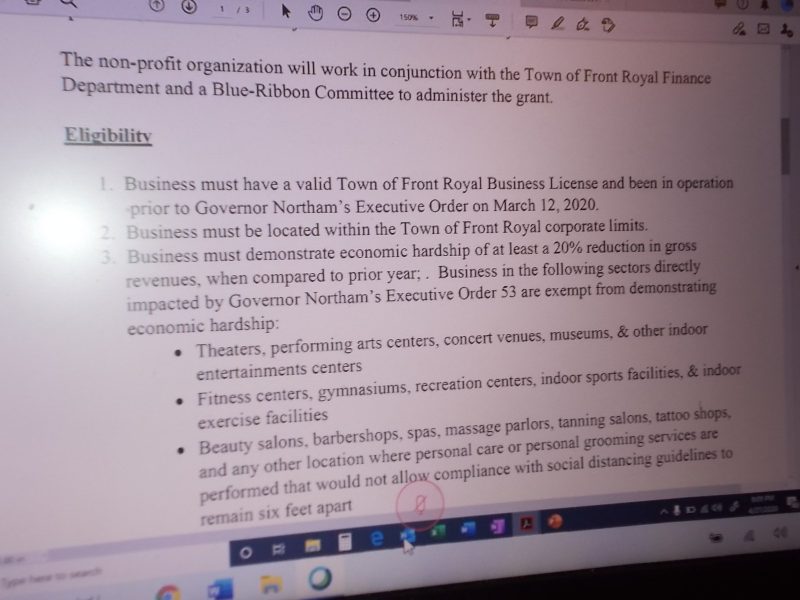
A portion of eligibility criteria for small business ‘Economic Recovery & Assistance’ program.
Due to the non-recoverable grant aspect of the proposal, the Town cannot administer the programs, Interim Town Manager Matt Tederick explained with an unanticipated analogy.
Of Towns, Kings & EDA’s
“If I can go back to the first comment I made about this matter, is towns, governments aren’t designed to be a charity, they’re designed to be the king,” Tederick offered of his perspective on the nature of the democratically-based political rule, adding, “They were designed to take the money and to receive taxes and to receive money, not necessarily pay it out in the form of a gift to the people.”
Tederick’s comment might raise an eyebrow from some in light of an American Revolutionary War fought to throw off the yoke of kingship and class elitism in the conduct of American governmental affairs, in favor of an elected, representative government designed to move the new nation to do the business of the entire citizenry “by the people and for the people”. However, the remark was delivered to explain the above-referenced state legal prohibition on a municipal government’s ability to administer a program in which money is offered as a non-recoverable grant to prop its constituency up in times of financial stress, as in this case financial stress not of their own making.
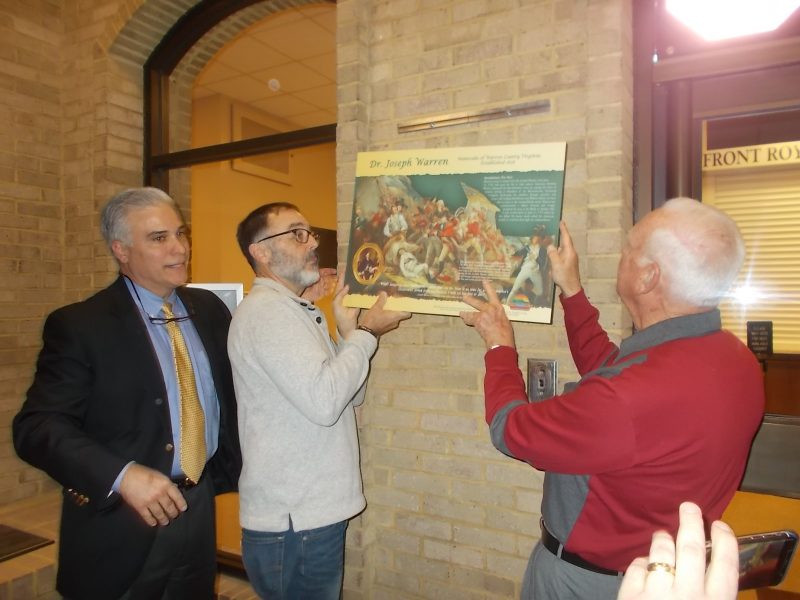
Wonder how Revolutionary War leader Joseph Warren, for whom the county is named, would feel about Interim Town Manager Tederick’s ‘governments are designed to be the king’ remark? Tederick, left, assisted Councilman Holloway, center, and Mayor Tewalt last December in hanging the donated Joseph Warren Town Hall display commemorating Warren’s service and death at the direction of one king during the American Revolution.
“That’s why it needed to be a non-profit,” Tederick said of an agency through which the proposed “Economic Recovery” and “Residential Utility Assistance” programs would have to be administered on behalf of the town government. “And the state code specifically said a chamber of commerce, and that’s why they would be administering the grant,” rather than the Town, Tederick told the council.
Whether parameters would be set to avoid any appearance that the Chamber’s business membership might be given preferential consideration for the grants was not broached during Monday’s discussion.
“The other alternative and I’ll just throw it out, for most localities that are – I won’t say most – I’ll probably go so far as to say all localities that are doing some kind of program like this if they’re abiding by the law, and that’s a qualifier, if they’re abiding by the law, by the books, they’re using their economic development authorities to do this.
“We have one, but we haven’t formed it yet,” Tederick said, perhaps first casting public light on his and the council’s current perspective on its continued membership in the existing Town-County EDA while moving toward the creation of its own, second unilateral EDA. It appears the Town’s governmental “rightsizing”, also known as downsizing, do not include EDA’s since town legal staff has publicly cited the advantage of maintained membership in the existing EDA.

Mayor Tewalt would like to maintain a working, non-litigious relationship with the existing EDA. However, it has become apparent the council he chairs and its appointed interim town manager do not.
Lori Cockrell then questioned Tederick and Finance Director B. J. Wilson on earlier meeting discussions on that state prohibition on municipalities offering grants – “So, we can’t give grants, correct?” she asked.
“We can donate to the non-profit organization and the non-profit organization can make the disbursements – we, the Town itself, cannot issue the grant is my understanding,” Wilson replied.
While complimenting finance and administrative staff for their time and effort in structuring and laying out an emergency funding relief program, Cockrell told staff and her colleagues, “I myself would just kind of like to see us slow down a little bit. I’d like to see what’s going to happen from the federal government, from the state governments, and see what kind of relief they’re going to provide to businesses.
“I know that Mr. Tederick just mentioned something about the EDA, and I believe I read in the minutes that they were even adding some type of committee or board that would have, like small business loans. And Mr. Tederick, Mr. Wilson, do you recall reading that in the minutes?”
“Yes mam, that’s correct. Their committee is doing loans, whereas this would be a forgivable grant,” Tederick replied of the existing EDA’s efforts as opposed to what he and the finance department had proposed.
Former EDA board member and Vice-Mayor Sealock observed that the EDA’s Small Business Loan Program was not newly formed in the wake of the pandemic situation, but a long-standing small business assistance effort.
“What you read today is just standard practice with them,” Sealock offered.
As Royal Examiner has reported, the newly formed SBL Committee is a tweaking of the EDA’s Small Business Loan application and review process, another fix-it-up effort to correct perceived past mistakes that allowed the EDA financial scandal to evolve in certain directions under previous EDA leadership.
Unknown variables
“Okay, but I guess what I’m saying is I’d like to see what is available out there before we move forward with a million dollars. I’ve had citizens give input to me, and they have concerns that our town has a lot of unknowns right now as to our own budget. And to what the COVID-19, the pandemic, what impact that’s going to have on us as a town.
“And their fear of how we’re going to provide services to the citizens if we do have some large deficits in our revenues. And they’re nervous about us providing a million dollars out there. And if nine months from now will we come back to them and ask them to raise taxes or raise rates and such.
“I’m not against assisting businesses or citizens; I’m not overly against this, I’m just concerned – I don’t want us to move quickly on this, I want to see what else is going to be available, first before we move forward.”
“Lori, along, those same lines, all of the arguments that were made against this, which I had a couple of too, are the same arguments that were made against … Dominion Power’s redundant water line – are the water rates going to go up? Are you going to increase taxes because of this huge project? And so forth and so on,” Letasha Thompson said in support of Cockrell’s concerns.
Vice-Mayor Sealock answered by saying, “That is why we’ve been doing contingency planning and moving dollars forward to make sure we can cover as many shortfalls in next year’s budget as possible.” However, he did not address the potential impacts of the $2.3 million in reserves council authorized earlier Monday evening to prop up the current FY 2020 budget through its final months.
In support of moving forward with a recovery plan, Sealock cited an article he said indicated one restaurant he did not name, already shutting its doors permanently as a consequence of the pandemic response restrictions on certain business operations.
“If we don’t help in some kind of recovery, our downtown is going to be a ghost town, if it isn’t already,” the vice mayor worried.
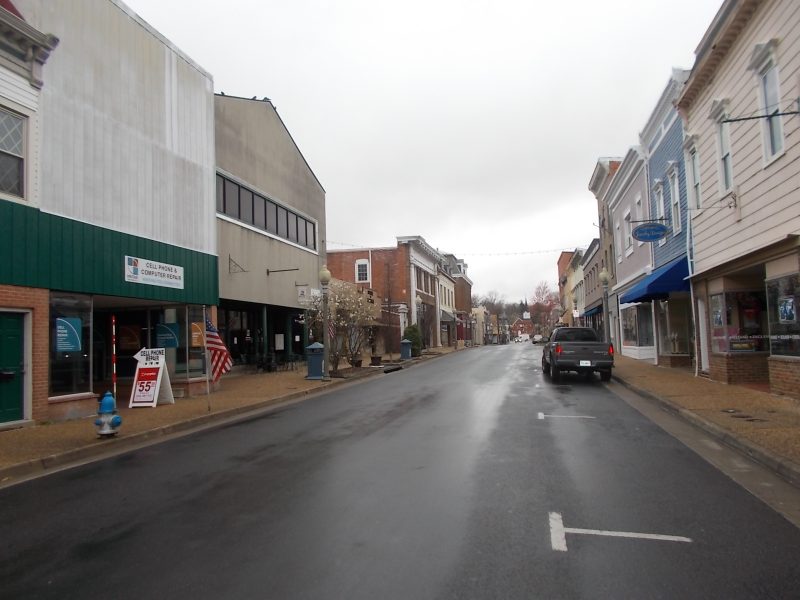
Vice-Mayor Sealock worried that without municipal economic assistance through the COVID-19 pandemic and emergency response, downtown Front Royal will become a ‘ghost town’ on a longer-term basis.
He said business owners he had consulted liked the Town draft recovery plan based on annual gross receipts. He then asked how the plan would work for multiple business owners – could they get relief for each of their business entities, or just as one owner?
Tederick replied that eligibility would be based on business licensing.
“If they have three business licenses and they qualify under the various terms, they would receive three grants,” the interim town manager replied as the draft proposal currently is written.
The questions remaining to be determined for council and staff are whether a $1.5 million dollar commitment from the Town will provide sufficient revenue to local businesses to assure their survival through this unknown pandemic and financial landscape.
“I’m not sure a thousand dollars is going to pull anybody out of the last month of a lack of receipts,” Cockrell observed. “However, I’m sure they would be grateful for any assistance. I’m encouraged by someone saying we could cap the amount differently or we could see how many people are actually interested in this type of relief – and it may be that more is, or it may be that less is. A graph presented in the draft estimated 30% of businesses in each Tier receiving assistance.
“But I like the idea of public input because the public input I have gotten has not been supportive at all,” she added, observing that with the proposal finally circulating into a wider public sphere with public discussion and media’s help, public feedback could increase and numbers on attitudes for or against could shift.
As the work session drew toward a 9:51 p.m. adjournment, a council consensus was reached to move the proposal in one form or another toward public input and a vote, if logistically possible as to advertising requirements, at council’s next regularly scheduled meeting, again likely virtually-held online, in two weeks, on May 11th.
Mayor Tewalt asked Tederick for an update on scheduling and proposal parameters by Thursday, April 30th. And with that, a far-reaching evening of budget discussion came to a close.
Hear work session discussion in the recording of the virtual meeting:


James Christopher “Chris” Sain (1948 – 2026)
Alice “Maybelle” Henson (1938 – 2026)

How Sleep and Stress Affect Cancer Risk

Spanberger Signs Sweeping Public Safety and Gun Violence Bills

Horses, Fans Return as Shenandoah Downs Season Begins

Skill Games Halted Again as Spanberger Issues Veto

VDOT: Warren County Traffic Alert for April 13 – 17, 2026

The Cat Who Outlasted Six Prime Ministers

Front Royal, Virginia. Vacation Destination?

Virginia State Police Report Major Drug Seizures in Weekly Crime Suppression Effort

Virginia Secures Birth Control Access as Other Southern States Eye Abortion Pill Manufacturers

SCC Approves Loudoun Transmission Line, Nixes Undergrounding; Final Route to be Determined

Slate of New Virginia Laws Address Health Care and Housing Affordability
James J. Coverston Sr. (1942 – 2026)

Business Growth Series: Your Biggest Problem Isn’t Competition — It’s Being Overlooked

Why Many Experts Say a Concussion Should Be Called a Brain Injury

Missouri Man Arrested in Undercover Operation Targeting Online Crimes Against Children

Trump Tax Plan Credited With Higher Refunds, Lower Taxes

Spanberger Vetoes Fairfax Casino Bill, Citing Local Opposition

Blue Ridge Point-to-Point Races Return Saturday at Woodley Farm

Legislative Effort to Buy Monroe’s Loudoun Estate on Pause, Budget Effort Underway

US House Democrats Call for Congress to Come Back Into Session for Iran War Debate

Virginia to Raise Minimum Wage to $15 by 2028 Under New Law

Spanberger Signs Bills to Aid Low-Income Utility Customers, Manage Power Demand
