
Local News
Electrical teacher blows students’ minds with hands-on training, daily code checks
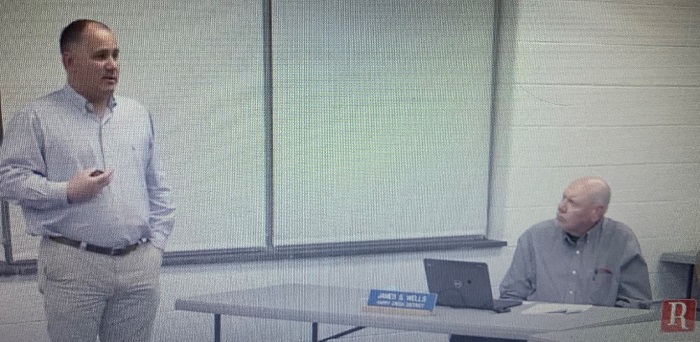
WCPS Electrical Teacher Darren McKinney (left) and Warren County School Board member James Wells.
Blue Ridge Technical Center Electrical Teacher Darren McKinney last week showcased his career and technical education (CTE) class for the Warren County School Board.
“Sometimes we forget the emphasis that trades programs play in our daily lives,” McKinney told board members during their Tuesday, November 16 work session. “We’re backing the professional lives of the people who are needed to do this.”
McKinney, a Sperryville, Va., resident who owns and operates McKinney Services, has been a Warren County Public Schools electrical teacher for almost three years and has taught at Lord Fairfax Community College as an LFCC workforce adjunct since January 2016. He’s been in the construction industry for more than 25 years, so he knows a thing or two about the skilled trades industry, which currently is experiencing workforce shortages.
“It’s not only electricians but all tradespeople. And this is nationally, too,” McKinney told the Royal Examiner today in an email.
In fact, the U.S. Bureau of Labor Statistics’ 2020 Occupational Outlook Handbook projects roughly 84,700 openings just for electricians each year, on average, through 2030. Many of these openings are expected to result from the need to replace workers who transfer to different occupations or who retire, according to the bureau.
Employment of electricians is projected to grow 9 percent from 2020 to 2030, about as fast as the average for all occupations, the bureau says, noting that the 2020 median pay for electricians was $56,900 per year, or $27.36 per hour.
Most electricians learn through an apprenticeship, according to the Labor Department, but some start out by attending a technical school. Most states require electricians to be licensed. Almost all electricians work full time. Work schedules may include evenings and weekends, and overtime is common.
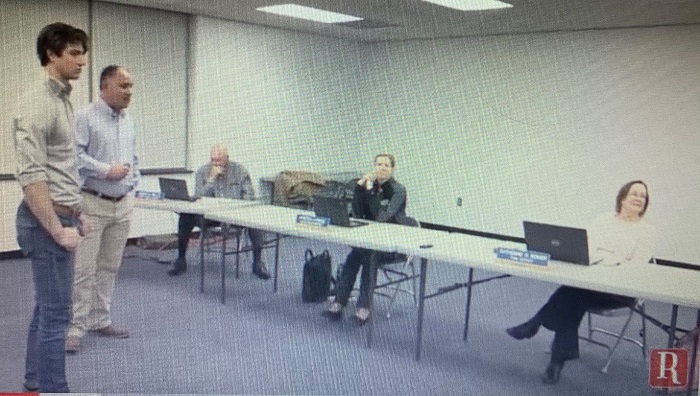
Left to right: WCPS student Ben LeBlanc, WCPS teacher Darren McKinney, School Board members James Wells, Kristen Pence, and Catherine Bower.
Ben LeBlanc, a second-year electrical student of McKinney’s who joined the teacher during the School Board presentation, plans to work in the field. He and his classmates are learning a national curriculum, said McKinney.
For instance, the Electricity I class is an introductory course that covers the basics of safety, tools, code, construction drawings, and electrical theory. Students cover two nationally accredited textbooks during one semester, he explained.
Specifically, Electricity I students cover construction and electrical safety, hand and power tools, rigging and material handling, communication and employment skills, construction and electrical drawings and schematics, basic electrical theory, Kirchoff’s Law, Ohms Law & Resistance, how power is generated, the National Electric Code, device boxes, conduit bonding, and more.
“It’s amazing and surprising to me sometimes because I was a kid who was always in my dad’s toolbox,” McKinney told the School Board. “But these kids never in their life have touched a screwdriver, a saw, a pair of pliers — they don’t even know what this stuff is. So, this introduction [course] helps.”
Electricity 2 is a formational course that builds on the concepts introduced in Electricity I. Students learn about the functionality of the aspects of electricity and during this second year, students have the opportunity for more hands-on experiences than in the first course, said McKinney.
For example, students will take their knowledge about the meaning of a transformer to create a transformer in order to understand how it works. LeBlanc explained that in year one, students would go through the codebook and learn about transformer theory. Comparatively, during the second year, students actually get to make a transformer, he said. McKinney said he helps students build them and learn about their scientific properties.
Electricity 2 “blows these kids’ minds,” McKinney said, noting that while students question why they must know certain math or science concepts, they soon realize how such topics are so applicable to trades.
And while students tire of hearing about it, McKinney said safety is discussed daily with them “because that is the most important thing, to come and be in a safe environment, to be able to go home at night and see our families and come back the next day.”
Another daily practice that students take on is a 30-minute code check. Students get five questions at the end of every class and then they spend the last 30 minutes of every class going through the codebook to find what’s right and wrong in the code.
“If you don’t understand how something works, then you can never fix it. And if you don’t understand how it’s supposed to be, then you don’t know whether it’s right or wrong,” said McKinney. “So, my whole goal is to give them the correct theory, the correct knowledge, and then let them know what’s right and wrong.”
He also teaches them professionalism, which includes how they dress and the language they use. “There is a profanity problem and I let them know that it’s not acceptable,” McKinney said. “It’s not just right and wrong, it’s a way of life.”
In Electricity 2, Warren County students also use their skills on campus to build electrical trainers for the Agriculture Department, for instance and installed an outlet for a temporary heater in the Ag Greenhouse at Skyline High School. They also learn about capacitors, bending conduits, and how to wire switches, outlets, cubicles, and then an entire modular home.
In Electricity 3, students get to start building things and experience a combination of in-class time to expand their experiences from year two, and get in-the-field experiences, in many cases as interns for local companies.
LeBlanc is also an intern for McKinney’s company and receives one credit for the semester. “Ben works with me every Saturday. He earns money and he gets real-life experience,” McKinney said.
The third-year is all about putting everything that was learned during the first two years into practice in real-world experiences. The goal is for students to use their skills in the workforce.
Students who go through the program earn their OSHA 10 card, which essentially lets the real world know that the students have learned the basics. Specifically, McKinney said that an OSHA 10 card proves to employers that a person has completed 10 hours of OSHA-authorized training on critical workplace safety topics. Entry-level workers with this credential have industry-specific knowledge and skills that help prevent injuries and keep workplaces safe and productive.
“Two things I’m really concerned about when I teach a student — I’m not concerned if they go into the electrical field,” said McKinney about his students. “I want to make them a good member of society and give them a good work ethic.”
Warren County Public Schools also tracks the employability of its CTE students. McKinney said that eight of his students from the last three years he has taught with WCPS do work in the electrical field now. He said some go on to the local union, which has its own training program, while others attend LFCC.
In Virginia, state licensure requires 240 vocational hours, 8,000 hours in the field, and a passing grade on a journeyman’s exam for a journeyman’s license, which is good for one year. Students, or apprentices, then can sit and take a master’s exam.
“It’s not as easy as people think,” McKinney said. “It takes a lot of time and a lot of education.”
Watch the latest Warren County School Board meeting in this exclusive Royal Examiner video.

3 Ways to Extend the Life of Your Electric Vehicle Battery

Serious Charges Highlight Warren County Grand Jury Indictments

Ducks, Flowers, and Fun: Redbud Festival Returns to Browntown

Potato-Crust Quiche Makes a Lovely Brunch

Faye Barr Vance (1930 – 2026)

James Christopher “Chris” Sain (1948 – 2026)
Alice “Maybelle” Henson (1938 – 2026)

How Sleep and Stress Affect Cancer Risk

Spanberger Signs Sweeping Public Safety and Gun Violence Bills

Horses, Fans Return as Shenandoah Downs Season Begins

Skill Games Halted Again as Spanberger Issues Veto

VDOT: Warren County Traffic Alert for April 13 – 17, 2026

The Cat Who Outlasted Six Prime Ministers

Front Royal, Virginia. Vacation Destination?

Virginia State Police Report Major Drug Seizures in Weekly Crime Suppression Effort

Virginia Secures Birth Control Access as Other Southern States Eye Abortion Pill Manufacturers

SCC Approves Loudoun Transmission Line, Nixes Undergrounding; Final Route to be Determined

Slate of New Virginia Laws Address Health Care and Housing Affordability
James J. Coverston Sr. (1942 – 2026)

Business Growth Series: Your Biggest Problem Isn’t Competition — It’s Being Overlooked

Why Many Experts Say a Concussion Should Be Called a Brain Injury

Missouri Man Arrested in Undercover Operation Targeting Online Crimes Against Children

Trump Tax Plan Credited With Higher Refunds, Lower Taxes

Spanberger Vetoes Fairfax Casino Bill, Citing Local Opposition
