
EDA in Focus
Following State Law seminars EDA votes to request legal fee assistance
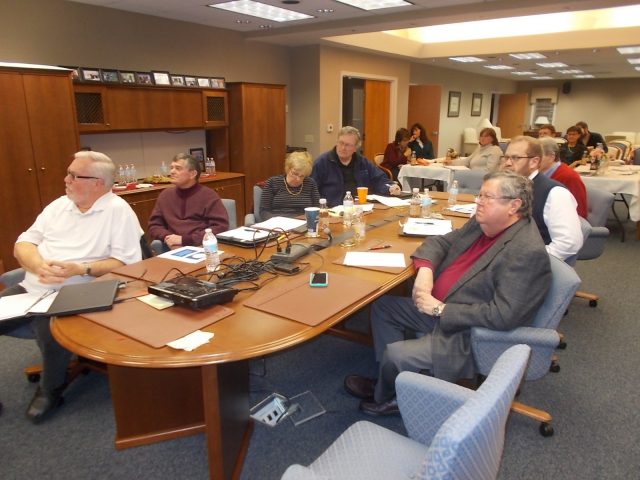
It was a rapt, and well-fed audience for Monday evening’s (Dec. 9) EDA-hosted seminars on Public Financial Disclosure and FOIA laws. Royal Examiner Photos/Roger Bianchini.
The three Warren County Supervisor-elects, Cheryl Cullers (South River District), Delores Oates (North River), and Walter Mabe (Shenandoah) were all present for seminars on State Freedom of Information Act (FIOA) and Financial Disclosure/Conflict of Interest laws Monday evening, December 9.
The seminars were presented by the Front Royal-Warren County Economic Development Authority (EDA), all of whose board members save Greg Harold out of state on business, were also present for the Special Meeting and seminars held in the Conference Room of the Virginia Inland Port in the county’s North Industrial Corridor.
And after hearing the two seminars totaling nearly two hours, the incoming supervisors were informed they are now legally-certified in FOIA and Conflict of Interest/Financial Disclosures for the first two-years of their coming four-year terms of office – and they got a free meal hosted by the EDA and catered by McAllister’s prior to the meeting’s 6 p.m. start.
Legal and fed – can beat that.
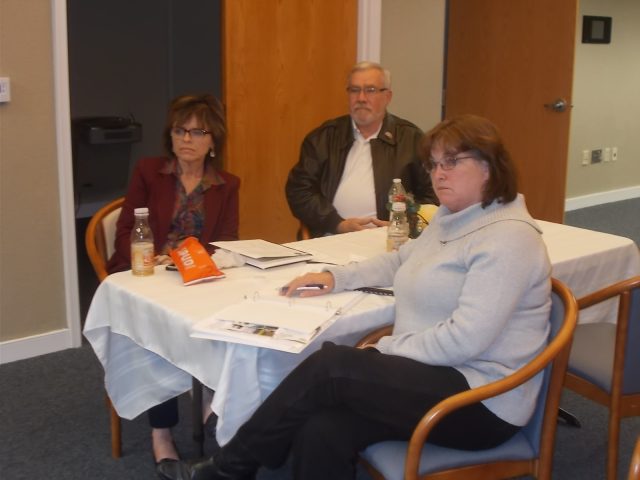
Legal and well fed – a good combination for incoming supervisors
The EDA Special Meeting agenda’s one other order of business was a vote on a Resolution reflecting the EDA’s intent to reimburse its past and present EDA board members’ legal fees regarding the now-dropped criminal misdemeanor charges of misfeasance and nonfeasance regarding oversight of former EDA Executive Director Jennifer McDonald in the latter part of 2018, upon requested receipt of that funding from the Warren County Board of Supervisors.
The total amount sought to cover the expenses of those seven current or past members is $36,827.17, with former member and Chairman Greg Drescher topping the list at $10,000 in legal fees and former member and Vice Chairman Bruce Drummond at the bottom end of the legal fee scales of justice at $3,000.
Discrepancies in legal fees have been explained by County staff as relating to when that representation was retained and the varying amounts of work those attorneys put into the cases before they went to court.
The vote on a motion by current Vice Chairman Jeff Browne, seconded by Greg Harold by remote phone connection, was 6-1, with only EDA Treasurer Jorie Martin dissenting. Martin later explained to the media that her dissent was based on her belief the reimbursement does not need to come through the EDA, but rather should be paid directly by the County Board of Supervisors to those EDA board members, most of whom the supervisors appointed.
Prior to the vote all involved current board members – Mark Baker ($4727.50), Gray Blanton ($4665), and Tom Patteson ($4809.67) read public disclosure statements concerning their personal interest in the vote. In addition to Drescher and Drummond, the no-longer serving members seeking reimbursement are William Biggs ($5000) and Ron Llewellyn ($4625).
The County Supervisors have already cast a 4-1 majority vote to compensate its own members’ legal fees on the same dismissed charges. Only dissenting voter Tom Sayre (Shenandoah District) declined to accept the County compensation, choosing to pay his own legal fees.
Despite that rift, Sayre’s colleagues joined in support of the departing Shenandoah District Supervisor’s motion (seconded by Fox) to delay a vote on that EDA legal fee request at the Board of Supervisors meeting the following morning, Tuesday, December 10. Recent public comment has urged the majority lame-duck county board to defer a decision on those legal fee compensations until the new board is seated at the turn of the year. And by a unanimous 5-0 vote they did.
Seminar dynamics
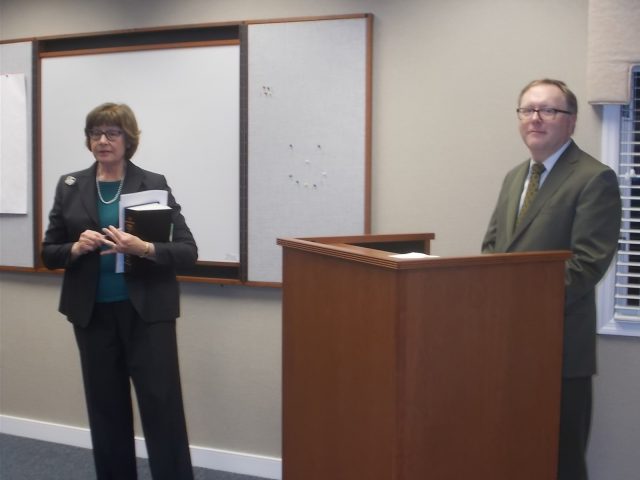
EDA Attorney Sharon Pandak introduces State Conflict of Interest/Ethics Council Executive Director Stewart Petoe to EDA board and staff and incoming County supervisors.
The seminar presenters were newly-contracted EDA Attorney Sharon Pandak of the Woodbridge law firm of Greehan, Taves & Pandak (FOIA law) and Virginia Conflict of Interest and Ethics Council Executive Director Stewart Petoe, the latter up from Richmond. Pandak deferred to Petoe to begin due to his longer trip home. And as Petoe informed the group during his presentation, overnight accommodations paid for by non-employers can run afoul of ethics law in certain circumstances.
As for adherence to conflict of interest and ethics standards, while there are many detailed rules, Petoe’s short advice was “if it seems squirrely” or “it doesn’t seem right, it probably isn’t.”
To expand slightly you can’t enrich yourself, family members or friends “from confidential information received in the conduct of your job until that information becomes common knowledge” available to the general public.
And take special care when inducements or gifts are offered by lobbyists, lobbyists’ employers and contractors seeking work from you or your board.
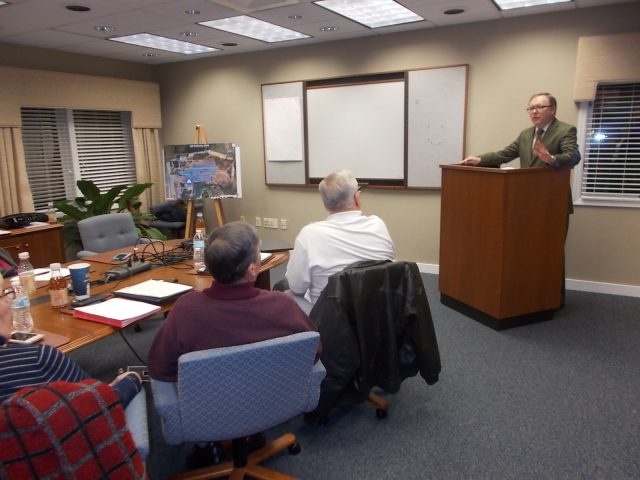
Petoe tells assembled officials a good rule of thumb on potential conflicts of interest is, ‘If it doesn’t seem right, it probably isn’t.’
There are many detailed rules and guidelines and when you get elected or appointed to an involved public entity, you better contact the COI/Ethics Council – anonymity assured on all specific queries – and find out what they are.
On the FOIA side, Pandak’s advice in a nutshell was that to conduct public business in governmental or quasi-governmental settings, the former like an EDA, it must generally be done in a public meeting setting advertised at least three days in advance.
Specific exceptions to open meeting requirements are noted in law, as in the familiar to the press “consultation with legal counsel” on matters where public disclosure could have a detrimental effect on the body’s litigation or pending business dealings; not to mention “personnel matters”.
But regardless of those exceptions to open meetings, action “on any matter” must be done at a public or special meeting properly advertised in advance – “NO secret ballots” to establish public policy. (Hmm, I wonder if there is any public record of that EDA board – the old one – decision to give ITFederal and Curt Tran that 30-acre Royal Phoenix parcel for a dollar when all the open meeting discussion this reporter, and apparently all others, ever heard revolved around a $2 million dollar sale price?)
As for producing public records requests showing adherence to public policy informational guidelines, the short advice was if those records exist, produce them within five working days; if there are difficulties you may request additional time; and if the request is extremely broad and encompassing, charge a justifiable price for the time and effort required to comply in whatever timeframe is authorized.
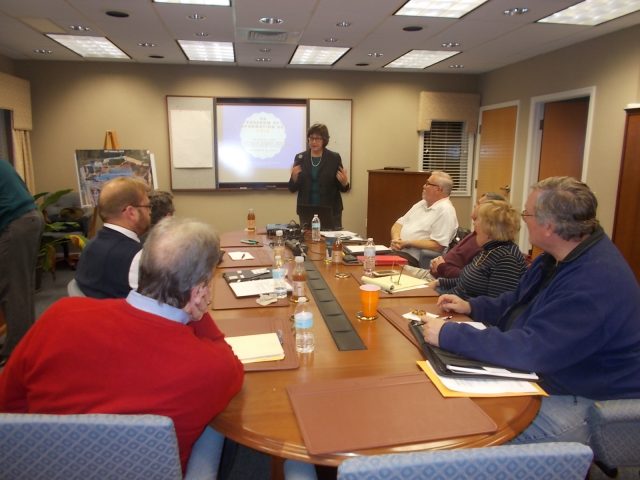
Pandak’s advice on Public Meeting and Public Information requests was – follow the law; and when there are questions reference AG opinions, court rulings and FOIA Council published opinions.
Pandak also noted that electronic communications, on public or personal devices, related to public business ARE subject to FOIA request. Her bottom line – follow the law and where questions exist rely on Attorney General opinions, court decisions or FOIA Council published opinions.
And like we said above, when you’re elected or appointed to a public body and need to know more – contact the relevant state councils and get schooled on the details.

Front Royal, Virginia. Vacation Destination?

Virginia State Police Report Major Drug Seizures in Weekly Crime Suppression Effort

Virginia Secures Birth Control Access as Other Southern States Eye Abortion Pill Manufacturers

SCC Approves Loudoun Transmission Line, Nixes Undergrounding; Final Route to be Determined

Slate of New Virginia Laws Address Health Care and Housing Affordability

James J. Coverston Sr. (1942 – 2026)

Business Growth Series: Your Biggest Problem Isn’t Competition — It’s Being Overlooked

Why Many Experts Say a Concussion Should Be Called a Brain Injury

Missouri Man Arrested in Undercover Operation Targeting Online Crimes Against Children

Trump Tax Plan Credited With Higher Refunds, Lower Taxes

Spanberger Vetoes Fairfax Casino Bill, Citing Local Opposition

Blue Ridge Point-to-Point Races Return Saturday at Woodley Farm

Legislative Effort to Buy Monroe’s Loudoun Estate on Pause, Budget Effort Underway

US House Democrats Call for Congress to Come Back Into Session for Iran War Debate

Virginia to Raise Minimum Wage to $15 by 2028 Under New Law

Spanberger Signs Bills to Aid Low-Income Utility Customers, Manage Power Demand

FTC Wants to Hear from Renters About ‘Unfair and Deceptive Housing Fees’

As Redistricting Referendum Nears, Spanberger Balances Governing and Campaigning

Drive for More Housing Sparks Rare Bipartisanship in Statehouses, Including in Virginia

Community Breakfast at Riverton Church Serves More Than Just Pancakes

Proposed Electric Substation Declared Compliant with Comprehensive Plan at County Planning Commission Meeting

Christopher Todd Thomas (1975 – 2026)

Constitution 101: The Commerce Clause

What Factors Are Most Likely to Affect the Cost of a Funeral?
