
Local Government
Meza explanation of pro-Crooked Run 2 stance resurrects corridor issues
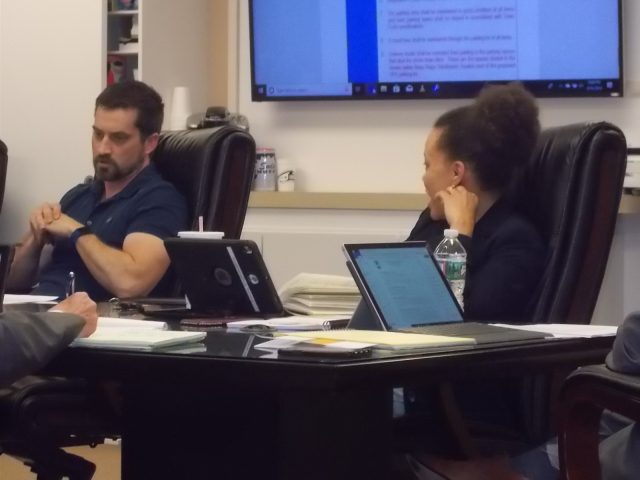
Jacob Meza during April work session as council colleague Letasha Thompson listens. Royal Examiner File Photos/Roger Bianchini
In addition to explaining why he doesn’t believe a majority of town citizens will tolerate an ongoing hike to either utility fees or taxes – even an 85-cent one – in support of any town service or public utility they may desire, Jacob Meza took time to respond to public criticism directed his way at the Monday, July 8, Front Royal Town Council meeting. That criticism came from Paul Gabbert, the one public speaker to address issues other than recycling during his remarks.
As reported in our related story on the continuation of recycling, after expressing support of opening speaker Adele Medved’s pro-recycling comments, Gabbert addressed the status of a trio of issues: the Afton Inn, the Crooked Run 2 development company request for Town water-sewer service for primarily residential development outside the town limits, and accountability for a past lack of due diligence regarding EDA business conducted inside the town limits.
China’s off the hook – Town will maintain single-stream recycling
It was the out-of-town water-sewer utility request, long a municipally contentious issue, that drew pointed criticism Meza’s way.
“The water in the Shenandoah is not yours to sell, sir, it belongs to everyone. I feel sorry for you if that’s how you look at the Shenandoah River,” Gabbert said of earlier work session Meza comments he interpreted as pro-Crooked Run 2 rezoning and town central utility access again being extended beyond the town limits into county land.
“At a work session several weeks ago, everyone except you, Mr. Meza, was against sending water out there. Your argument for sending water was, ‘Aren’t we in the business of selling water?’ which I assume means you are in favor of the rezoning” (of the Crooked Run 2 property from Commercial to Residential mixed use).

How do you look at the Shenandoah River? A state-winning view of the river near Cullers Outlook in Warren County was used for national tourism promotion for the Commonwealth of Virginia.
Actually the rezoning is county business since the property at issue is on county land, just west of the Target-based Crooked Run Shopping Center, north of I-66. However were the Town to deny the utility request, it has been a foregone conclusion by most that the rezoning would become a moot point without Town central water-sewer service.
“Look at the future. When those jurisdictions up river from us … build residential, what’s going to happen to us?” Gabbert asked of changing municipal central water demands along one of the region’s great recreational assets.
“Is it going to be a trickle by the time it gets to the Potomac,” Gabbert wondered of the Shenandoah’s future.

I don’t know if I’d drink out of it anyway – Former Shenandoah Riverkeeper Jeff Kelbe examines Shenandoah River cattle manure-fed algae bloom in 2017. OH WAIT, that’s what those tens of millions of dollars in water and wastewater plant upgrades are all about, right? Photo Courtesy Shenandoah Riverkeeper
Drawing on past meeting public comments Gabbert told Meza and his colleagues that he perceives an overwhelming citizen consensus opposed to authorizing the out-of-town extension of Town water-sewer beyond existing parameters, particularly as it might facilitate private-sector financial gain by way of out-of-town residential development.
“What you need to remember is the citizens of Front Royal and the county don’t want this rezoned; they do not want water to be sent to everything that’s going on in this county,” Gabbert said, adding an admonition to those on the council dais not to “play” the role of public servant, while operating on privately-held agendas.
“You hold your seats to do and to listen to what the citizens want, not what you as an individual wants,” Gabbert said as Vice-Mayor Sealock queried if he was concluding his remarks about a half minute after his time limit bell had gone off. That led Gabbert to hurry onto to his final topic, a request council members add a broader public apology to the one several of them had offered former colleague Bébhinn Egger on March 25, following her appearance to urge them to learn from past mistakes regarding an absence of due diligence in considering EDA requests for financial assistance, project rezonings and code exemptions.
Some 10 minutes later during council reports, Meza offered to sit down with Gabbert at some point to discuss in detail his constituent’s concerns.
Why not out of town?
“But I do want to go on the record that I am for different affordable housing options that were proposed in the Crooked Run project from apartments, town homes and senior living,” the councilman began, observing there was also a planned local commercial aspect to serve the neighborhood.
Meza said he had seen such development successfully done “IN the west end of Richmond” – an apparent indication that it was not done across municipal boundaries, as is being requested here.
“In order to make that happen you have to send water out and that’s what brings up the term ‘selling water’. It is actually what we do as a town for the commercial businesses out there; even the homes at Blue Ridge Shadows, we charge them for the water and it generates revenue for the infrastructure, and continues the expansion and building of our plants,” Meza said of the North Corridor’s industrial development on County land. It is development dependent on the extension of Town water-sewer service beyond the Town’s boundaries.
“So, I didn’t mean it as selling water as if we’re trying to make a profit on our community or on residents for providing our services (which is good, since that would be illegal by state law). But we’re charging for the water that we’re providing and in turn we develop the infrastructure that will provide water out there,” Meza said of what IS legal for municipal utilities. What is legal is charging fees that cover the cost of creation, maintenance and expansion of municipal utilities. Traditionally such municipal utility maintenance or expansion is accomplished within the jurisdiction’s boundaries, or to land that would first be annexed into those boundaries.
However, post the 1998-99 Route 340/522 Corridor Agreement that facilitated such utility extension beyond town limits without annexation such tradition has become blurred for many in this community, particularly those operating outside the town limits.
That Town-County corridor agreement approved as a first of its kind in Virginia by a three-judge panel will also probably be the last of its kind in the wake of the Town of Front Royal’s experience of it. That experience includes years of lost commercial tax base revenue from both corridor businesses that successfully sued to remove PILOT (Payment In Lieu Of Taxes) fees attached to Town water-sewer bills, and the loss of “mom and pop” business revenue in town due to the mega chain competition created outside town limits. But that is another story for another day.
“So, I do like the further development idea,” Meza reiterated of his pro-Crooked Run 2 perspective. He noted work session discussion of State-permitted water capacities versus existing usage and other variables impacting the Town’s ability to access the Shenandoah River for increased central water distribution.
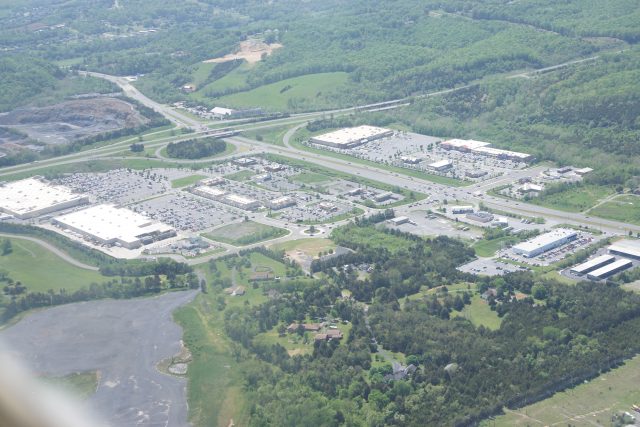
An aerial view of Crooked Run 1’s Target-based commercial center – Crooked Run 2’s now planned residentially-based development lies to the west, at upper right of photo. Royal Examiner File Photo Courtesy CassAviation
“I do think your point is well taken but we do have to be very conscientious about that, very thoughtful about the rezoning that would allow – I am concerned that we have over a thousand residential households zoned in the Town of Front Royal proper that have been that way for a very, very long time, decades, and we haven’t seen the development of any of those houses.
“And I would like to see some development around the Town of Front Royal. It would be wonderful if it was within the town limits and wasn’t out at Crooked Run but that’s not happening. And I would like to see that done sooner rather than later, so that we do have some different, alternate housing options,” Meza concluded.
The FRLP variable
The unrealized development within town limits Meza was referring to is the Front Royal Limited Partnership (FRLP) land on two parcels: the 604 acres zoned to accommodate 818 homes north of Happy Creek Road and a nearby 150 acres zoned for either 150 or 300 homes dependent upon the type of residential units placed there.
The FRLP saga dates back well over a decade, perhaps as far back as 2004. It includes a two-year process that brought the 604 acres into the town limits on November 1, 2014, in a “friendly annexation” between the Town and County that would facilitate in-town utility rates as opposed to the double rate supposed to be charged for out of town utility service extension. And that saga appears to include years of a seemingly unresolved hashing out of variables including economic development loans, per-unit and transportation infrastructure proffers between the three involved parties, the Town, County and FRLP. Coverage at the time of the annexation indicated proffers on the table totaling nearly $30 million from the developer.
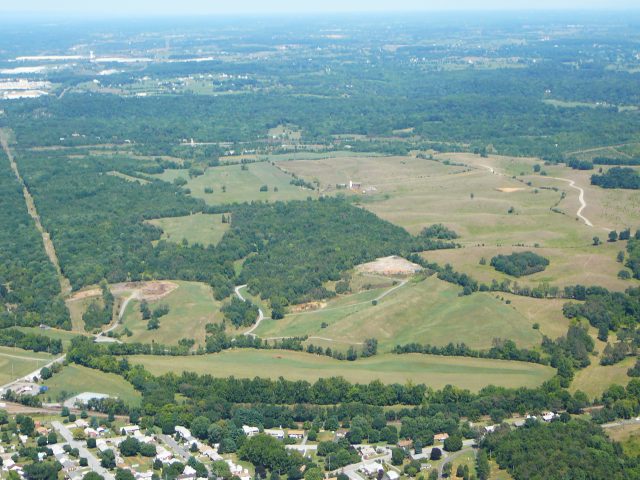
The annexed FRLP 604 acres earmarked for development of over 818 residential units lies on the cleared pasture land in upper right portion of photo off Mary’s Shady Lane, the winding dirt road to far, upper right. Perhaps ironically, the FRLP parcel is adjacent to Truc ‘Curt’ Tran’s acquired Millennium Lotus/‘FR Farms’ property in the partially-cleared, partially-wooded area at center and lower-center of photo.
Long-time FRLP real estate consultant Bill Barnett was an interested observer at the unscheduled July 8 council meeting discussion of Meza’s perception of why the Town should facilitate residential development on county land, while planned in-town development flounders at an apparent economic impasse.
An attempt to reach FRLP principal David Vazzana regarding the status of his projects and causes of the referenced decade-plus of delays was unsuccessful prior to publication.

Front Royal, Virginia. Vacation Destination?

Virginia State Police Report Major Drug Seizures in Weekly Crime Suppression Effort

Virginia Secures Birth Control Access as Other Southern States Eye Abortion Pill Manufacturers

SCC Approves Loudoun Transmission Line, Nixes Undergrounding; Final Route to be Determined

Slate of New Virginia Laws Address Health Care and Housing Affordability

James J. Coverston Sr. (1942 – 2026)

Business Growth Series: Your Biggest Problem Isn’t Competition — It’s Being Overlooked

Why Many Experts Say a Concussion Should Be Called a Brain Injury

Missouri Man Arrested in Undercover Operation Targeting Online Crimes Against Children

Trump Tax Plan Credited With Higher Refunds, Lower Taxes

Spanberger Vetoes Fairfax Casino Bill, Citing Local Opposition

Blue Ridge Point-to-Point Races Return Saturday at Woodley Farm

Legislative Effort to Buy Monroe’s Loudoun Estate on Pause, Budget Effort Underway

US House Democrats Call for Congress to Come Back Into Session for Iran War Debate

Virginia to Raise Minimum Wage to $15 by 2028 Under New Law

Spanberger Signs Bills to Aid Low-Income Utility Customers, Manage Power Demand

FTC Wants to Hear from Renters About ‘Unfair and Deceptive Housing Fees’

As Redistricting Referendum Nears, Spanberger Balances Governing and Campaigning

Drive for More Housing Sparks Rare Bipartisanship in Statehouses, Including in Virginia

Community Breakfast at Riverton Church Serves More Than Just Pancakes

Proposed Electric Substation Declared Compliant with Comprehensive Plan at County Planning Commission Meeting

Christopher Todd Thomas (1975 – 2026)

Constitution 101: The Commerce Clause

What Factors Are Most Likely to Affect the Cost of a Funeral?
