
Community Events
Neurofeedback Specialist to Offer Free Community Program at Samuels Public Library
Front Royal residents curious about neurofeedback and how it may work alongside traditional counseling can learn more at a free program at Samuels Public Library on Wednesday, Sept. 23.
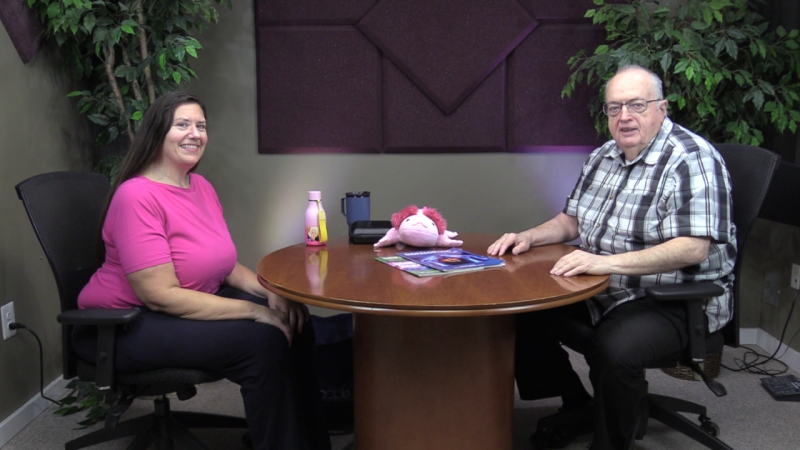
Carmen Kimball, a licensed professional counselor specializing in neurofeedback, joins Royal Examiner publisher Mike McCool in the studio to discuss neurofeedback and her upcoming free community presentation at Samuels Public Library.
Carmen Kimball, a licensed professional counselor who specializes in neurofeedback, will present an information session beginning at 5:45 p.m. Doors will open at 5:30 p.m., and the program is open to adults 18 and older at no charge.
“My mission is to help individuals gain greater control over their own thoughts, feelings, and behaviors,” Kimball said.

That work can involve counseling, psychotherapy — commonly called talk therapy — neurofeedback, or a combination of approaches.
Kimball described neurofeedback as a form of biofeedback. Biofeedback generally involves detecting signals from the body and providing that information to a person so they can become more aware of those signals. Neurofeedback focuses on the brain’s electrical activity.
Her Sept. 23 presentation will focus on three basic questions.
“The goal is to talk about what neurofeedback is, what it is not, and can it help you?” Kimball said. “Can it help someone you love? Can it help your current patients? Can it help your clients?”

Measuring Brain Activity
During her Royal Examiner interview, Kimball displayed some of the equipment she uses, including a 19-channel electroencephalography, or EEG, cap.
The cap contains sensors positioned around the head to measure electrical activity from different areas of the brain.
Kimball said an initial assessment includes a standard biopsychosocial evaluation, followed by a quantitative EEG. During that process, brain activity is recorded for about 10 minutes with the person’s eyes open and another 10 minutes with their eyes closed.

She said she combines those measurements with information from the client and, when appropriate, observations from parents or others to determine areas she considers most relevant to treatment.
Kimball said she works with clients experiencing trauma and post-traumatic stress disorder, generalized anxiety and executive-functioning conditions. She also works with people with ADHD, obsessive-compulsive disorder and autism.
She emphasized during the interview that ordinary worry or nervousness should not automatically be viewed as a mental health disorder.
Kimball used her own nervousness about appearing for her first Royal Examiner interview as an example. She said feeling some anxiety in an unfamiliar situation can be a natural response. A more serious concern can arise when symptoms begin interfering with eating, sleeping, working or other parts of everyday life.

“When it ruins or bothers, affects your daily life in a negative way, that’s the difference,” she said.
As a counselor, Kimball said she views her role as helping clients better understand themselves rather than simply telling them what to do.
“I help people help themselves,” she said. “It’s my job to see things from the client’s worldview. You have to get to know who you’re working with because it’s their life.”
Medical Equipment and Consumer Devices

One subject Kimball plans to address at the library is the difference between professional neurofeedback equipment and consumer products marketed for relaxation or meditation.
Kimball said the medical-grade equipment she uses is regulated by the U.S. Food and Drug Administration. She contrasted that equipment with consumer “wearables,” which she said may be marketed for uses such as meditation and relaxation.
Her presentation will give attendees an opportunity to see equipment and demonstrations while learning more about how she practices neurofeedback.
Kimball also demonstrated an electromagnetic field meter during the interview. She explained that she uses it to check the environment around her neurofeedback equipment for electrical interference that could affect EEG readings.
The goal, she said, is to ensure the equipment measures the client’s brain activity rather than picking up signals from electrical outlets or other sources.
From Research to Counseling
Kimball earned a bachelor’s degree in biology and a master’s degree in counseling from George Mason University.
She said she previously worked as a research assistant in a physiological and behavioral neuroscience laboratory at George Mason’s Krasnow Institute, where her work included research involving spatial navigation, learning, and memory.
After learning about neurofeedback, Kimball said she decided to leave the laboratory and pursue board certification in the field.
Her practice has been located on Chester Street in Front Royal for nearly two years.
Kimball said she enjoys working with clients of different ages, including children, although the Sept. 23 library presentation itself will be limited to adults.
She also plans to discuss uses of neurofeedback beyond mental health treatment, including performance training.
Questions Encouraged
The main presentation is expected to last about an hour to an hour and 15 minutes. Kimball plans to reserve about 30 minutes afterward for audience questions.
She encouraged people to come prepared with questions, whether they are interested for themselves, a family member, or because of their work with patients or clients.
Medical professionals and others who work with people experiencing mental health concerns are also welcome.
The free program will be held Wednesday, Sept. 23, at Samuels Public Library in Front Royal. Doors open at 5:30 p.m., with Kimball beginning promptly at 5:45 p.m.
“Anybody, everybody, come on down,” Kimball said, “because I want to tell everybody about this wonderful therapeutic modality.”
Town Talk, sponsored by National Media Services, Inc., is a Royal Examiner series that introduces you to local entrepreneurs, business owners, nonprofit leaders, and public officials who help shape Warren County. Conversations cover a wide range of topics about our community and the people making a difference.




Front Royal Outdoors Founder Don Roberts Named 2026 Protector of the Shenandoah

Front Royal Man Held Without Bond Following Child Sexual Abuse Material Investigation

Performing Arts Center Pointing to 2027 Opening as Local Entertainment, Business, and Educational Partner

Town Planning Commission Continues to Prepare for the Arrival of Cannabis on the Local Market

Warren County Schools Improve, But Federal Rules Lower Seven Ratings

Spanberger Announces $1.3 Million in Scholarships and Incentives for Nursing Students

The First Long-Distance Phone Call Came With Receipts

Middletown Man Killed In I-81 Crash In Frederick County

Cline Backs Veteran Cancer Screening Effort, Highlights Sixth District Programs

Sheriff Cline Details Flock Safeguards, Uses and Limits at Warren County Work Session

Flock Safety: A Tool for the Common Good

Melissa Ichiuji Studio Gallery Reopens With Two Fall Exhibitions

Just Hours Away: Festival Of Leaves Returns To Downtown Front Royal Saturday

Sheriff’s Office Addresses Use of ‘ALPR’ Cameras – Health Insurance, 4-H Week, and Parks & Rec Events Also Presented

Before Relying on a Model, Look at the Assumptions

The Question Is Not Which Apple Tastes Best

Brian Anthony Lamb (1980 – 2026)

Mary Brinham Walton (nee Arnold) (1947 – 2026)

Sandra Jo Alger (1941 – 2026)

All Warren County Schools Fully Accredited as State Releases New Performance Results

This Week’s Showtimes at Royal Cinemas as of October 9th

Samuels Public Library to Expand ‘Library of Things’ With $2,000 Grant

Ask Stewart: Why Do Leaves Turn Different Colors in the Fall?

After Statewide Tour, Virginia Lt. Gov. Hashmi Officially Opposes Dominion-NextEra Merger
