
National News
New Smithsonian Exhibit Features Rare and Unusual Orchids
WASHINGTON – Nothing like a stroll through wild orchids to chase the February blues away.
Smithsonian Gardens and the United States Botanic Garden have opened their annual orchid exhibit. This year’s theme is “The Future of Orchids: Conservation and Collaboration.”
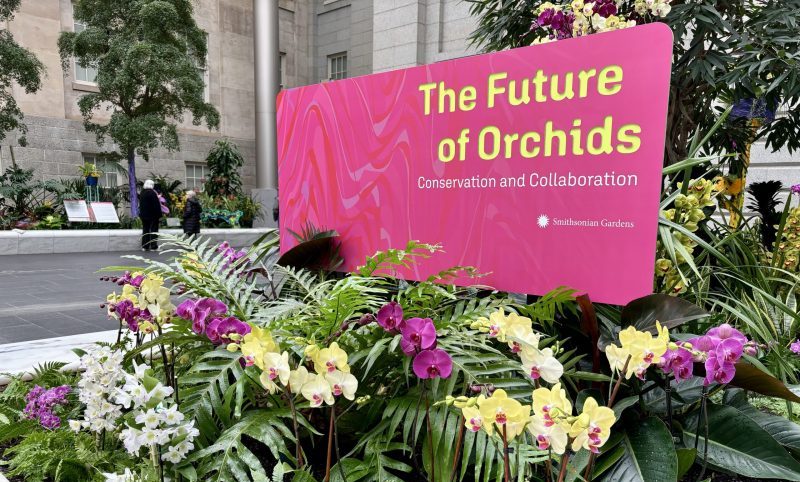
The collaborative orchid exhibit from Smithsonian Gardens and the U.S. Botanic Garden in the Kogod Courtyard focuses on environmental factors and conservation. (Yesenia Montenegro/Capital News Service)
The exhibit, which opened on Jan. 27 and is displayed in the Kogod Courtyard at the Smithsonian National Portrait Gallery, includes around 350 live orchids and original artwork by Baltimore-based artist Phaan Howng.

The installation addresses the importance of plant conservation and the issues affecting orchids around the world. Each flower bed is categorized by a collaboration with a specific group working toward the conservation of orchids, such as researchers, schools, public gardens, and others.
“Everybody has an idea of what an orchid looks like and it’s from a corsage probably, or from the plants you can get at the grocery store,” said Sarah Christianson, a Smithsonian Gardens volunteer interpreter for the exhibit. “But those are just the hybrids that are easy to grow. Whereas here, we have species of orchids that are wild, not hybridized. And some of them are just incredibly different from what your image is.”
“The diversity is mind-boggling. The colors are fantastic. The difference is amazing,” said Deborah Zavos, a museum visitor from DC.
Howng’s art is in the form of tree wraps, brightly colored planters, model mountains, and other objects distributed throughout the exhibit.

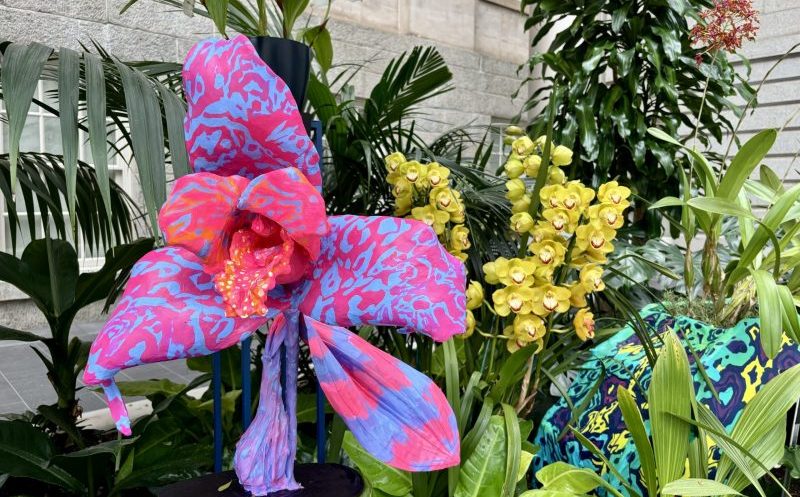
Artist Phaan Howng used scans of live orchids to create her own 3D-printed models. (Yesenia Montenegro/Capital News Service)
Highlights of the exhibit are Howng’s 3D-printed orchids, which allow viewers to see intricate details of the flowers that otherwise might not be as clear. Howng worked with 3D printing for the first time for this exhibit.
Howng said she drew inspiration from Robert Brendel’s botanical models from the late 1800s while creating her 3D prints. Brendel’s models could be taken apart, similar to Howng’s work, and were designed to aid in the study of botany.
“I based them off the Brendel models because I liked the idea that we’re teaching everyone about orchids, and the Brendel models are a nod to that old-school type of teaching,” Howng said.

Howng received 3D scans of various orchid species from the Smithsonian, which inspired the designs of her printed flowers. She spent around three months working on pieces for the exhibit.
Compared to her other projects, which also often focus on nature, this exhibit is geared toward a much broader audience, Howng said. She wanted her work to have educational concepts and wanted people to learn from it.
“I love how they’re naturally so inventive to serve their purpose,” Howng said. “Different orchids have different engineering to them in order to be pollinated… They develop certain patterns as a way to attract specific pollinators. The mechanics of each orchid is so particular and specific that it’s just so wild.”
Smithsonian Gardens has a greenhouse facility in Suitland, Maryland, where the orchid collection, made up of almost 5000 plants, is stored. A portion of the plants in the exhibit also comes from the United States Botanic Garden’s collection. The plants will be refreshed and swapped out as needed, ensuring that the exhibit always presents blooming flowers.

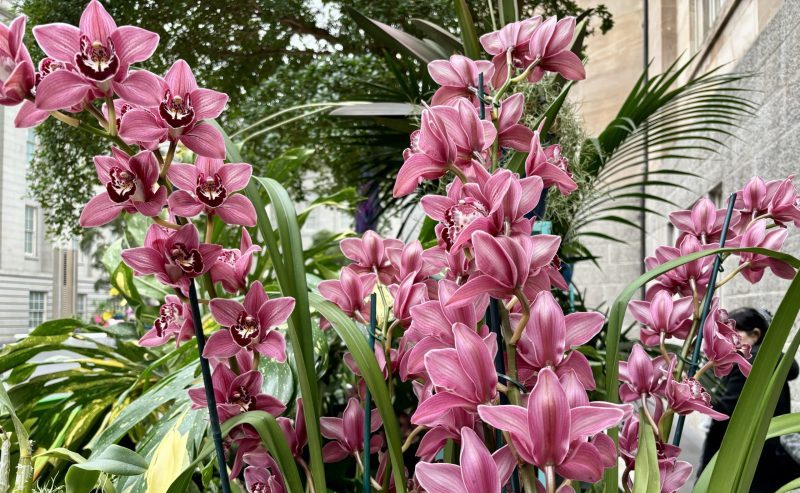
The Smithsonian exhibit includes 350 live orchids, such as this species, the Cymbidium Clarisse Austin. (Yesenia Montenegro/Capital News Service)
The Smithsonian Gardens collection started in the 1970s and has grown immensely over the years. It consists mainly of orchids from Central America, the Caribbean, and South America, according to Justin Kondrat, the lead horticulturist within the Smithsonian Gardens orchid collection.
The collection is managed with a focus on conservation, outreach, display, innovation, and education. The facility ensures that the plants are safeguarded and that they can be propagated and shared with other institutions that can protect them.
“As a living collection, nothing is stagnant. It’s constantly changing and evolving with the times,” Kondrat said.

According to Kondrat, orchids are an indicator species, meaning they can show the health of an environment. Most orchids have coevolved with their pollinators over millions of years, so the two parts are interconnected and rely on each other.
“When it comes to orchids, climate change will definitely impact when it comes to those plants because they are so sensitive in certain areas,” Kondrat said. “Some orchids are resilient, but when your whole environment or ecosystem is destroyed… that really impacts… the willingness for them to survive.”
Kondrat hopes that the exhibit showcases the importance of collaboration and coming together to preserve something. The orchids shouldn’t just be safeguarded, but they should thrive, he said.
“My favorite part is the way that the signage is really crediting collaboration with the whole trying to maintain a future for orchids,” said Chuck Dulaney, a museum visitor and member of Master Gardener, a nationwide program that trains volunteers in sustainable urban gardening. “They’re such delicate things, and when the environment gets messed up… one of the first things that’s going to suffer are the orchids.”
The 28th annual exhibit runs until April 28.
By YESENIA MONTENEGRO
Capital News Service




Mayor Lori Athey Cockrell Looks to Water, Economic Development and Rail Trail in Another Term

WCHS vs. Brentsville HS – Girls Volleyball – October 6, 2026

BMI Is Only One Piece of the Health Picture

The Eye Surgery Factory That Could Not Expand

Ancient Ownership of Israel

VDOT: Warren County Traffic Alert for October 5 – 9, 2026

Reaching Out Now Expands Programs and Opportunities for Warren County Youth

Dance and Arts VA Finds New Home, New Opportunities on Water Street

Ann L. Shuman (1933 – 2026)

Wendy Lee Whitacre-Stout (1966 – 2026)

Spanberger’s Energy Plan Keys in on Clean Energy to Meet Growing Demand and VCEA Goals

Jean Elizabeth Grubbs Fogle (1939 – 2026)

Feds Provide Guidance on New Federal K-12 Scholarship Tax Credit Program

Why Wait Till November? Mid-Term Election Early Voting Processes in Place Now

US Senate Leaves Nation’s Capital in Advance of Midterms With Much Still Undone

Business Growth Series: If You Don’t Control Your Day, It Controls Your Business

The End of a 20-Year Monopoly on the Credit Score
Voltron and Immigration

States OK Solar Panels for Balconies. Safety Guidelines Haven’t Caught Up

Trump TV Ads Paid for with $20M in Homeland Security Funds, Dems Find

Blue Ridge Wildlife Center Patient of the Week: Gray Treefrog

Birthday Twins: See Which Famous Face Shares Your Big Day

Meet-and-Greet Set Sunday for Republican-Endorsed Front Royal Candidates

Barbara Ann Mathews Smelser (1943 – 2026)
