
Local News
School masks opt-outs change; Board briefed on counseling programs
Students attending Warren County Public Schools (WCPS) now may be opted out of the division’s face mask mandate without citing a reason, in line with a new order issued by Virginia Gov. Glenn Youngkin.
The governor’s January 15 Executive Order Number Two, which takes effect on Monday, January 24, permits parents to opt-out their children from the mask requirement without stating a reason, replacing the current state policy issued by Gov. Ralph Northam allowing parents to opt-out students from any mask requirement with a religious or medical exemption.
Additionally, in lieu of Youngkin’s new order, WCPS Director of Special Services Michael Hirsch and WCPS Superintendent Christopher Ballenger provided members of the Warren County School Board, during its Wednesday, January 19 work session with the division’s updated 2021-2022 mitigation plan.
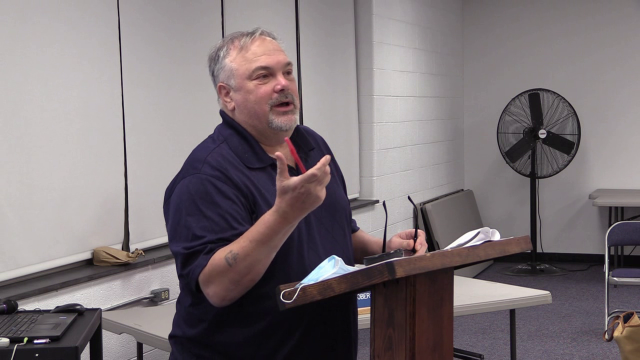
WCPS Director of Special Services Michael Hirsch provided members of the Warren County School Board, during its Wednesday, January 19 work session with the division’s updated 2021-2022 mitigation plan. Photos and video by Mike McCool, Ro
The plan remains in Phase II due to the County’s high coronavirus transmission rate and requires students, staff, and visitors to wear face coverings while inside school buildings, among other steps that may be taken to prevent the spread of COVID-19, such as social distancing.
Specifically, Ballenger discussed with board members his concerns related to staff and teacher shortages due to the ongoing pandemic. Attending Wednesday’s work session were School Board Chairwoman Kristen Pence, Vice Chairman Ralph Rinaldi, and School Board members Antoinette Funk, Andrea Lo, and Melanie Salins.
On Thursday, Ballenger issued a Parent Communication posted online — that will also be sent home to parents and guardians — stating that to adhere to Virginia law, WCPS must ensure that staff is available to provide daily in-person instruction.
“In order to meet the needs of our students, WCPS recognizes that current infection rates in Warren County could limit our ability to provide in-person instruction,” according to Ballenger’s communication. “Therefore, WCPS will remain in Phase II (masks are required for students unless they have an exemption form on file) of our mitigation plan for the next two weeks and will reevaluate phased status at the February 2, 2022, board meeting.”
Due to federal requirements, students and staff still must wear masks on school buses, Ballenger told board members. He added that WCPS will continue to check data on transmission rates to ensure the division is in the appropriate phase and plans to survey teachers and staff on whether masks should be required or encouraged for staff.
School counseling presentation
The School Board at its January 5 regular meeting voted to put on hold the Second Step Social-Emotional Learning (SEL) program curriculum in WCPS pending review after two members said parents should be made more aware of the program’s content. The vote was to temporarily suspend Second Step until parents, school administrators, teachers, the School Board, and community leaders have time to review the program’s content.
Following a review, board action can then be introduced to either continue the program, modify it, or cancel it.
During the board’s Wednesday work session, WCPS Curriculum Supervisor Heather Bragg and other WCPS staff provided such a review that included information on Second Step, which is a registered trademark of the nonprofit Committee for Children. WCPS purchased Second Step from the Committee for Children, which says on its website that the Second Step programs are research-based, teacher-informed, and classroom-tested to promote the social-emotional development, safety, and well-being of children from early learning through Grade 8.
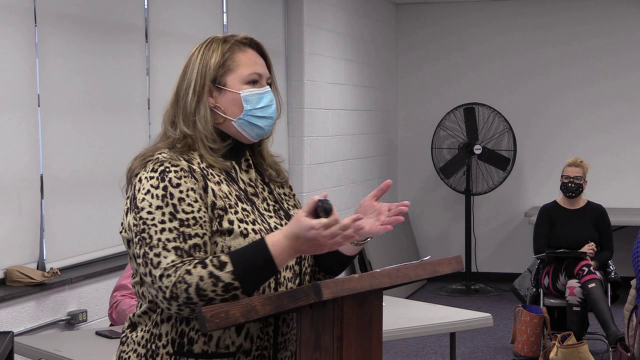
WCPS Curriculum Supervisor Heather Bragg and other WCPS staff provided the School Board with a review the Second Step Social-Emotional Learning (SEL) program curriculum in WCPS.
Specifically, Bragg and other WCPS staff reviewed the Elementary and Middle School Standards for School Counseling Programs that included primary lessons and supplementary materials, including Second Step.
Overall, the K-12 programs, Bragg said, are designed to support the development of students’ academic, career, and personal/social development. Specifically, the academic component is designed to meet local, state, and national standards. The career development component addresses successful transitions for students from elementary to middle to high school and on to post-secondary education or the workforce, while the personal/social development component is designed to foster responsible citizens, said Bragg.
“To address the needs of all of our students, we offer teachers and staff the flexibility to choose the materials that best meet their needs,” she said, adding that each school has its own set of needs-based upon the students served by each school. Therefore, instruction is “unique and tailored” and uses a variety of materials implemented by counselors and classroom teachers, said Bragg.
Lisa Rudacille, principal at E. Wilson Morrison Elementary School, reviewed the counseling lessons provided to WCPS students, which cover topics such as working hard for success, teamwork, and building positive relationships with peers, among others. She said the school counselors’ lessons are reinforced daily by teachers since counselors provide just five counseling sessions in the elementary schools for an entire year.
Kristin Frankel, a school counselor at Ressie Jeffries Elementary School, provided information on the Second Step program, which has been available to WCPS elementary students since 2015 and is only used as a supplemental resource in the guidance classes. “So, it’s not fully implemented,” Frankel explained.
With the Second Step program comes some training videos that are provided for anyone who is going to use the curriculum, said Frankel. The program does not address all the standards needed to be covered in WCPS so counselors have to create additional lessons in order to meet those standards. Second Step is also not taught by the teachers at the elementary school level, she said.
Frankel explained that each kit for elementary students includes 20-25 lessons on grade levels K-5. The kits start on the skills for learning — for example, being respectful, focusing attention, listening, being assertive whenever asking for help — and then they move on to empathy to help students learn how to identify other people’s feelings, understand the perspectives of others, and show compassion.
Emotion management is another unit covered that includes work on calming anger, for instance. The final unit is problem-solving, Frankel said, and lessons vary depending on the grade level, such as dealing with problems on the playground or handling peer pressure.
“Since 2015, there have been no additional costs to use this program because it was a one-time cost to use this curriculum,” said Frankel.
Salins said there’s confusion about which version of Second Step is being used. She said the “most controversial” version is copyrighted 2020-2021. “Do our ES students not have access to this new material that parents are not allowed to view” because it is copyrighted material, asked Salins.
“That is correct,” answered Frankel, who said that WCPS students receive the 2015 Second Step Elementary Classroom Kits, “which are not the new digital program,” she said.
All counseling-related instruction information and materials are available online for the public and parents and guardians may schedule to meet with school counselors and principals to view any of the unit materials and lessons and have questions answered, Frankel added, and opt-out forms are also available.
Ballenger reiterated to School Board members that not every school in the division uses Second Step. For instance, Leslie Fox Keyser Elementary School doesn’t use it so parents would not receive information on accessing it, he said.
Maria Kisner, a counselor at Hilda J. Barbour Elementary School, and Raychel DeArmitt, a counselor at E. Wilson Morrison, also presented information on the other supplemental materials they use in their lessons, as did counselors from WCPS middle schools.
Parents may at any time contact their child’s school principal or classroom teacher to discuss any concerns, questions, and thoughts, or to schedule a meeting they might have regarding a lesson, standard, practice, or any other school-related topic, said Ballenger.
Click here to watch the first part of the School Board’s January 19 work session.

School Board Seeks to Restore Meals Tax Funding for School Facilities

Wasting Drinking Water: 3 Habits to Eliminate From Your Daily Routine

Medicare Launches TEAM Program to Improve Recovery After Surgery

Izaak Walton League Promotes Conservation and Outdoor Programs at Community Forum

POLICE: 7 Day FRPD Arrest Report 3/16/2026

Blue Ridge Wildlife Center Patient of the Week: Great Horned Owl

Airline CEOs Warn of Travel Strain Amid DHS Funding Uncertainty

Robert B. Walters (1931 – 2026)

Lemmon & Hale Highlight Importance of Estate Planning for Families and Businesses

Hike Kidz Foundation Highlights Programs for Families in Need

Phoenix Project Offers Support and Resources for Victims of Abuse

Virginia Moves to Launch Legal Cannabis Marketplace After Years of Delay

As Spanberger Reviews State-Level ‘Momnibus’ Bills, Kaine and Booker Try Again on a Federal Package

Detox Diets: Don’t Overlook the Risks

How to Answer the Interview Question: “Where Do You See Yourself in Five Years?”

HARTS, DSS & House of Hope Highlight Services at Community Forum

Joyce Henry Sutherland (1942 – 2026)

Commentary: Building on What We Have – A Proposed Economic Development Agenda for Warren County

Jamie Christopher Tewalt (1971 – 2026)

George Jules Pouzenc III (1958 – 2026)

Samuels Public Library Prepares for Annual “Taste for Books” Fundraiser

Assistant Chief and Fire Marshal Gerry Maiatico Highlights Staffing Needs and Volunteer Opportunities

Data Center Bills Dominated This Year’s General Assembly. Here’s What Passed.

Housing Bills to Boost Supply, Protect Tenants On The Way to Spanberger’s Desk
