
Local News
Is the Shenandoah River safe for recreational use?
At a Wednesday (April 26) telephone press conference, officials of a Shenandoah River watchdog group released a scathing appraisal of the condition of the river and consequent dangers to the public from its continued recreational use. The news is a huge blow, not only to outdoor-loving Shenandoah Valley residents, but to their communities, many of which rely on the river as a primary tourist attraction.
However, according to at least one Valley businessman whose livelihood revolves around the Shenandoah River, the information released by the Environmental Integrity Project on Wednesday does not come as a surprise.
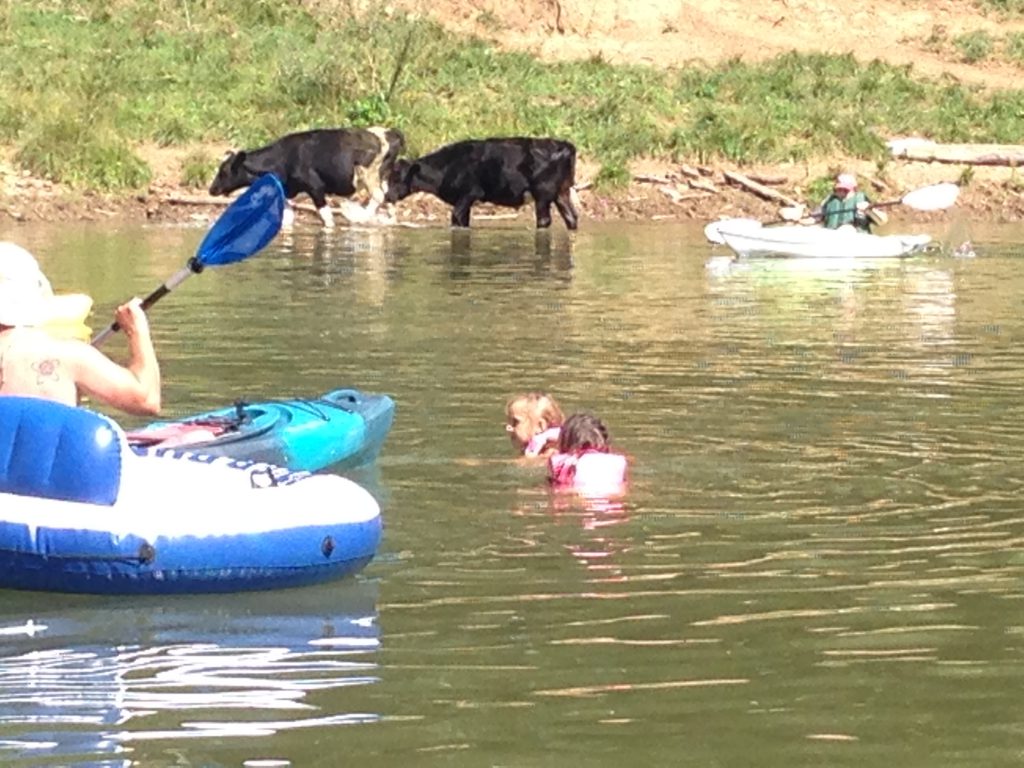
‘Hi, Mr. Cow’ – Mommy, where do they poo?’ Photos/Environmental Integrity Project
Colby Trow is a professional fishing guide and tackle store owner whose business, Mossy Creek Fly Fishing, is based in Harrisonburg. In the press release accompanying the EIP teleconference, he is quoted stating, “Unfortunately claiming the Shenandoah our home water is becoming more and more embarrassing each year as we see constant algae blooms, fish kills, disease, foul smelling water, experience waterborne infections, and more. Some of our guests will not return to fish the Shenandoah or our area again as a result of what they see on the water.”

A Shenandoah algae bloom
The report “Water Pollution from Livestock in the Shenandoah Valley” utilizes the State’s own records to document that “more than 90 percent of the water quality monitoring stations in the Shenandoah River and its tributaries in 2014 to 2016 detected fecal bacteria (E. coli) at levels unsafe for human contact.”
Despite the finding of widespread bacterial contamination, the report notes that unlike state alerts about ocean water conditions failing to meet required standards, “Virginia officials fail to warn the swimmers, tubers and kayakers who flock to the Shenandoah about the health risks, even when bacteria levels are more than 100 times the limit for water recreation.”
A map of the Shenandoah River and referenced monitoring points through the valley shows Front Royal surrounded by locations indicating fecal pollution 10% to 50% above human safety levels. The worst monitoring reports occur further south, in the Waynesboro and Harrisonburg to Long Meadow areas to our south. Stations there showed fecal pollution levels ranging from 50% to 75%, with one station just north of Harrisonburg showing a 75% to 100% contaminant level. One station to our south at Flint Run, and two to our north at Page Brook and Wheat Spring Branch had 50% to 75% fecal pollution levels.

On this map, Front Royal near top, is surrounded by yellow dots indicating fecal pollution 10% to 50% above human safety levels.
The Environmental Integrity Project is a 15-year-old nonprofit, nonpartisan organization, based in Washington D.C. that is dedicated to “enforcing environmental laws and holding polluters and governments accountable to protect public health.” Shenandoah Riverkeeper Mark Frondorf also contributed to the release.
The source of the problem lies with the Valley’s livestock industries and an enforcement failure of environmental guidelines on that industry.
“Virginia currently requires pollution control plans for only 12.5 percent of the farmland in the valley. These documents, called ‘nutrient management plans,’ have limited impact because they allow farmers to keep piling on more manure even to fields that are already have more than enough phosphorus for crop growth.
“Under the state’s current system to reduce runoff from fields that are already overloaded with manure, 86 percent of the poultry manure in the valley is “exported” to other farms. But waste transfer records for 2013, 2014, and 2015 show that the “exported” manure rarely leaves the Shenandoah Valley watershed. For example, an estimated 92 percent of the poultry waste shipped offsite is simply spread on nearby farms. This allows phosphorus and bacteria in the manure to run off and pollute the same local waterways.”
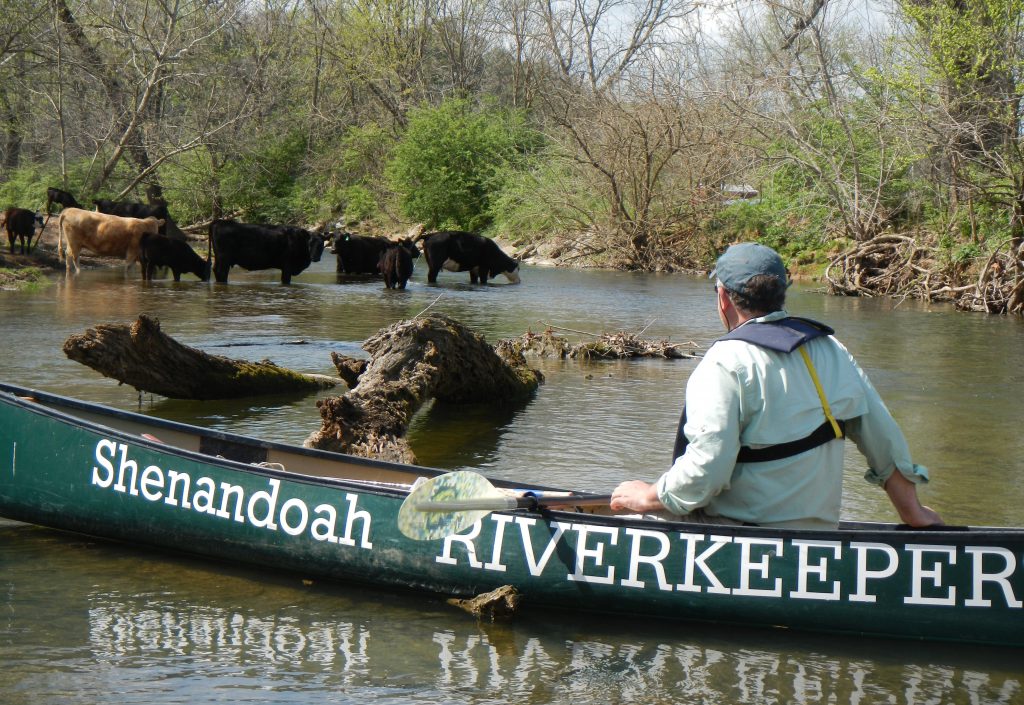
Shenandoah Riverkeeper Mark Frondorf monitors the situation – bet he’s NOT getting in!
“Virginia needs to start notifying the public that the Shenandoah Valley’s waterways are unsafe for swimming and tubing – or, better yet, the state should solve this manure overload problem,” said Eric Schaeffer, Executive Director of the Environmental Integrity Project and former Director of Civil Enforcement at EPA. “The state should either require the livestock industry –or use public funds — to collect the excess manure that crops can’t use and ship it out of the valley, to a region that needs it.”
Shenandoah Riverkeeper Frondorf adds, “Virginia’s failed pollution control system damages our waterways. Excessive algal blooms drive down oxygen levels, suffocating fish and creating dead zones. The environment suffers, but so does our economy. Industries that rely on clean water depend on state regulators to do their jobs.”
The report concludes that the state’s system for controlling manure runoff from the livestock and poultry industries needs major improvements to protect the health of local waterways and the Chesapeake Bay.
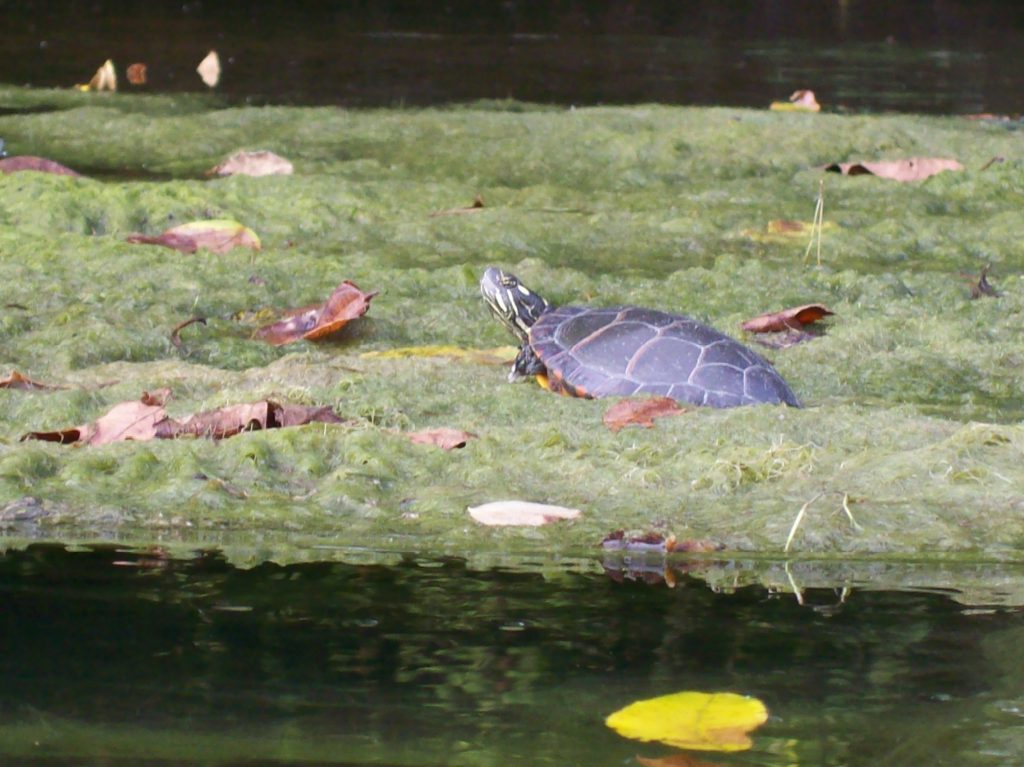
A turtle rides an algae bloom oblivious to the source of its ride. – Do we have to be as clueless?
“Almost half (7 of 16) of the long-term state monitoring stations on the Shenandoah and its tributaries detected high phosphorus pollution levels in 2014 through 2016, based on averages from those years, according to state records. This glut of phosphorus, a plant food, fuels the growth of blankets of algae that are increasingly hurting the fishing and paddling industries in the valley.
“Because of the increasingly frequent algal blooms, the Shenandoah Riverkeeper and parent organization, Potomac Riverkeeper Network, petitioned the Virginia Department of Environmental Quality in 2015 to identify the Shenandoah’s waters as officially “impaired” by algae under the federal Clean Water Act – a designation that would require stronger efforts to control pollution. The state and EPA, which approves the state’s impairment decisions, have failed to take this action to protect the river.”
As a Valley resident and local recreational user of the Shenandoah, or potential tourist to the area, the report is a major blow. The remaining question is what state and local officials will do, if anything, in response to the documented threat to one of the Valley’s major tourist attractions.
Click here to read the following story:
Analysis, recommendations to fix the Shenandoah River

James Christopher “Chris” Sain (1948 – 2026)
Alice “Maybelle” Henson (1938 – 2026)

How Sleep and Stress Affect Cancer Risk

Spanberger Signs Sweeping Public Safety and Gun Violence Bills

Horses, Fans Return as Shenandoah Downs Season Begins

Skill Games Halted Again as Spanberger Issues Veto

VDOT: Warren County Traffic Alert for April 13 – 17, 2026

The Cat Who Outlasted Six Prime Ministers

Front Royal, Virginia. Vacation Destination?

Virginia State Police Report Major Drug Seizures in Weekly Crime Suppression Effort

Virginia Secures Birth Control Access as Other Southern States Eye Abortion Pill Manufacturers

SCC Approves Loudoun Transmission Line, Nixes Undergrounding; Final Route to be Determined

Slate of New Virginia Laws Address Health Care and Housing Affordability
James J. Coverston Sr. (1942 – 2026)

Business Growth Series: Your Biggest Problem Isn’t Competition — It’s Being Overlooked

Why Many Experts Say a Concussion Should Be Called a Brain Injury

Missouri Man Arrested in Undercover Operation Targeting Online Crimes Against Children

Trump Tax Plan Credited With Higher Refunds, Lower Taxes

Spanberger Vetoes Fairfax Casino Bill, Citing Local Opposition

Blue Ridge Point-to-Point Races Return Saturday at Woodley Farm

Legislative Effort to Buy Monroe’s Loudoun Estate on Pause, Budget Effort Underway

US House Democrats Call for Congress to Come Back Into Session for Iran War Debate

Virginia to Raise Minimum Wage to $15 by 2028 Under New Law

Spanberger Signs Bills to Aid Low-Income Utility Customers, Manage Power Demand
