
Local Government
Short-Term Rental, Rezoning, Retaining Walls, and Auxiliary Dwelling Units at Town Planning Commission Work Session
The February 4 work session of the Town Planning Commission featured four items, which were executed in approximately an hour.
The first was an application for a special-use permit to operate a short-term rental at 214 Lee Street. Advantageously placed within walking distance of Main Street, this residential structure is nestled in a neighborhood with proximity to a variety of churches, like St. John the Baptist and United Methodist, that stand proudly in that area. Adjacent at one end to the Prospect Hill cemetery, Lee Street forms a triangle with Luray Avenue and converges with the latter within several feet of Luray’s intersection with West Main, where Maddox Funeral Home has served the community for generations.
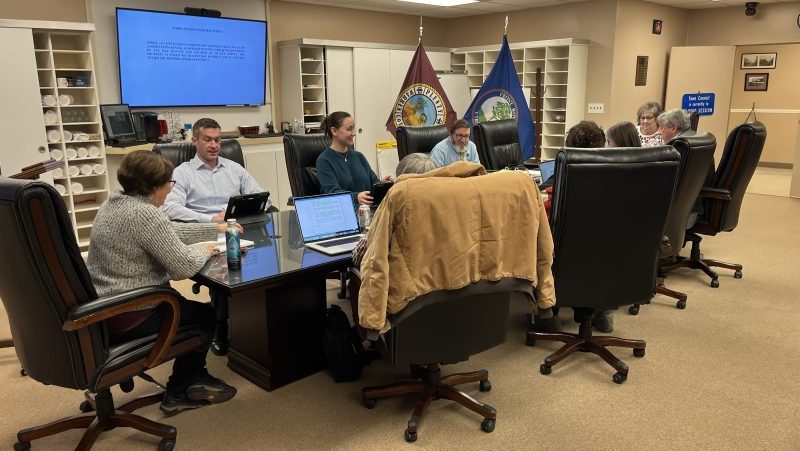
The Town Planning Commission gathers for a work session on February 4. Royal Examiner Photo Credits: Brenden McHugh
Deputy Zoning Administrator John Ware explained to the commissioners the various requirements that the applicant has met, like parking standards, although Planning Director Lauren Kopishke noticed that the occupancy maximum is ten people, and the applicant is fully taking advantage of that maximum, while there is a requirement for no more than two people to a bedroom, and there are only four bedrooms. Thus, for this house, only eight occupants would be feasible. Ware expressed his intention to reach out to the applicant and rectify this issue. Otherwise, no objections to this application were raised by commissioners or staff.
Next, the commissioners took a close look at a proposed rezoning on Grand Avenue from R-1 to R-3, wherein the low-density, single-family nature of that street as it currently stands would accommodate a higher-density insertion adjacent to the intersection of Grand with Cypress. Whether that accommodation would be a service to the neighborhood is a question that many people in that neighborhood would answer in the negative. Included in the evening’s agenda packet were letters from residents expressing their concern, including but not limited to the value of their homes being depreciated by the duplexes the applicant wishes to build.
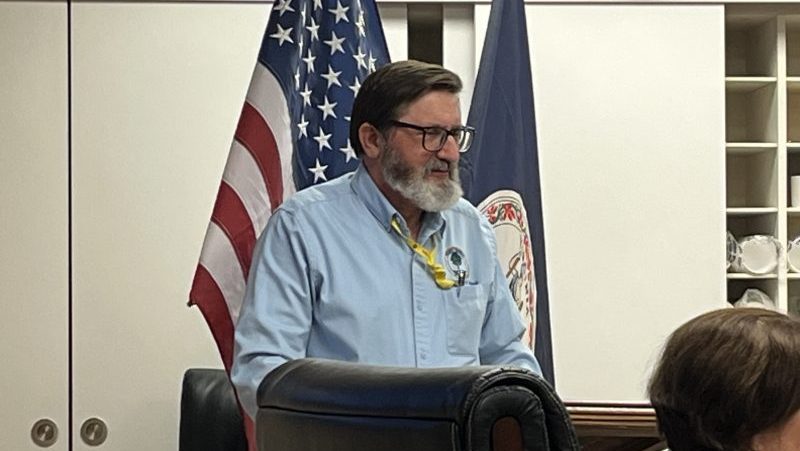
Deputy Zoning Administrator John Ware presents the items on the agenda to the commissioners.
If he were to build those duplexes under an R-3 designation, the applicant would be acting in harmony with the comprehensive plan, which, to use vocabulary from Commissioner Allen Neel, establishes a “macro” vision for that area. But in the micro, things might be different. The vacant lots meet every space requirement for the proposed development, but will it compromise character in that segment of Grand Avenue? The residents who wrote the letters certainly feel that way. Chairman Connie Marshner noted that farther down Grand Avenue, there are townhouses built under a denser zoning designation that look quite nice. To Neel’s point, the microenvironment for that stretch of Grand may not operate under the same necessity as the historic stretch closer to Cherry Street, into which the applicant would be inserting the duplexes.
Granted, the applicant’s property shares a boundary with an R-3 zone. Thus, there is an argument to be made that the change would be continuous with existing conditions and, furthermore, would serve the vision of the comprehensive plan. Also, he says in a letter to the Town that he perceives a need for available housing, and this development would be his contribution to that worthy goal. A few residents in their letters addressed this pro among the cons as fictitious, since in their opinion, there are other zones already designated R-3 that could meet this need, if indeed it is a need, as an Internet search will produce available housing on the market.
“Anomalous” is the big word that Commissioner Megan Marrazzo used for the development under the proposed rezoning. She said she appreciated the feedback from residents. It bears notice that while the Town Council is discussing the merits of reinstating two readings for public hearings to give members the necessary time to process information received from the public, this surge of public input in advance of any public hearing is a testimony to the fact that the community can mobilize effectively to reach their public officials when they simply must. Perhaps the solution lies in not waiting until the public hearing to make contact.
Marrazzo sought clarity from staff about a misunderstanding related to the authorization to advertise. Some Grand Avenue residents expected that signs should have been placed on the applicant’s property in advance of the meeting in which the consent agenda containing that item was passed, the point at which all items on that agenda are authorized for advertisement. It makes no sense that the commission and staff would be required to advertise that they are going to advertise. They are required to advertise at least two weeks in advance of a public hearing. They did so. They are not required to advertise the meeting in which they vote to advertise.
Thirdly, five parcels on Orchard Street, the higher-density area that runs parallel to Grand Avenue, were considered for a proposed exception to the maximum height requirement for retaining walls. The current maximum is six feet, and the applicant would like an exception to raise the limit to ten to allow leeway in the likely scenario that the walls reach eight to eight and a half feet in height. While the height of the walls is something that the commission should address, many engineering concerns make it more appropriately a matter to be addressed by the Warren County building department. The commission did receive a geotechnical report in their packet.
Finally, the commissioners reviewed auxiliary dwelling units for the third time, sent back to them from the council. Internal or detached, this is a use that would facilitate returning college students, ageing relatives, and other demographics, and with the necessary performance standards in place, it is the consensus among the commissioners that this is a process that would ideally be managed administratively by right. A legislative, special-use permitting process would not, in Neel’s presentation of the general opinion, be in keeping with recent state legislation that is making more tasks administrative. What could be seen as routine development is best served, under Neel’s rationale, by a sworn affidavit, executed by staff, with a provision for review as needed.
With no substantive changes made to that item and with the chairman thanking her colleagues for the hours they have spent on it, the meeting adjourned.
Click here to watch the Front Royal Planning Commission Meeting of February 4, 2026.

“Christmas in April” or Overspending? Budget Draws Criticism

Court Ruling Voids Prince William Data Center Rezoning, Raising Stakes for Local Debate

Spanberger Signs First Bills Targeting Healthcare, Housing and Energy Costs

Blue Ridge Singers Spring Concerts to Showcase Powerful Blend of Voices and Brass
What Counts as “Good Policy” Depends on Who’s in Power

Planned Parenthood Presses Virginia to Restore State Funding for Contraception Program

Weapon Offenses Rise on Virginia University Campuses

Trump Steps In to Pay TSA Workers as Congress Remains Stalled

Escaping the ‘Captivity of Activity’ by Making Time to Rest

Why Wearing a Bike Helmet Matters

Wilma J. Martin (1927 – 2026)

Michael Fanning (1957 – 2026)

Spanberger Order, RNC Lawsuit Highlight Divide Over Virginia Voter Roll Maintenance

DNC Kicks Off Voter Registration Blitz, Unveils New Campaign Playbook Ahead of Midterms

Republican State Lawmakers Propose Three-Month Gas Tax Holiday in Virginia

April Star Birthdays: Famous Faces Celebrating This Month

Time to Strengthen Those Hips Again

Supervisors Discuss Evolving FY-26/27 Budget Priorities and Revenue Sources, Including Real Estate Tax Hike & Cigarette Tax

From Students to Leaders: Mountain Vista Governor’s School Hall of Fame Honors Two Graduates

Hundreds Gather in Front Royal for “No Kings Day” Rally

How Public EV Charging Stations Work

A Social Network Just for AI? Bots Chat About Life, Love and More

Out of Closed Session FR-WC EDA Approves Resolutions Regarding Evolving Property Sales and Brokerage Services

Driver Dies After Crash While Fleeing Police on I-81
