
Local News
The solar eclipse – not total in Northern Valley, but impressive anyway
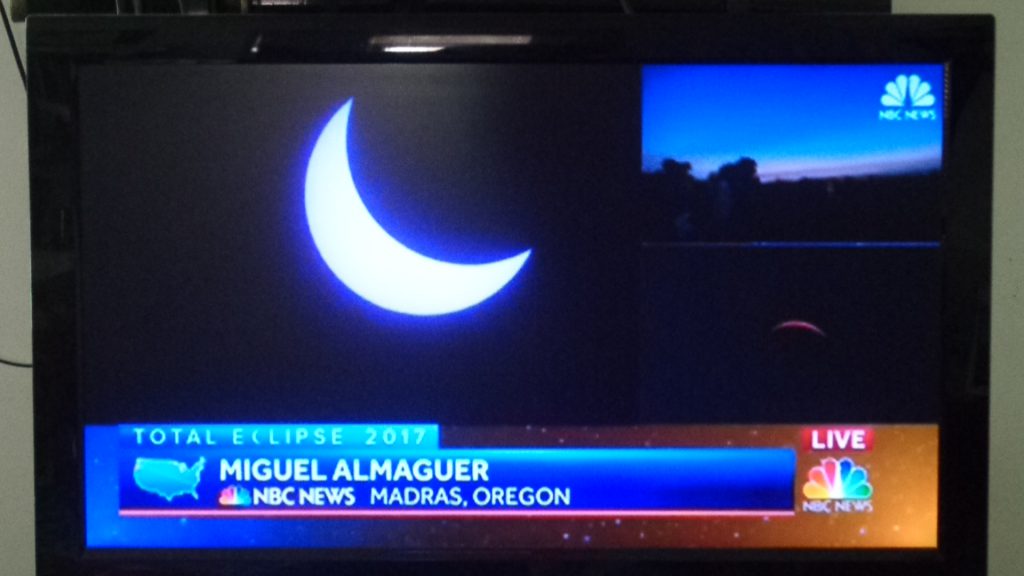
After unsuccessfully trying to photograph the eclipse through protective eyewear and directly, we will have to resort to images from televised and online coverage. Above, the moon’s shadow entered the solar orb moving right (from northwest) to left (southeast); below, intrepid National Media/Royal Examiner science staffer Mary Carnahan tracks eclipse’s progress toward totality; which here had to be viewed on TV and occurred in Madras, Oregon about the time the eclipse began in Front Royal, shortly after 1:20 p.m. EDT. Photos/Roger Bianchini

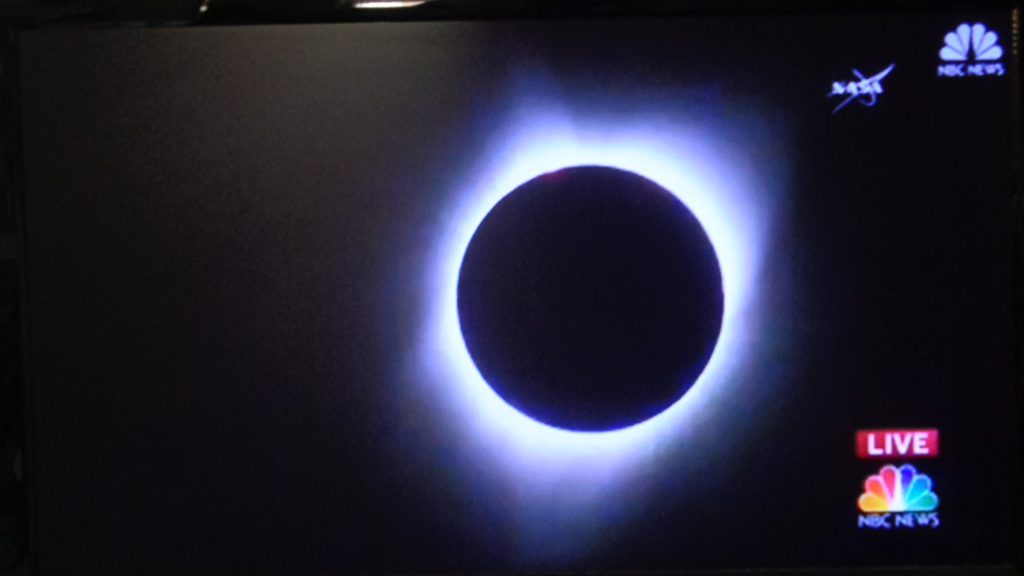
While lacking the dramatic impact of night for day and temperature drops reported as much as 10 to 20 degrees along the path of totality, the eclipse of 2017 came, peaked at about 85-percent of totality, and was gone from the sky over Front Royal by 4 p.m. the afternoon of Monday, August 21.
Our Royal Examiner science team, armed with four pair of eclipse protective eyewear distributed by Samuels Public Library and one welding mask, clocked the eclipse’s start in Front Royal at 1:23 p.m.; with peak coverage during which the moon’s shadow was precisely centered under the remaining 15-percent sliver of sun at 2:35 p.m.; and that shadow gone at about 3:59 p.m. just as the sun re-emerged in its entirety from a passing cloud that politely waited to edge over Front Royal’s view near the eclipse’s end.
As reported in our eclipse preview by Malcolm Barr Sr., this was a celestial event of some note, with most of the U.S. experiencing at least 70-percent of totality. And if as reported on one science website, some point on the earth experiences an eclipse about every 18 months, they, particularly the paths of totality retain a somewhat magical context from pre-scientific cultures experience of them as unexplained and frightening events involving the blinking out of the primary celestial body, worshipped by some as a deity.
A glimpse of that aura of magic was illustrated during CNN’s live eclipse coverage from a cruise ship in the Atlantic when a group cheer went up when the sun began to re-emerge from totality, beginning to restore the celestial order by returning light and warmth to the day.
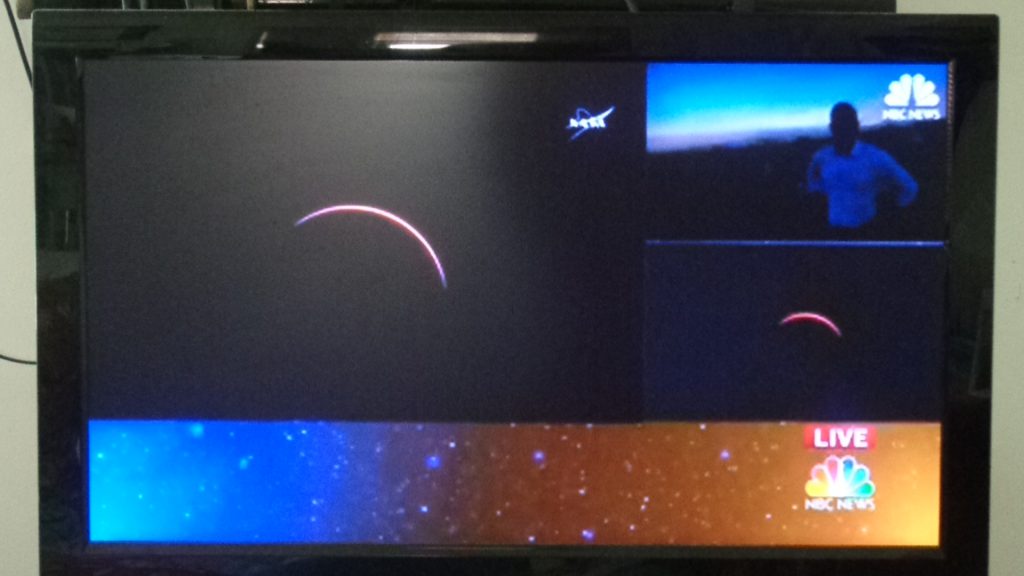
As the moon’s shadow began to recede from totality, some crowds cheered the restoration of celestial order – light in the daytime, dark at night.
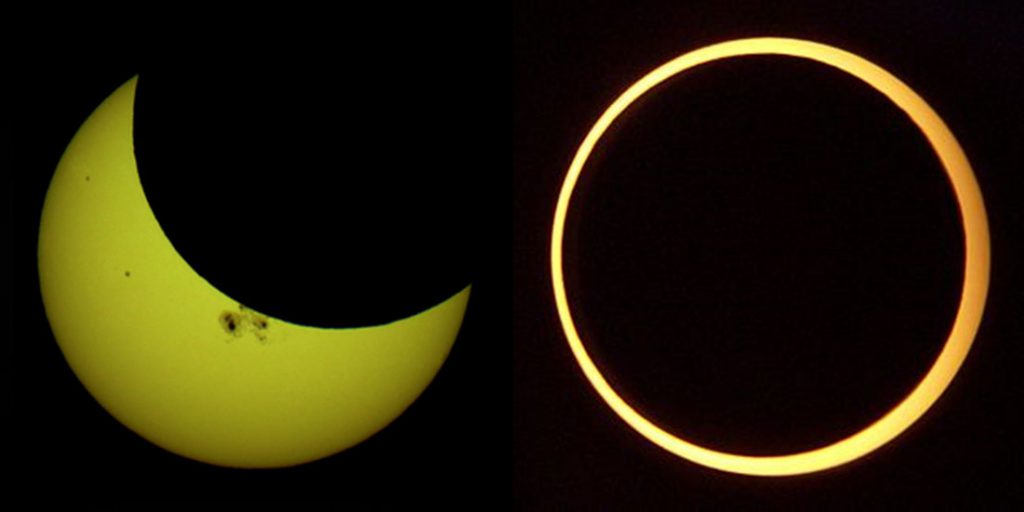
These AstonomyConnection.com eclipse photos show sunspots made more visible as the eclipse progresses and the sun’s corona during totality.
And if it didn’t exactly get dark here, for those observing closely there was a distinct, if relatively slight dimming of our mid-afternoon exceptionally BRIGHT sunlight – if not a noticeable dip in temperature or humidity.
Our advance-guard eclipse and retinal health correspondent Malcolm Barr Sr. forwarded us this photo of local realtor Chris Laurence in his eclipse-watching head gear. We’re not sure how well it worked, but Laurence certainly has added a twist to the eclipse story to be told to his grandchildren. And speaking of grandchildren, Barr was joined at his Rockland eclipse observation post by neighbor Regina Meador and her six-week-old grandson to view the solar event. They took advantage of Samuels Library-provided eyewear that Barr immediately sealed and addressed to his 32-year-old son for use in the eclipse of 2024.

Some got creative in eclipse viewing wear – how’d it work, Chris?
“Who knows, I may still be here to share them,” Barr remarked.
With your family genes, Mal, at 91, you probably will.

James Christopher “Chris” Sain (1948 – 2026)
Alice “Maybelle” Henson (1938 – 2026)

How Sleep and Stress Affect Cancer Risk

Spanberger Signs Sweeping Public Safety and Gun Violence Bills

Horses, Fans Return as Shenandoah Downs Season Begins

Skill Games Halted Again as Spanberger Issues Veto

VDOT: Warren County Traffic Alert for April 13 – 17, 2026

The Cat Who Outlasted Six Prime Ministers

Front Royal, Virginia. Vacation Destination?

Virginia State Police Report Major Drug Seizures in Weekly Crime Suppression Effort

Virginia Secures Birth Control Access as Other Southern States Eye Abortion Pill Manufacturers

SCC Approves Loudoun Transmission Line, Nixes Undergrounding; Final Route to be Determined

Slate of New Virginia Laws Address Health Care and Housing Affordability
James J. Coverston Sr. (1942 – 2026)

Business Growth Series: Your Biggest Problem Isn’t Competition — It’s Being Overlooked

Why Many Experts Say a Concussion Should Be Called a Brain Injury

Missouri Man Arrested in Undercover Operation Targeting Online Crimes Against Children

Trump Tax Plan Credited With Higher Refunds, Lower Taxes

Spanberger Vetoes Fairfax Casino Bill, Citing Local Opposition

Blue Ridge Point-to-Point Races Return Saturday at Woodley Farm

Legislative Effort to Buy Monroe’s Loudoun Estate on Pause, Budget Effort Underway

US House Democrats Call for Congress to Come Back Into Session for Iran War Debate

Virginia to Raise Minimum Wage to $15 by 2028 Under New Law

Spanberger Signs Bills to Aid Low-Income Utility Customers, Manage Power Demand
