
Local Government
Supervisors fall short of harshest delinquent tax code change
On Tuesday January 17, the Warren County Board of Supervisors toughened up its delinquent tax collection codes. However, the Board fell short of approving the harshest proposed change – mandating that locally-based businesses have ALL their delinquent real estate taxes paid in full before receiving an annual business license renewal.
What local business people will now have to pay in full to receive a business license renewal from Warren County include licensing, personal property, meals and transient occupancy (lodging) taxes. However, following the 4-1 vote (Glavis dissenting) approving Tony Carter’s amended Business License Code change, the Board did vote unanimously to mandate that delinquent real estate taxes be paid in full on individual parcels before building permits on those parcels are applied for. It was noted that the code changes only impact businesses licensed in the county, outside the town limits.
Of the deletion of real estate taxes from the business license proposal, Happy Creek Supervisor Carter voiced concern that such an abrupt change to County policy could be counterproductive. That is because by far the largest tax debts to the County are in real estate taxes and the County’s goal in the code change is to get paid, not to drive those owing the most money out of business.

Tony Carter, center, and Dan Murray, right, discuss compromises to the proposed delinquent tax code changes as County Administrator Doug Stanley, left, listens. In the end payments on back real estate taxes were only mandated on lots building permits are being applied for. Photo/Roger Bianchini
And for those developers who have taken advantage of a defacto Board policy that allows them to carry years of unpaid real estate taxes on investment properties until they have sold or developed that land, the possibility of being driven out of business could be a real one. This reporter first looked into Warren County’s Delinquent Real Estate Tax situation after it was raised during the FY 2016 Budget process by Supervisor Archie Fox in early 2015 – Fox is County Treasurer Wanda Bryant’s brother, so might be closer to the issue than his colleagues.
At that time a number of prominent local property owners and developers were carrying anywhere from $35,000 to $150,000 or more in real estate tax debt on the County’s books. And an indication that the County policy was being abused was that not all of the debt was on undeveloped, or even on investment properties.
At the time the Treasurer’s Delinquent Real Estate Tax list was 700 pages, totaling about $4-million dollars. Checks with surrounding counties indicated that was a relatively high number for the amount of taxable land in the county. A more recent check with the County Treasurer has shown some progress in knocking those delinquent numbers down since her brother first raised the issue.
Following Carter’s expression of concern that refusing to issue business licenses to real estate tax delinquents might defeat the purpose of the code change, North River Supervisor Dan Murray suggested a compromise. That was to allow business license renewals as long as the debtor had worked with the County to establish a payment plan on their real estate tax debt.
However, when Carter made his motion to approve the new business licensing code, deleting real estate tax debt from it, no mention of a real estate-debt payment plan was added. Despite the absence of his idea that a gesture toward delinquent real estate tax payments be included, Murray seconded Carter’s motion as presented.
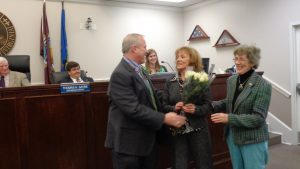
County Administrator Doug Stanley and Board Chair Linda Glavis bid farewell to long-time County Clerk Janice Standridge at her last meeting. Standridge is retiring to a simpler life outside municipal government. Her replacement, Emily Mounce, in background will continue receiving on-the-job training through the end of the month – tell her to be nice to us, Janice (like you were, no matter how annoying we got). Photo/Roger Bianchini
Only Chairman Linda Glavis opposed Carter’s amended motion on the business license code change. Glavis’s concern was that mandating any delinquent tax payments in full to achieve a County business license could put those in default out of business and with no means to make good on their debt to the County.
However, a majority apparently felt that after perhaps a decade or more of letting people slide on real estate tax payments rather than risk taking a loss on forced sales, some effort was necessary to help move collections forward. Responding to a question, staff said the collections authorized would include penalties and interest that had accumulated.

Hike Kidz Foundation Highlights Programs for Families in Need

Phoenix Project Offers Support and Resources for Victims of Abuse

Virginia Moves to Launch Legal Cannabis Marketplace After Years of Delay

As Spanberger Reviews State-Level ‘Momnibus’ Bills, Kaine and Booker Try Again on a Federal Package

Detox Diets: Don’t Overlook the Risks

How to Answer the Interview Question: “Where Do You See Yourself in Five Years?”

HARTS, DSS & House of Hope Highlight Services at Community Forum

Joyce Henry Sutherland (1942 – 2026)

Commentary: Building on What We Have – A Proposed Economic Development Agenda for Warren County

Jamie Christopher Tewalt (1971 – 2026)

George Jules Pouzenc III (1958 – 2026)

Samuels Public Library Prepares for Annual “Taste for Books” Fundraiser

Assistant Chief and Fire Marshal Gerry Maiatico Highlights Staffing Needs and Volunteer Opportunities

Data Center Bills Dominated This Year’s General Assembly. Here’s What Passed.

Housing Bills to Boost Supply, Protect Tenants On The Way to Spanberger’s Desk

4 Ideas for Keeping Fit While Babysitting Your Grandchildren

Do You Know Your Grains?

Tips for Staying Safe Around Unfamiliar Dogs

Skyline FFA Students Promote Agriculture at South River Community Forum

Warren Coalition Works to Build Resilience and Prevent Substance Abuse

Warner Files for Reelection, Launching Bid for Fourth U.S. Senate Term

Registrar Urges Residents to Stay Informed and Participate in Upcoming Elections

South River Forum Brings Residents and Leaders Together at Skyline

CHEO Garden Expands Mission of Food, Learning and Community
