
Local Government
Town planners move short-term rental draft ordinance toward public hearing
At 6 p.m., Wednesday, December 1, the Front Royal Planning Commission met at work session in the Town Hall second floor meeting room to discuss formulating a text amendment to zoning codes to facilitate legally prescribed short-term tourist rentals. To this point, as a sub-municipality of the county such applications within a vacuum of town codes, have been directed by county codes. The town council recently requested the planning commission to explore creation of a town ordinance to oversee the application for short-term tourist rentals within the town limits.
Planning Director Lauren Kopishke presented a 10-page report, including a draft “Addition to (Code) 175-3” with a 14-point check list of requirements for submission of a Special Use Permit (SUP) application and draft “Short Term Rental Property Management Plan” that would be required of all applicants. Also included in the agenda packet distributed to the commission were Warren County’s checklist for such permitting applications and relevant state codes, including taxing processes. It might be noted that the Code of Virginia Chapter 35, Article 3.1 on Merchants Capital and Short-Term Rental Properties regarding taxation repeatedly refers to short-term rentals as a “business” endeavor, not a residential operation.

Planning Director Lauren Kopishke, at top left of table, briefs Town Planning Commission on dynamics of her draft short-term rental ordinance requested for development by town council. Royal Examiner Photos by Roger Bianchini
After four sentences defining the topic, the Code 175-3 draft checklist’s opening line – “Short-term tourist rentals shall be permitted in all Zoning Districts by Special Use Permit and shall meet the following requirements:” drew a lengthy discussion begun by Commissioner Darryl Merchant.
That discussion centered on the question of whether within the confines of the town limits, short-term tourist rentals should be allowed in residential districts, particularly R-1 Districts. Merchant was skeptical of a business operation being allowed in the often closer proximity of R-1 residential areas.
Another sticking point was raised by Commission Chairman Douglas Jones. That was whether a proposed Town Code should override Home Owner Association (HOA) rules regarding the conduct of short-term tourist rentals. A consensus was fairly quickly raised to eliminate any wording suggestion that the town government was in the business of overruling written HOA standards for short-term tourist rental operations.
The R-1 Residential District discussion centering on the advisability of introducing a “commercial element” into town residential neighborhoods took more time to resolve. Merchant noted the planning director’s reference to investors in some areas moving to buy multiple properties specifically for use in short-term rental businesses. Merchant worried that such commercial investing strategies would threaten to alter the character of neighborhoods from residentially based to commercial, as well as shrink the housing market for families seeking to put roots down in the community.

Darryl Merchant, center, flanked from left by Josh Ingram, Planning Director Kopishke, and Vice-Chair Connie Marshner across table, explains his reservations about potential over-commercialization of residential neighborhoods in town.
“I’m not saying short-term tourist rentals will tear the fabric of the town apart, but it’s a start,” Merchant said of his concern about business enterprises, rather than individual homeowners seeking additional revenue, controlling the coming of short-term tourist rentals to the town. However, a majority consensus was reached that with care the town governments overseeing and defining of short-term tourist rental processes could offer the necessary control to avoid the kind of commercialization Merchant feared.
“I don’t think we have a choice,” Commission Vice-Chair Connie Marshner said of allowing short-term tourist rentals in residential, including R-1, neighborhoods. The counter concern to Merchant’s was that to forbid them in residential areas would likely shrink the town’s short-term tourist rental marketplace too significantly to allow it to exist in any meaningful way. Marshner said that perhaps the commercial investor aspect could be utilized to direct a reclaiming of blighted properties in town – “It might be a plus,” she offered of that potential outcome.
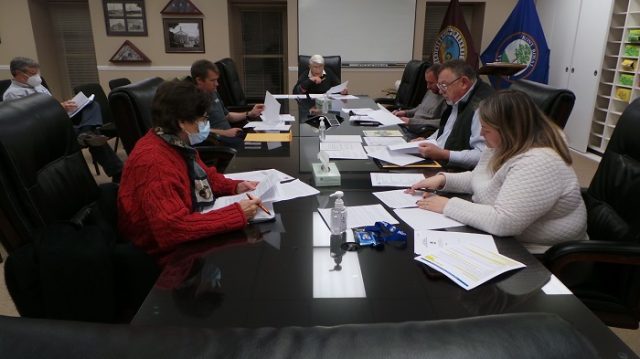
The planners agreed to move a slightly re-worked draft of the short-term rental ordinance proposal toward public hearing. Assistant Town Attorney George Sonnett, far left, was present to answer questions on involved legal variables.
“I think it’s something we should try,” Josh Ingram observed of allowing them in all zoning districts.
“We’d be foolish not to,” Marshner added.
“Let’s take it to public hearing and see what the people think,” Merchant said, leading Ingram to concur.
Following the commission consensus, Planning Director Kopishke said she would make the few suggested changes to her draft and then move the matter toward a planning commission public hearing.
In the commission’s only other business Wednesday evening during the planning director’s update, Kopishke told the commission that 200 responses to the Comprehensive Plan Citizen Survey had been received. Noting a target of 3,000 responses by the end of the year, ways to increase the pace of public input were pondered. Of the replies received, Kopishke said a recurring theme was retaining Front Royal’s “small town charm”. – “It seems very anti-growth,” the planning director noted of the replies thus far received.

Electric Vehicle Market Adjusts as Industry Rethinks the Road Ahead

Cultures Around the World Mark the Spring Equinox With Unique Traditions

Laurel Ridge to Host 46th Annual Spring Follies: “Back to the ’90s”

Love Revival to Host Free Community Easter Celebration in Front Royal

Salvation Army of Front Royal Plans Annual Dinner and Raffle Fundraiser

Stephen Paul Sill (1955 – 2026)

Virginia Seeks Public Input for 2026 Statewide Rail Plan

Front Royal Craftsmen Revive Centuries-Old Timber Framing Tradition

VDOT: Warren County Traffic Alert for March 16 – 20, 2026

Virginia Lawmakers End Session Without Final Budget

Your Personal Mission Statement: A Guide to Getting What You Want Out of Life

Disappointed In Our Olympic Spirit

How St. Patrick’s Day Became America’s Biggest Irish Party

Virginia State Police Urge Sober Plans for Saint Patrick’s Day Celebrations

In a One-Party County, Internal Party Decisions Affect Us All

Virginia State Police Seize Nearly 100 Pounds of Narcotics, Recover Firearms in Weekly Crime Suppression Effort

Barton Charles “Bart” Haller (1940 – 2026)

Dawn Lee Dodson (1970 – 2026)

Mary Helen “Nanny” Spires Johnt (1954 – 2026)

Another Round of ‘Momnibus’ Bills Are Headed Towards the Governor This Year

Virginia Joins States Challenging Trump Admin Regulations That Limit Free Birth Control Access

Update: Charlotte Swanson Smith (1951 – 2025)
Why We are Challenging the Republican Mass Meeting

Bruce Norman Showman (1954 – 2026)
