
State News
Virginia Marriage Equality Amendment Campaign Launches at Start of Pride Month
Chad Stewart and Blake McDonald met in college in 2007 and began dating two years later, eventually building a life together in Richmond after settling in Virginia more than a decade ago.
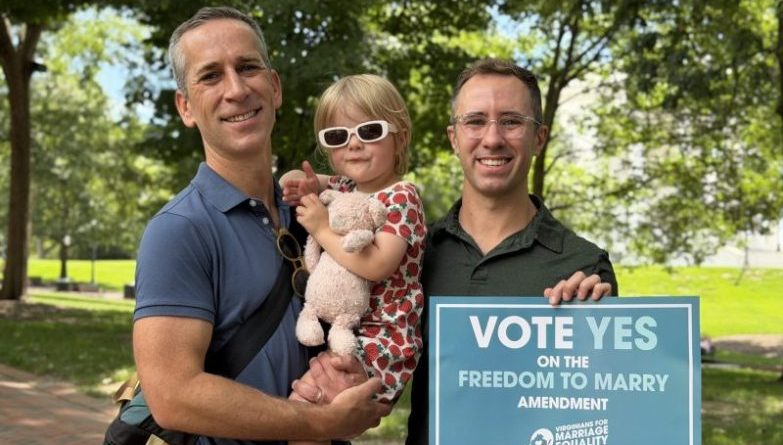
Blake McDonald (left) and Chad Stewart pose with their daughter, Flora, during the launch of the Virginians for Marriage Equality campaign near the Bell Tower in Richmond’s Capitol Square on Monday, the start of LGBTQ Pride Month. The campaign supports a constitutional amendment referendum that would permanently protect same-sex marriage in Virginia’s constitution. (Photo by Markus Schmidt/Virginia Mercury)
By 2015, the couple married — just one week before the U.S. Supreme Court’s landmark Obergefell v. Hodges decision legalized same-sex marriage nationwide.
“We didn’t want to have to think about politics or court cases,” McDonald said Monday outside the Bell Tower in Richmond’s Capitol Square. “We just wanted to dream about the future we’re going to build together.”
The couple spoke as Virginians for Marriage Equality formally launched its statewide campaign to pass a constitutional amendment referendum in November that would permanently protect same-sex marriage in the Virginia Constitution.
The coalition gathered at the start of LGBTQ Pride Month to rally support for the amendment, which would repeal Virginia’s dormant constitutional ban on same-sex marriage and replace it with language requiring the commonwealth to recognize all marriages, regardless of sex, gender or race.
Advocates say the amendment is needed in case federal protections for same-sex marriage are ever overturned.
Concerns intensified after the U.S. Supreme Court overturned Dobbs vs. Jackson Women’s Health Organization in 2022 and Justice Clarence Thomas later suggested the court should reconsider other rulings involving privacy and due process rights, including same-sex marriage protections.

Over time, Stewart said, the future he and McDonald imagined together in Virginia expanded beyond the two of them. During the pandemic, they began the adoption process. In 2023, they received a call, giving them just 16 hours notice before bringing home their daughter, Flora.
“And so now our life is daycare drop offs, bedtime routines, holidays together, play dates with neighbors, and our daughter proudly calling the people down the street family, too,” Stewart said.
From Marshall-Newman to Obergefell
Virginia’s fight over marriage equality has spanned two decades, from one of the country’s strictest constitutional bans to this year’s referendum effort to permanently protect those marriages in state law.
Voters approved the Marshall-Newman amendment in 2006 after legislation introduced by then-Del. Bob Marshall, R-Manassass, and then-Sen. Steve Newman, R-Bedford County.
The amendment defined marriage exclusively as a union between “one man and one woman” and barred the state from recognizing same-sex relationships or similar legal arrangements.
Roughly 57% of voters backed the amendment at the time.
The issue later became the subject of federal lawsuits including Bostic vs. Schaefer and Harris vs. Rainey, in which same-sex couples argued Virginia’s ban violated the Equal Protection and Due Process clauses of the 14th Amendment.
A federal judge struck down Virginia’s ban in 2014, and the 4th U.S. Circuit Court of Appeals later upheld the ruling. When the U.S. Supreme Court declined to hear Virginia’s appeal later that year, same-sex marriages began statewide.
The following year, the high court’s Obergefell ruling established a nationwide constitutional right to same-sex marriage under the 14th Amendment’s guarantees of due process and equal protection. Although the decision invalidated Virginia’s constitutional ban, the language itself remained in the state constitution.
The amendment before voters in the 2026 midterm elections passed the General Assembly in 2025 and again during the 2026 legislative session, satisfying the constitutional requirement that amendments pass in two separately elected legislatures before reaching the ballot.
If approved by voters this fall, the amendment would repeal the Marshall-Newman language and replace it with protections requiring Virginia to recognize marriages regardless of sex, gender or race.
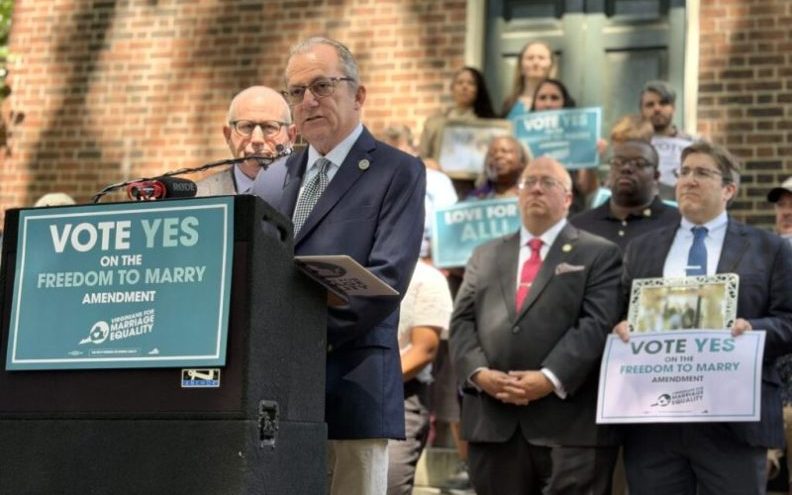
Former state senator Adam Ebbin speaks during the launch of the Virginians for Marriage Equality campaign in Richmond Monday. (Photo by Markus Schmidt/Virginia Mercury)

‘Dignity, respect, and equal treatment under the law’
In Richmond on Monday, several speakers described the referendum as the culmination of decades of legislative efforts and legal battles.
Former state senator Adam Ebbin, a Democrat from Alexandria and the first openly gay legislator elected to Virginia’s General Assembly in 2003, recalled watching lawmakers approve the constitutional ban more than 20 years ago.
“For Mark and me, today is deeply personal,” Ebbin said, referring to Virginia Secretary of Finance Mark Sickles, another openly gay former lawmaker standing next to him.
“Twenty years ago, we stood in the General Assembly and watched Virginia write discrimination into its constitution. We argued against it, we voted against it, and for 20 years, we worked to undo that mistake.”
Ebbin said same-sex couples across Virginia have spent more than a decade building families while the constitutional ban remained written into state law.
“Back in 2006, Virginians were told that marriage equality would somehow threaten our community,” Ebbin said. “But today, for more than a decade, same-sex couples have been building marriages, raising children, buying homes, and growing all together across the commonwealth.”
Sickles said public attitudes shifted over time as LGBTQ Virginians became more visible in communities and families across the state.
“People keep organizing,” Sickles said. “Families kept showing up. Virginia has changed because people got to know their neighbors, their coworkers, their friends, their siblings, their children more fully.”
Narissa Rahaman, executive director of Equality Virginia and a committee member of Virginians for Marriage Equality, described the campaign as centered on dignity, family and personal freedom.
“This November, Virginians have the opportunity to protect the Freedom to marry and affirm what so many of us already know,” Rahaman said. “Every Virginia family deserves dignity, respect, and equal treatment under the law.”
Rahaman referred to her marriage to her wife, Brianna, as “a million little decisions and a million little moments” built around love, commitment and stability.
“No family in Virginia should have to wonder whether their rights will be protected tomorrow,” she said.
Marshall, the sponsor of Virginia’s 2006 same-sex marriage ban, declined to comment when reached by phone Monday.
But the political landscape around the issue has since shifted dramatically. In 2024, then-Gov. Glenn Youngkin, a Republican, signed legislation sponsored by Democratic lawmakers aimed at ensuring same-sex marriage would remain legal in Virginia regardless of future federal court decisions.
Still, Youngkin’s office at the time emphasized provisions protecting religious liberties, including language allowing clergy members and religious organizations to decline to perform same-sex weddings.
Campaign heads into election season
Organizers said they plan to spend the coming months traveling across Virginia to build support ahead of the November elections.
Alexandria Democrat Del. Kirk McPike, who is also campaign co-chair, said marriage equality advocates will engage voters in communities statewide in the coming months.
“My own husband, Jason, and I have built a life together here in Virginia, just like thousands of other couples and families across the commonwealth,” McPike said. “Every Virginian has a place in this campaign and a place in this commonwealth.”
Mary Bauer, executive director of the American Civil Liberties Union of Virginia, tied the amendment effort to Virginia’s broader civil rights history, including the 1967 U.S. Supreme Court decision in Loving v. Virginia, which struck down interracial marriage bans.
“This amendment is about making clear that the government has no business deciding which marriages or which families are worthy of recognition,” Bauer said.
For Stewart and McDonald, the constitutional debate ultimately comes back to protecting and honoring their union.
“When you build a family like that, legal recognition stops feeling abstract very quickly,” Stewart said. “Marriage equality is what allows families like ours to navigate healthcare, school enrollment, parenting, and all the ordinary parts of life that come with making a home together.”
by Markus Schmidt, Virginia Mercury
Virginia Mercury is part of States Newsroom, a nonprofit news network supported by grants and a coalition of donors as a 501c(3) public charity. Virginia Mercury maintains editorial independence. Contact Editor Samantha Willis for questions: info@virginiamercury.com.



County Supervisors Fill Vacant Planning Commission Seat, Look to Future on Processes and Capital Improvements

America 250: ‘I Only Regret That I Have but One Life to Lose for My Country’

Building Gas Plants More Important Than Dominion Sale, Data Center Politics

Home Inspectors Help Buyers and Sellers Understand a Property’s Condition

Bowling Together: Why Work Is More Than a Paycheck

This Week’s Showtimes at Royal Cinemas as of September 24th

POLICE: 7 Day FRPD Arrest Report 9/21/2026

Blue Ridge Wildlife Center Patient of the Week: Eastern Cottontail

UVA Health Review Examines Real-World Results of Incisionless Liver Tumor Treatment

Maximilian James Donora (1995 – 2026)

Dollars for Dolly Campaign Aims to Turn Small Gifts Into Big Community Impact

Clean Virginia: NextEra’s Utility Takeover Attempts, Alleged Political Moves Relevant to Merger Case

Commentary: If You Enjoy Virginia’s Wildlife, Thank a Hunter or Angler

Spanberger Presses Congress for AI Guardrails as States Forge Ahead

‘Drive Them Into Hell’: Trump Ponders Destruction of Iran at United Nations

National Chicken Month Celebrates a Versatile Source of Protein

Face Paint That Can Read Your Heartbeat

Leisa Wood (1961 – 2026)

GO VOTE: Because Complaining Alone Isn’t a Good Strategy
The Third Most Important Gift Is Laughter

Skates, Treats and Safety: Warren County Sheriff’s Office Foundation Pack October with Community Events

Celebrate Kids Day Returns Sept. 27 With Family Fun, Activities and a New Train Ride

Survey Finds That More Than Half of Virginia Families With Children Face Food Insecurity

Could Virginia’s New Law Allowing 1% Sales Tax for School Construction Need a Fix?
