
State News
Virginia tightens landfill rules
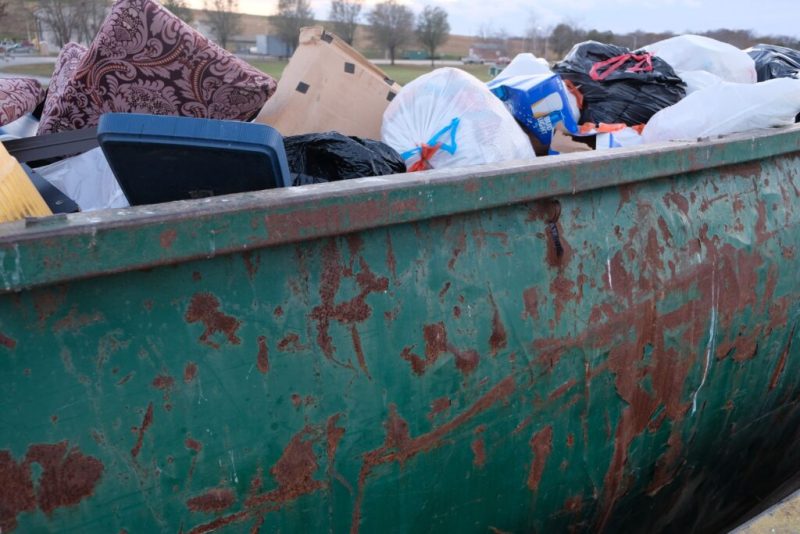
A trash collection container at the Maplewood (Amelia) Landfill in Jetersville. (Charlie Paullin / Virginia Mercury)
Following three years of public input, Virginia is tightening its regulations for landfills.
This October, the state’s Waste Management Board voted to require greater setbacks for landfills from the surrounding community, more frequent covering of waste at active landfills, regular capacity studies, notification of excess gas emissions, and additional groundwater monitoring.
Kathryn Perszyk, a division director with the Virginia Department of Environmental Quality, in a release, said the changes “strengthen waste management practices to be more protective of human health and the environment while increasing certainty for the regulated community.”
But the citizen group Virginians for Conservation and Community Rights, an organization that emerged out of local opposition to the proposed Green Ridge landfill in Cumberland County, says the regulations still fail to protect the environment and surrounding communities, particularly when it comes to groundwater contamination. Especially concerning to the group is a continued lack of protection for private wells that lie near landfills.
“We are very disappointed because it didn’t address any of the concerns that we have,” said Victoria Ronnau, executive director of the VCCR.
The regulations
DEQ proposed the changes to the regulations in response to a report from former Secretary of Natural and Historic Resources Matthew Strickler that called for revisions to how the state handles landfill siting and pollution.
The new regulations increase setback requirements from 200 to 500 feet between the landfill’s boundary and any residence, school, daycare center, hospital, nursing home, or recreational park area.
“These changes will create a larger buffer between the waste management boundary and development on properties adjacent to the landfill” and are consistent with both requests received from the public and what is found in surrounding states, a DEQ memo on the new regulations notes.
Landfills will also have to conduct periodic topographic surveys, which will provide updated information on their capacity and cover exposed waste at active sites on a weekly basis.
According to the memo, the latter change followed DEQ observations of “an increase in the number and severity of occurrences of fires, odors, blowing litter” and other impacts at landfills.
In June, the Roanoke County Fire and Rescue Department spent about two and a half hours extinguishing a fire at the Smith Gap Landfill. Air pollution and odor control problems at the Bristol landfill also sparked a lawsuit from neighboring Bristol, Tennessee. The facility stopped accepting waste on Sept. 9, and officials estimate it will take $30 million to clean up.
Additionally, landfills will be required to notify occupants of structures within a 500 feet radius of any excess levels of methane gas, which is a byproduct of decomposition, and to monitor groundwater for contaminants, including perfluoroalkyl and polyfluoroalkyl substances, or PFAS, which are colloquially known as “forever chemicals.”
The groundwater monitoring regulations don’t specify maximum contaminant levels for PFAS in groundwater near landfills. A Virginia workgroup has been developing recommendations for contaminant levels under 2020 legislation, and the U.S. Environmental Protection Agency has recently been rolling out proposals to limit PFAS pollution.
That’s where the regulations fall short, according to Ronnau and Keith Buch, a retired environmental engineer who has advocated for more stringent landfill rules.
While Virginia requires any landfill sited within a certain range of a public water system to use a double liner, which can prevent leakage of contaminants, the state has no such requirement for landfills near private wells, said Buch.
Private wells are used in a “majority” of counties in the state, Buch said, and primarily by rural residents, such as those who would live near the Green Ridge site.
“There’s a huge group of individuals, homeowners that could be negatively impacted either through a landfill or some other industrial activity,” Buch said.
In its memo on the new regulations, DEQ said the agency is waiting for the state to set maximum contaminant levels. The regulation “can be modified in the future if necessary” based on those actions, wrote DEQ.
‘A lack of value’
The potential harm around the Green Ridge site is just an example of deficiencies in Virginia’s landfill regulations, Ronnau said. At risk in Cumberland, she added, is the Pine Grove School, a century-old Rosenwald school founded to educate Black children during segregation.
“A landfill would destroy both the environmental ecosystem and, just as important, it would destroy the historic ecosystem,” said Muriel Branch, 79, who attended the school.
The proposal includes rerouting a portion of Pine Grove Road, which leads to the school.
“It just makes me very angry that you would consider upending and rerouting a historic road so … your trucks can have easier access to the dump,” Branch said. “It just shows a lack of value that Green Ridge placed on our predominantly historically Black community.”
Community members hope to use the school, which is in need of stabilization, as a cultural center, museum, and place for research on the surrounding African American community. The Agee Miller Mayo Dungy group, named after four descendants of the school, recently obtained a $290,000 grant from the National Park Service for work on the building.
Green Ridge has said its plans will not impact the school and its immediate area.
“We have every intention of complying with all the rules and regulations,” said Jay Smith, a spokesperson for the company. The road change will happen on their property and “doesn’t block access to Pine Grove,” he noted.
Regulatory impacts
Green Ridge would not be subject to the new regulations because it submitted its application for a new solid waste landfill before the new rules’ effective date, DEQ spokesperson Aaron Proctor said in an email.
Still, “it appears that the proposed landfill meets the revised requirements,” Proctor added.
Proctor was unable to immediately say how the regulations might impact the Bristol, Virginia landfill.
When the Green Ridge site could become operational is also unclear, as its permit is currently undergoing review by DEQ and the Army Corps of Engineers.
The landfill is expected to provide Cumberland $1.4 million to $2.8 million in revenue each year over the roughly 30-year life of the project. Smith said that thirty-five jobs, ranging from commercial drivers to laborers, with salaries that can exceed $60,000, will also be created.
by Charlie Paullin, Virginia Mercury
Virginia Mercury is part of States Newsroom, a network of news bureaus supported by grants and a coalition of donors as a 501c(3) public charity. Virginia Mercury maintains editorial independence. Contact Editor Sarah Vogelsong for questions: info@virginiamercury.com. Follow Virginia Mercury on Facebook and Twitter.

Virginia State Police Seize $22.4 Million in Drugs, Recover Firearms in Weeklong Operation

Virginia Home Sales Rise in February as Inventory Grows, Spring Outlook Uncertain

Bing Crosby Stadium Hosts Warren County–Skyline Baseball Battle Tonight

Warren Supervisors Address Audit Contract, Permits, and Property Sale at March 17 Meeting

Here’s How Virginia Lawmakers Suggest the Next State Budget Handle Federal Health Care Funding Fallout

Spring Essentials Checklist: Prepare Your Home for Summer

Virginia Joins National Push for Refunds After US Supreme Court Voids Trump Tariffs

Four Reasons to Consider Hiring a Professional Cleaning Company

Ask the Expert : We Are Applying for a Mortgage Soon. What Kind of Documents Will We Need?

Charles Michael “Rusty” “Chuck” Fischbein (1944 – 2026)

Jerrold E. “Jerry” Groves (1931 – 2026)

Town Planning Commission Moves Forward with Industrial Zoning, Holds Preliminary Discussion of Urban Agriculture

Schools Push for Budget Flexibility, Consistent Funding as Needs Grow

Skyline High Teams, Athletes Successful Seasons and Performances Acknowledged – Oh, and Those Roosters

School Board Seeks to Restore Meals Tax Funding for School Facilities

Wasting Drinking Water: 3 Habits to Eliminate From Your Daily Routine

Medicare Launches TEAM Program to Improve Recovery After Surgery

Izaak Walton League Promotes Conservation and Outdoor Programs at Community Forum

POLICE: 7 Day FRPD Arrest Report 3/16/2026

Blue Ridge Wildlife Center Patient of the Week: Great Horned Owl

Airline CEOs Warn of Travel Strain Amid DHS Funding Uncertainty
Robert B. Walters (1931 – 2026)

Lemmon & Hale Highlight Importance of Estate Planning for Families and Businesses

Hike Kidz Foundation Highlights Programs for Families in Need
