
State News
Virginia’s Abortion and Marriage Amendments Face Court Challenges Following Voter Approval
Virginia voters approved constitutional amendments protecting reproductive rights and marriage equality on November 3, but the legal fight over both measures is far from over.
A hearing scheduled for Friday, November 13, in Tazewell County Circuit Court could determine whether the state can certify the reproductive rights amendment. Meanwhile, a separate lawsuit filed in Prince William County challenges the marriage amendment on similar procedural grounds.
The Founding Freedoms Law Center (FFLC), the legal arm of the conservative Family Foundation of Virginia, brought both cases.
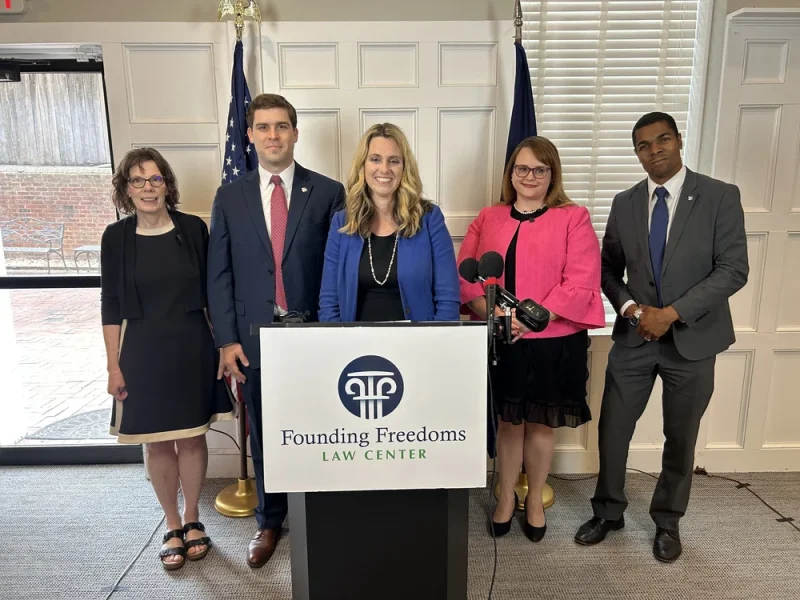
Left to Right: Dr. Sheila Furey, President of Virginia Medical Freedom Alliance; Josh Hetzler, Executive Director and Chief Counsel for FFLC; Victoria Cobb, President of The Family Foundation; Meagan Kade, Tazewell resident and Bluefiled Town Council Member; and Michael Sylvester, Litigation Counsel for FFLC
The challenges come despite substantial statewide support. Unofficial election results showed approximately 62.4% of Virginians voting for the reproductive rights amendment, known as Question 1, and 57.4% supporting the marriage amendment, Question 2.
Warren County voters took the opposite position, rejecting Question 1 by 56.99% and Question 2 by 58.43%.
Judge Allows Abortion Amendment Challenge to Proceed
On October 26, FFLC announced that Tazewell Circuit Court had denied motions by the Commonwealth seeking to prevent a post-election hearing in its lawsuit challenging the reproductive rights amendment.
The decision allows the legal arguments to be heard on November 13 before Judge Jack Hurley. It does not mean the judge has determined that the amendment is unconstitutional or that the election results are invalid.
The lawsuit, originally filed in April 2026, was brought on behalf of the Association of American Physicians and Surgeons, the Virginia Medical Freedom Alliance, and Bluefield Town Council member Meagan Kade.

FFLC is seeking a preliminary injunction to prevent certification of the election results.
The organization makes two principal arguments.
First, it contends that the General Assembly failed to comply with requirements governing how it must present proposed constitutional amendments to the public before an intervening legislative election.
Second, it argues that the ballot question was misleading because it did not adequately disclose the amendment’s potential consequences.
Among the concerns raised by opponents are the amendment’s possible effects on parental consent requirements for minors seeking abortions and existing restrictions on abortions later in pregnancy.
Supporters dispute those interpretations, arguing that the measure establishes constitutional protections for reproductive healthcare rather than automatically eliminating existing parental consent laws.
A Dispute Over Constitutional Procedures
Central to the lawsuit is a dispute over a former Virginia law requiring proposed constitutional amendments to be distributed to local circuit court clerks and publicly posted at courthouses.
FFLC alleges that the House of Delegates clerk failed to distribute copies of the amendment and that the required courthouse postings were not completed before the November 2025 election.
The General Assembly subsequently repealed the statutory provision containing those requirements, with the repeal taking effect in July 2026.

The timing matters because the amendments had already passed earlier stages of the legislative approval process before that repeal took effect.
FFLC maintains that the procedural requirements in effect at the time should have been followed and that the later repeal cannot cure an earlier failure.
Attorneys defending the state’s actions have argued that the General Assembly possesses constitutional authority to establish and modify the procedures for advancing amendments.
A separate lawsuit raising similar procedural objections was dismissed in another Virginia circuit court during the summer. That decision was appealed.
Judge Hurley also presided over an earlier challenge involving a congressional redistricting referendum that Virginia voters approved in the spring. The Virginia Supreme Court ultimately struck down that referendum.
However, the outcome of the redistricting case does not automatically determine the result of the reproductive rights challenge.
Marriage Amendment Faces Separate Lawsuit
The Founding Freedoms Law Center also filed a lawsuit on October 22 in Prince William County Circuit Court challenging the marriage amendment.
That case was brought on behalf of Pastor Ben Purves of Occoquan Bible Church.
Unlike the reproductive rights lawsuit, which also challenges the wording presented to voters, the marriage lawsuit focuses on the alleged failure to follow the required constitutional amendment procedures.

FFLC argues that the same failure to distribute and publicly post the proposed amendment occurred during the marriage amendment’s legislative process.
Purves has helped organize opposition to both measures through an open letter signed by more than 400 Virginia pastors.
FFLC Executive Director Josh Hetzler said the lawsuit concerns the rule of law and whether changes to Virginia’s Constitution were advanced in accordance with legal requirements.
Pastor Purves has also expressed concerns about the amendment’s potential consequences for religious freedom.
The marriage amendment removes Virginia’s constitutional language defining marriage exclusively as a union between one man and one woman. It protects marriages between two adults regardless of sex, gender, or race and requires legally valid marriages to receive equal treatment under state law.
Same-sex marriage has already been legally protected nationwide since the U.S. Supreme Court’s 2015 decision in Obergefell v. Hodges. Supporters argue that Virginia’s amendment adds state constitutional protections should federal law change.
Supporters Defend the Voters’ Decision
Advocates for both amendments have rejected the lawsuits as attempts to overturn decisions made by Virginia voters.
Following the election, Han Jones, campaign manager for Virginians for Reproductive Freedom, said the results demonstrated substantial public support for protecting reproductive healthcare decisions.
Representatives of Virginians for Marriage Equality similarly described the vote as an important step toward protecting equal rights under Virginia law.

The statewide margins also indicate that support extended beyond any single political party.
The third constitutional amendment on the November ballot, establishing a fundamental right to vote and providing for the automatic restoration of voting rights following incarceration for felony convictions, also passed with approximately 56.5% support.
Although it advanced through the same legislative process, FFLC has said it does not intend to challenge that amendment.
What Happens November 13?
The upcoming Tazewell hearing will place the reproductive rights lawsuit before Judge Hurley for consideration of the legal arguments and FFLC’s request for preliminary relief.
The immediate question is whether the court should intervene to prevent certification of the amendment’s election results.
If the judge grants an injunction, the certification process could be disrupted while the court resolves the underlying legal issues. If the request is denied, the amendment could move closer to taking effect, although additional litigation or appeals remain possible.
The three voter-approved constitutional amendments are scheduled to take effect January 1, 2027, following the required election certification process.
For now, Virginians have spoken at the ballot box. Whether the challenged amendments were advanced according to the procedures required by law remains a question for the courts.
The November 13 hearing will be the next significant development in that dispute.





Commentary: In This Year’s Midterms, the Rest of the Country Learned What Virginia Has Known for a While

Voter turnout for Virginia’s constitutional amendments transcended partisanship

Virginia’s Abortion and Marriage Amendments Face Court Challenges Following Voter Approval

Democrats Won Congress. Now They Have to Figure Out How to Deal With Trump

Business Growth Series: Clear Thinking Leads to More Customers

Reaching Out Now Brings Back the Old-Fashioned Telethon With a Modern Twist for Giving Tuesday

A Boy, a Marine, and a Christmas Wish List: The 1997 Toys for Tots Commercial Still Touches Hearts

Forgetfulness or Alzheimer’s? Warning Signs Families Shouldn’t Ignore

Pulled Over by Police? Why You Shouldn’t Reach for Your License Right Away

Scouting for Food Returns November 7 and 14 to Help Feed Families Across the Shenandoah Valley

Front Royal Named 2026 Top Adventure Town by Blue Ridge Outdoors Magazine

County Supervisors Get Overview of Inland Port Benefits, Review Town/County MOU on Future Tourism Initiatives

Front Royal High School Seniors Can Apply for $3,000 Electric Utility Scholarship

Retaining Wall Variance Under Close Scrutiny at Town Planning Commission Work Session

Warren County Schools to End Parent Walk-Ins During Morning Drop-Off Beginning January 6

Virginia Voters Split on 1% Sales Tax for School Construction

Warren County Schools Unveils Five-Year Strategic Plan, But Board Members Want Building Maintenance and Academic Results Added

Staying Strong After 50: How Movement Specialists Can Help You Stay Active and Independent

Does a Second Paycheck Really Pay? Why Earning More Doesn’t Always Mean Keeping More

Warren County Schools Outlines Fast-Track Plan for E. Wilson Morrison Structural Investigation

The Election Is Over. What’s Supposed to Happen Next for Congress?

Spanberger Saw a Path to Four House Flips. Democrats Have Won Two

Myrtland Hugh “Myrt” Haden (1939 – 2026)

Every Ring Helps a Neighbor: Front Royal Salvation Army Kicks Off Red Kettle Campaign on November 7
