
National News
Voters Could Move Congress to Revisit H.R. 1 Healthcare Overhaul, Kaine and McClellan Say
During a roundtable discussion at Feed More, a food bank in Henrico County, Wednesday, U.S. Sen. Tim Kaine, D-Va., said he believed there’s a growing chance Congress could adjust or undo Medicaid changes the Republican-controlled legislature enacted last summer — with or without flipping Congress to Democratic control.
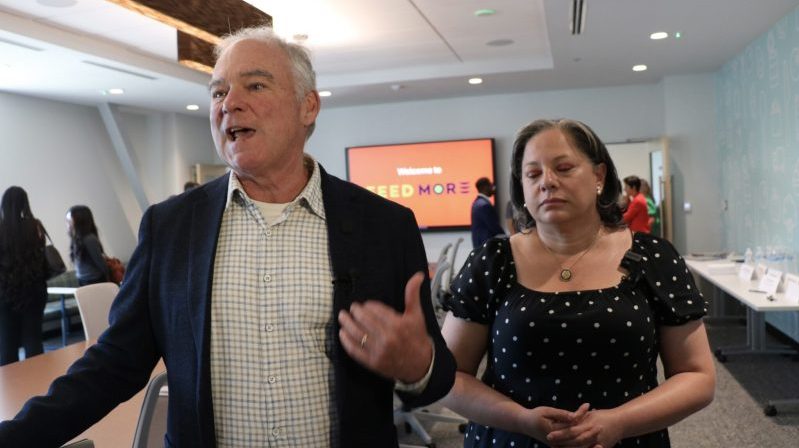
U.S. Sen. Tim Kaine, D-Va., and U.S. Rep. Jennifer McClellan, D-Richmond, speak with the media following a roundtable discussion on federal healthcare and housing policy in Henrico County on Sept. 9, 2026. (Photo by Charlotte Rene Woods/Virginia Mercury)
It would still be a long shot, he and U.S. Rep. Jennifer McClellan, D-Richmond, noted. But since H.R. 1 passed, every member of Congress has spent time in their districts hearing from their constituents, as voters name healthcare a chief concern.
Some Republicans — including Virginia U.S. Reps. Jennifer Kiggans and Rob Wittman — voiced opposition to the changes last summer before ultimately voting for the federal spending bill.

“The magnitude of these cuts is really becoming manifest right now,” Kaine said. “We probably could have had three or four votes a year ago. People have been home during recess, talking to their healthcare providers. We might have now, you know, 10 or a dozen. We need about a dozen Republican votes to do that.”
With forthcoming additional eligibility factors and processes, an estimated 300,000 Virginians are expected to lose Medicaid, while 125,000 Virginians have already lost their Supplemental Nutrition Assistance Program benefits. The federal programs have for decades helped people nationwide access health insurance and provided assistance buying groceries.
Virginia’s health secretary Marvin Figueroa, who also attended the roundtable, said that H.R. 1 “by design” was intended to make people lose their benefits.
He explained that as the top public health official in the state, he’s responsible for helping blunt the impact.

He and others in Gov. Abigail Spanberger’s administration plan to ensure state and local agencies comply with additional workloads. State lawmakers approved funding to boost those efforts and prevent eligible people from losing their benefits.
Congress had also failed to renew expired tax credits that helped offset costs for people who buy their insurance through the Affordable Care Act marketplace.
Roughly 94,000 Virginians have dropped their coverage amid spiking premiums. Some may be eligible this November to tap into part of a $150 million state-level subsidy that state legislators earmarked in the current budget.
As the bill made its way through the nation’s legislature, the Rural Health Transformation Fund also emerged as a compromise to offset impacts in existing healthcare deserts.

Over the past year, a handful of Virginia hospitals have trimmed services and clinics have closed, all citing H.R.1 as a factor. Thirteen rural hospitals have also been flagged as vulnerable to cuts or closure by a state report.
Kaine and Figueroa said Wednesday that the fund — totaling $10 billion, with $189 million earmarked for Virginia — is not enough money to fill the healthcare holes that H.R. 1 will create, but it can still help.
More than reading headlines or connecting with providers in their states and districts, McClellan reiterated that elected leaders are hearing concerns and calls to action directly from people they represent.
“They’re hearing from their constituents the impact that this is having, and their constituents are demanding action too,” she said.

Richmond Mayor Danny Avula also participated in the roundtable panel, focusing his remarks on another top concern for voters: housing. He and the elected leaders discussed federal tools to support expanding housing access for Richmonders, Virginians and Americans.
“The tariffs are killing us, the cost of labor is killing us,” Avula said. “It just takes so much more public subsidy to get housing costs down.”
Congress celebrated a bipartisan win this summer with the passage of the 21st Century Road To Housing Act, Avula noted, but implored Kaine and McClellan to ensure funding for grants within the federal policy actually gets appropriated.
All seats in the U.S. House of Representatives are up for election this fall, along with half of the U.S. Senate. Analysts and polls have identified voters’ view of affordability and healthcare as key issues that could tip the balance of partisan power in both chambers.

Early voting begins Sep. 18 and Election Day is Nov.3.
By Charlotte Rene Woods, Virginia Mercury
Virginia Mercury is part of States Newsroom, a nonprofit news network supported by grants and a coalition of donors as a 501c(3) public charity. Virginia Mercury maintains editorial independence. Contact Editor Samantha Willis with questions: info@virginiamercury.com.




Surveillance, Outdoor Dining, and Other Community Concerns at Town Council Meeting

When Elected Officials Cross the Line

Trump Administration Revokes $810M Approved by Congress for Refugee Aid and More

The Signs Offer Quick Cash for Homes. But States Want More Oversight

This Drone Hunts Mosquitoes

William Morgan and the Anti-Mason Party

Luria and Kiggans Rematch in Virginia’s 2nd Congressional District Among Most-Watched Races In Nation

Youth Advocates Warn Higher Marijuana Fine Could Deepen Racial Disparities

Virginia DMV Wait Times Plummet to Record Lows After Major Reforms

Lorraine Kephart Dovell (1942 – 2026)

POLICE: 7 Day FRPD Arrest Report 9/28/2026

ORDER OF PUBLICATION: In the Circuit Court for Warren County, Virginia

The Silent Danger of Heating Season

Three Common Myths About STBBIs Explained

Standing Counts, but Walking Counts More

VDOT: Warren County Traffic Alert for September 28 – October 2, 2026

Virginia Health Committee Considers Mandating Licensed Nurses in Every School

After Obama-Era Chesapeake Bay Executive Order Rescinded, Environmental Groups Brace for Fallout

Federal Judge Strikes Down SNAP Deadline That Put Virginia at Risk of Added Costs

Children Activities by Samuels Public Library for the Month of October

$5,000 Match Challenge to Support Warren County Children on Give Like Dolly Day

October 23rd Set for Post-Discovery Motions Hearing in Bradley Treece Gunfire Incident With Neighbors

Virginia State Police Seize More Than $1 Million in Drugs During Weeklong Operations

Jolissa Steele Shifflett Mathews (1944 – 2026)
