
Local News
‘A walk on the wild side’ – surprising info about coyotes
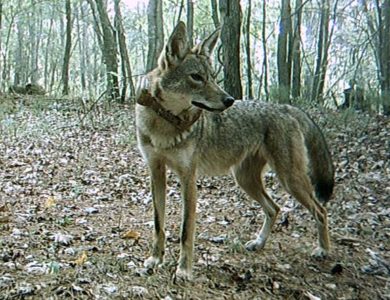
Coyote wearing a GPS radio collar as part of a research study conducted by Virginia Tech and the Virginia Department of Game and Inland Fisheries./ Photo: VA. Tech.
BOYCE, VA – A chance meeting with a wild animal veterinarian, the sound of coyotes calling from afar, and remarks by local hunters who’d run across these canines while seeking out deer, led this domestic dog owner – a husky with a similar howl when provoked or encouraged – to investigate the expanding coyote packs which use Warren, Clarke and neighboring counties as their habitat.
The bottom line is that Warren, and several Virginia counties, encourage this perhaps accidental expansion in our area through sheer ignorance of what they are doing.
First, killing a coyote, willfully or otherwise, leads directly to the expansion of its pack. Unfortunately, Warren County offers a bounty – 50 dollars – for every coyote shot and killed, presumably a reward for reducing our local coyote population.
Wrong!
Dr. Jennifer Riley, a full-time wildlife veterinarian at the Blue Ridge Wildlife Center (BRWC) states unequivocally that the deliberate killing of just one or more coyotes will inevitably increase the pack size. Yet Warren County among others, encourages hunters to shoot these wild dogs by paying them to do it. A word in a moment on how this is so. First, however, I put in telephone calls to animal control leaving messages, one specifically on the line of Deputy Sheriff Junior Darr, to discuss “coyotes.” No returned calls. For whatever reason, animal control in Warren doesn’t want to discuss coyotes.
“Many people kill every coyote they see,” Riley told me. “And this goes against science,” she warned.
That sounds to this reporter a bit like the familiar discussion on climate change, but we’ll save that for another time.
Dr. Riley, appointed to her job at the Boyce wildlife center about two years ago, tends to more than 1,000 injured wild animals a year. She’s seen only “two or three” injured coyotes during that time, probably for good reason.
First, it is illegal to rehabilitate coyotes in Virginia. Another reason is that any injured coyotes brought to her must immediately be euthanized.
“When people call about injured coyotes, we generally recommend calling animal control as those officers will humanely dispatch those animals in most of our surrounding counties and give that animal the benefit of less stress in capture and transport time,” she told me. In other words, officers may shoot them at an accident scene to save the animals further pain. Those she’s seen and others she’s heard of have mostly been hit by cars or trucks.
A good friend who lives just off the Strasburg Road in Front Royal told me of having a coyote take up residence on his property. In effect, in a call to animal control, he was told to wait for it to go away. He did, and after a few days, the animal did. He/she likely had strayed from his/her pack.
Coyotes have a reputation as being a threat to livestock? I asked.
Yes, agreed the veterinarian, but so are many species. Domestic dogs, particularly those like my husky, that are off leash are also a big threat to UNPROTECTED livestock. Foxes, raccoons, skunks, raptors, mink, snakes and other will get into poorly secured poultry houses causing major losses. Bobcats can kill newborn sheep and goats, just like coyotes.
“Despite all predators following their natural instincts, the blame gets placed (mainly on) coyotes, and mostly without any proof,” Riley said. She added that those living in rural areas and raising or keeping livestock are responsible to secure their animals and provide proper, safe shelter.
“Guard animals can serve as great protectors for livestock that cannot be housed indoors overnight. Protection of your livestock is what you should stress,” Riley advised.
Insofar as hunters – and the county – contributing to the rising coyote problem hereabouts, Riley criticized the bounty system, in place here in Warren.
“This goes against science,” she said. “Generally, there is just one ‘problem’ coyote or pair in an area and killing every coyote you see doesn’t mean you get the right one! If you kill a coyote that took your livestock and did not fix the problem – how the coyote was able to contact the (prey) animal in the first place) – you’ve just opened a spot for another coyote to come into your area.”
Coyotes are known for being very smart and adaptable. They will spread to fill an area that has a food supply, your poorly constructed hen house, for example.
“When you kill one coyote, it is quickly replaced. Also, large scale lethal control measures are largely ineffective,” Riley said, warming to her topic.
Studies have shown, she wrote, that in response to to killing large percentages of a population, young females will begin reproducing earlier and will have larger litters.
Because humans already killed so many adults, there is now more food available and more young will survives. By killing a percentage of the population, you’ve just caused it to grow at a faster rate.
So, interestingly, if a hunter kills a coyote, in return for its $50 bounty, the hunter will have caused a rebound effect – a further proliferation of coyotes through a surge in reproductive rates. This suggests Warren County, at least, should study its bounty system and perhaps amend it, in light of this veterinarian’s report on the local situation.
She adds more words of advice.
“Coyotes and many nuisance wildlife species are often around because people leave food out for cats and wildlife. Keeping cats inside is important for many reasons. This is one of them. Never feed coyotes intentionally. Realize that putting pet food outside has the same effect as intentionally feeding wildlife.
“Secure trash. Build secure housing for poultry and livestock. Build and maintain strong, tall fences,” the wildlife vet warns.
She said “trapping and moving any mammal to another location is illegal in Virginia, though many do it.”
So what resulted from a chance meeting between me, a Royal Examiner contributing writer, and a local wildlife expert, turned out nicely for Dr. Jen. She described the opportunity to discuss coyotes as “a really important public education issue and I’m excited that you wanted to follow up,” she said.
And nice for me, too!
(The Blue Ridge Wildlife Center and wildlife hospital are dedicated to the rescue and rehabilitation of local wildlife, and education and research which will ensure the future of (the) region’s wildlife. Its new and expanded facility, one of only three wildlife hospitals in Virginia, serves Loudoun, Frederick, Clarke, Warren, Fauquier, Shenandoah counties, and the city of Winchester. It is located at 106 Island Farm Road, Boyce VA 22620 and may be reached by calling 540.837.9000. Email info@blueridgewildlifectr.org. Dr. Riley: drjen@blueridgewildlifectr.org)
Website: Blue Ridge Wildlife Center

Virginia Home Sales Rise in February as Inventory Grows, Spring Outlook Uncertain

Bing Crosby Stadium Hosts Warren County–Skyline Baseball Battle Tonight

Warren Supervisors Address Audit Contract, Permits, and Property Sale at March 17 Meeting

Here’s How Virginia Lawmakers Suggest the Next State Budget Handle Federal Health Care Funding Fallout

Spring Essentials Checklist: Prepare Your Home for Summer

Virginia Joins National Push for Refunds After US Supreme Court Voids Trump Tariffs

Four Reasons to Consider Hiring a Professional Cleaning Company

Ask the Expert : We Are Applying for a Mortgage Soon. What Kind of Documents Will We Need?

Charles Michael “Rusty” “Chuck” Fischbein (1944 – 2026)

Jerrold E. “Jerry” Groves (1931 – 2026)

Town Planning Commission Moves Forward with Industrial Zoning, Holds Preliminary Discussion of Urban Agriculture

Schools Push for Budget Flexibility, Consistent Funding as Needs Grow

Skyline High Teams, Athletes Successful Seasons and Performances Acknowledged – Oh, and Those Roosters

School Board Seeks to Restore Meals Tax Funding for School Facilities

Wasting Drinking Water: 3 Habits to Eliminate From Your Daily Routine

Medicare Launches TEAM Program to Improve Recovery After Surgery

Izaak Walton League Promotes Conservation and Outdoor Programs at Community Forum

POLICE: 7 Day FRPD Arrest Report 3/16/2026

Blue Ridge Wildlife Center Patient of the Week: Great Horned Owl

Airline CEOs Warn of Travel Strain Amid DHS Funding Uncertainty
Robert B. Walters (1931 – 2026)

Lemmon & Hale Highlight Importance of Estate Planning for Families and Businesses

Hike Kidz Foundation Highlights Programs for Families in Need

Phoenix Project Offers Support and Resources for Victims of Abuse
