
Legislative Update
Warner Weekly Wrap-up: Wash Your Hands
This week, the Senate considered several pieces of legislation, including bills related to energy policy and the coronavirus response.
CORONAVIRUS
As coronavirus continues to spread in the United States and around the world, Sen. Warner has made the federal response a top priority. Congressional pressure on the American coronavirus response has taken on increasing importance as the President’s direct contradictions of public health officials and false statements about the U.S. coronavirus response have come under scrutiny.
Already, Congressional pushback against the Trump administration’s initial proposal for a relatively low $1.25 billion in coronavirus response funding has led to a larger final emergency coronavirus package.
This week, Sen. Warner joined a broad bipartisan majority in passing that significantly larger $7.8 billion emergency funding bill that will direct needed resources to federal, state and local agencies responding to coronavirus. This legislation, which the President signed into law today, will immediately provide Virginia with $13.3 million in federal funding to help cover the costs of preparations for this public health emergency. It also includes language based on Sen. Warner’s CONNECT for Health Act of 2019, which reduces restrictions on the use of telehealth for public health emergency response, as well as $500 million to facilitate its implementation.
Sen. Warner has also been active in communication with the business and government leaders at the federal, state, and local levels to encourage a robust response to coronavirus. Here’s a roundup of Sen. Warner’s additional efforts this week on coronavirus:
For a full list of updates and additional resources, see the coronavirus updates page on Sen. Warner’s website.
A BIPARTISAN PARKS BREAKTHROUGH
For nearly three years, Sen. Warner has led the effort to provide rebuild America’s crumbling national parks, which currently face a backlog of nearly $12 billion in deferred maintenance. In Virginia, the increasing maintenance backlog currently sits at more than $1.1 billion dollars and surpasses that of every state except for California and the District of Columbia. Sen. Warner has introduced bipartisan legislation, the Restore Our Parks Act, which would create a dedicated funding source of $6.5 billion to address the highest priority repairs to America’s national parks.
In a major breakthrough, his week, the Restore Our Parks Act, won the endorsement of none other than President Trump (although he credited two GOP senators who are up for reelection this year).
The deal the President endorsed would combine Sen. Warner’s Restore Our Parks Act with another bipartisan bill creating a permanent funding source for the Land and Water Conservation Fund (LWCF), one of the country’s major conservation programs. On Wednesday, Sen. Warner joined a bipartisan group of Senators at a press conference to announce details of the bipartisan deal.
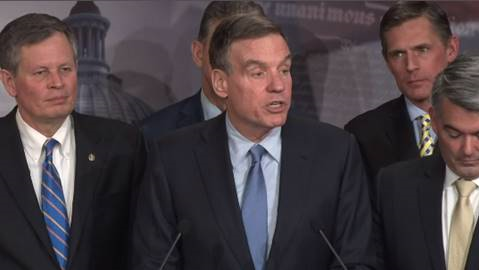
Click the image to view the press conference.
The Restore Our Parks Act, which has been praised by key stakeholders, would reduce the maintenance backlog by establishing the “National Park Service Legacy Restoration Fund” and allocating existing revenues the government receives from on and offshore energy development. This funding would come from 50 percent of all revenues that are not otherwise allocated and deposited into the General Treasury, not to exceed $1.3 billion each year for the next five years.
In November, the Restore Our Parks Act was overwhelmingly approved by the Senate Energy and Natural Resources Committee and sent to the Senate floor, where it awaits approval.
A full list of deferred maintenance needs at Virginia’s national parks can be found here.
MILITARY FAMILIES DESERVE BETTER
On the heels of his recent visit to Fort Lee, Sen. Warner is out with a new Richmond Times-Dispatch op-ed on conditions in military housing. In the op-ed, Sen. Warner calls on the Pentagon to “fundamentally change the way it does business with private housing contractors,” starting with the implementation of housing reforms Sen. Warner fought for in the Senate.

The op-ed reads, in part:
When I visited Fort Lee in April of last year, I heard directly from military families facing these dangerous conditions in privatized on-base housing owned by Hunt Military Communities. I promised the families that I would go to bat for them in the Senate, and that I would keep coming back until the problems were resolved. In the months that followed, I wrote a bill giving military families new tools to stand up to the private housing contractors responsible for these deplorable conditions. In December, President Donald Trump signed the bipartisan National Defense Authorization Act into law, which included my bill and the first-ever Tenants Bill of Rights for military families.
Recently, I returned to Fort Lee to update the families on this new legislation and get a status report on conditions at the base. To my frustration, families reported ongoing problems with black mold and other hazards. I credit the leadership at Fort Lee for creating a forum for families to air these issues without fear of retaliation. Nevertheless, these families’ stories are a wake-up call for base leaders and Hunt housing officials that they have much more work to do.
In February, Sen. Warner traveled to Fort Lee to hear from military families facing mold and other dangerous conditions in on-base housing. This was a follow-up to his visit in April of last year. In the time since then, Sen. Warner introduced and passed legislation, the Ensuring Safe Housing for our Military Act, which creates new accountability measures for military families. That legislation was signed into law in December as part of a larger defense authorization package that also creates the first-ever Tenants Bill of Rights for military families.
BIG W FOR 5G
The race to develop the next generation of wireless technology, known as fifth-generation or 5G wireless, is an issue of both American competitiveness and national security. As Vice Chairman of the Senate Intelligence Committee and a former telecommunications executive, Sen. Warner has made bolstering America’s 5G capabilities one of his top priorities in the Senate.
Part of Sen. Warner’s efforts has been to push the administration to develop a national 5G strategy. Earlier this year, he introduced the Secure 5G and Beyond Act with fellow Senate Intelligence committee members, Sen. John Cornyn (R-TX) and committee chairman Sen. Richard Burr (R-NC).
This week, the Senate passed the legislation unanimously. In a statement, Sen. Warner celebrated the passage, saying: “5G promises to usher in a new wave of innovations, products, and services. At the same time, the greater complexity, density, and speed of 5G networks relative to traditional communications networks will make securing these networks harder and more complex. It’s why we need a coherent, national strategy to harness the advantages of 5G in a way that addresses those risks.”
Background on the Secure 5G and Beyond Act:
• It requires the President to create an inter-agency strategy to secure the 5th generation and future generation technology and infrastructure in the United States and with our strategic allies.
• Designates NTIA to coordinate the implementation of the plan in coordination with the Chairman of the FCC, the Secretary of Homeland Security, the Director of National Intelligence, the Attorney General, Secretary of State, and the Secretary of Defense.
• Ensures that the strategy and implementation plan do not include a recommendation to nationalize 5th generation deployment or future generations of mobile telecommunications infrastructure in the United States.
Also this week, Sen. Warner joined a bipartisan group of senators in introducing the Network Security Trade Act, legislation to ensure U.S. communications infrastructure security is a clear negotiating objective of our country’s trade policy. The Network Security Trade Act would amend the 2015 Trade Promotion Authority, which is in effect until July 1, 2021, to include a negotiating objective related to the security of communications networks. While the bill does not name specific state-owned companies, it would direct the executive branch to ensure that the equipment and technology that are used to create the global communications infrastructure are not compromised. It would achieve that goal by addressing barriers to the security of communications networks and supply chains and unfair trade practices of state-owned or state-controlled communications equipment suppliers in new trade agreements. Confronting these issues, which this legislation requires, is critical as the United States begins formal trade talks with the United Kingdom and other allies.
GRAB BAG
• SEAFOOD WIN: After months of pressuring the administration on behalf of Virginia small businesses in the seafood industry, Sen. Warner celebrated the announcement by the Department of Homeland security that it would release 35,000 additional temporary visas that the seafood industry relies on to meet its seasonal labor needs.
• BOGUS: Sen. Warner applauded Facebook for (belatedly) taking down deceptive Trump campaign ads that undermined the census program.
• FAST COMPANY: Sen. Warner spoke with Fast Company magazine about the threats facing U.S. election systems.
• RURAL SCHOOLS: Sens. Warner and Kaine sent a letter with a bipartisan group of Senators expressing their strong opposition to an abrupt decision by the Department of Education that jeopardizes funding eligibility for 800 rural, low-income schools across the country. Shortly after the letter was sent, the Department of Education publicly reversed the policy, preserving this source of federal funding for at least five rural counties in Virginia.
• FRAUD: Ahead of Supreme Court arguments in Liu v. SEC, a case challenging the Securities and Exchange Commission’s (SEC) enforcement powers to seek disgorgement on behalf of defrauded investors, Sen. Warner and fellow Banking Committee member Sen. John Kennedy (R-LA) released a statement on the importance of preserving SEC tools to protect Main Street investors from Ponzi schemes and other fraudsters.
WEEK AHEAD
The Senate is expected to continue consideration of energy legislation next week, in addition to a series of executive branch nominees. Sen. Warner will participate in a Banking Committee hearing with Consumer Financial Protection Bureau head Kathy Kraninger. He’ll then join a bipartisan group of senators meeting with the CEOs of major conservation and public lands groups to discuss the path forward on the Restore Our Parks Act/LWCF funding legislation. On Thursday, he’ll deliver remarks at an Opportunity@Work event focused on skilled workers without a four-year college degree.
The Senate will recess on Thursday evening for the March state work period and return on March 23.

Joyce Henry Sutherland (1942 – 2026)

Commentary: Building on What We Have – A Proposed Economic Development Agenda for Warren County

Jamie Christopher Tewalt (1971 – 2026)

George Jules Pouzenc III (1958 – 2026)

Samuels Public Library Prepares for Annual “Taste for Books” Fundraiser

Assistant Chief and Fire Marshal Gerry Maiatico Highlights Staffing Needs and Volunteer Opportunities

Data Center Bills Dominated This Year’s General Assembly. Here’s What Passed.

Housing Bills to Boost Supply, Protect Tenants On The Way to Spanberger’s Desk

4 Ideas for Keeping Fit While Babysitting Your Grandchildren

Do You Know Your Grains?

Tips for Staying Safe Around Unfamiliar Dogs

Skyline FFA Students Promote Agriculture at South River Community Forum

Warren Coalition Works to Build Resilience and Prevent Substance Abuse

Warner Files for Reelection, Launching Bid for Fourth U.S. Senate Term

Registrar Urges Residents to Stay Informed and Participate in Upcoming Elections

South River Forum Brings Residents and Leaders Together at Skyline

CHEO Garden Expands Mission of Food, Learning and Community

Sharing a Room: How to Avoid Sibling Conflicts

Laurel Ridge to Host Week of the Young Child Art Exhibit

Free $1,000 ‘Trump Accounts’ Draw 1 Million Families

‘The Revenant: A Novel of Revenge’

Virginia Lawmakers Close 2026 Session With Focus on Lowering Costs

The 10 Most Important Things That Happened in Virginia’s 2026 Legislative Session

Electric Vehicle Market Adjusts as Industry Rethinks the Road Ahead
